8 months ago

Artificial Intelligence
AI Software Development Company Strategies for High-Performance Machine Learning Systems: Unlocking Next-Level Results
AI Software Development Company
AI Development Services for Business
Machine Learning Development Services
In the era of digital transformation, the success of machine learning (ML) implementation is not determined solely by the sophistication of algorithms, but also by how systems are designed, developed, and integrated into business processes. This is where the role of an AI software development company becomes critically important. Experienced AI software development companies are able to bridge business needs with practical, scalable technology solutions.
AI software development companies play a vital role in ensuring the success of machine learning systems, not only from a technical perspective but also from a business strategy standpoint. They help organizations design machine learning systems that align with real business requirements, covering model selection, data architecture, and scalable infrastructure.
Through custom AI solutions, organizations move beyond one-size-fits-all implementations toward AI systems optimization designed around their unique processes, data assets, and strategic goals. Within enterprise AI development services for business, an experienced AI software development company ensures seamless integration of machine learning systems into complex enterprise environments, while upholding enterprisegrade standards for security, performance, and regulatory compliance.
A structured approach to Machine Learning project management further enables predictable delivery and measurable outcomes. From use case definition and data governance to model validation, deployment, and continuous performance monitoring, an end-to-end delivery model helps enterprises reduce risk, accelerate time-to-value, and maximize return on AI development services for business investment.
In the pursuit of high-performance machine learning systems, data is not simply an input, it is a strategic asset.
Without a robust, scalable, and well-governed data pipeline, even the most advanced ML models fail to deliver consistent results. For enterprises, building a resilient data pipeline is a foundational requirement to ensure long-term scalability, reliability, and sustained business impact from AI initiatives.

- Data Engineering Strategies That Drive Performance
The implementation of effective data engineering strategies enables organizations to manage data flows from multiple sources in a consistent and efficient manner. This includes data ingestion, transformation, and storage processes designed to support analytics and machine learning development services requirements. A welldefined strategy allows ML teams to focus on model development without being constrained by data-related challenges. - Data Preprocessing Best Practices
The performance of machine learning models is highly dependent on the quality of the data they consume. By applying data preprocessing best practices—such as data cleaning, normalization, handling missing values, and outlier detection—data is better prepared for ML algorithms. This stage plays a critical role in improving model accuracy, reliability, and overall stability. - Scalable Data Pipelines for Business Growth
As data volume and complexity continue to grow, machine learning systems require scalable data pipelines that can adapt without compromising performance. Scalable pipelines ensure efficient data processing for both batch workloads and real-time data streaming, enabling ML systems to evolve in line with changing business demands. - Data Quality Assurance as a Reliability Foundation
Without strong data quality assurance, the risk of errors, bias, and inaccurate predictions increases significantly.
Data validation processes, continuous quality monitoring, and automated testing within the pipeline help maintain data consistency over time while strengthening confidence in ML system outputs. - Feature Engineering for Machine Learning
Feature engineering for machine learning development services focuses on transforming raw data into meaningful, high-value features that enhance model learning. Well-designed features enable models to capture critical patterns within the data, leading to improved predictive performance and more efficient training.
Selecting the Right Algorithms and Architectures for Speed and Accuracy
Choosing the right algorithms and architectures is a primary determinant of success in building high performance machine learning systems. This decision directly impacts inference speed, prediction accuracy, and the efficient use of computational resources.
In modern machine learning development services, selecting appropriate algorithms and architectures is essential to achieving the optimal balance between processing speed and model accuracy. These choices have a direct influence on overall system performance, infrastructure efficiency, and the end-user experience
Key Considerations for High Performance Machine Learning Systems
- Algorithm selection strategies
Ensuring that selected algorithms align with data characteristics, system scale, and business objectives—recognizing that more complex models do not always deliver better results. - Neural networks optimization
Optimizing network structure, layer depth, and parameters to enhance performance without slowing down training or inference processes. - Deep Learning architecture
Selecting the right deep learning architectures enables models to efficiently learn complex patterns while maintaining stability in production environments. - Model tuning techniques
Techniques such as hyperparameter tuning, regularization, and early stopping improve model accuracy and generalization capabilities. - High performance machine learning frameworks
High performance ML frameworks support scalable, fast, and reliable model development, training, and deployment.
Optimizing Infrastructure for Scalability and Efficiency
In modern machine learning development services, model performance depends not only on algorithms but also on the underlying infrastructure. Optimizing infrastructure for scalability and efficiency is a critical factor in enabling AI systems optimization to grow alongside business demands without introducing excessive cost or complexity.
- Cloud-Based AI Infrastructure
The adoption of cloud-based AI infrastructure allows organizations to access computing resources flexibly and on demand. Cloud environments support rapid ML experimentation, automatic scalability, and seamless integration with data and analytics services—accelerating time-to-market for AI solutions. - GPU Acceleration in ML Systems
For compute-intensive workloads, GPU acceleration in ML systems plays a key role in speeding up model training and inference. By leveraging GPUs, ML systems can process large-scale data more efficiently, particularly for deep learning and complex model architectures. - Distributed Computing for Machine Learning
Through distributed computing for machine learning, computational workloads are distributed across multiple nodes or clusters. This approach improves data processing speed, enables parallel training, and ensures system stability as data volume and user demand continue to grow. - Containerization (Docker/Kubernetes)
Containerization using Docker and Kubernetes simplifies the deployment and management of machine learning systems. Containers ensure consistency between development and production environments, enable easy replication, and enhance security. Kubernetes further supports automated container orchestration for scalability and high availability. - Cost-Effective AI Deployment
Cost efficiency is a critical consideration in large-scale AI implementations. Cost-effective AI deployment is achieved through optimal resource utilization, autoscaling, infrastructure usage monitoring, and selecting cloud services that align with specific ML workload requirements.
Building High-Performance Machine Learning Systems: From Data Pipeline to MLOps Excellence
Amid the rapid adoption of artificial intelligence, many organizations are realizing that building reliable machine learning (ML) systems is not merely about using advanced models.
Machine learning development services success is driven by the combination of robust data pipelines, the right algorithm selection, scalable infrastructure, and mature MLOps practices. Key considerations include the following:
- MLops Workflow Automation
Automating MLops workflows simplifies processes across model training, testing, and deployment, reducing human error and accelerating the ML development lifecycle. - Continuous Delivery for Machine Learning Models (CI/CD)
Implementing CI/CD ensures that machine learning models can be continuously updated, tested, and released into production in a consistent and secure manner without disrupting live systems. - Model Monitoring Tools and Strategies
Real time model performance monitoring enables teams to detect accuracy degradation, data drift, or concept drift easily, ensuring prediction quality remains reliable. - Automated Retraining Pipelines
With automated retraining pipelines, models are regularly updated using the latest data, keeping ML systems relevant and adaptive to evolving data patterns. - Production Grade ML Systems
Mature MLops practices result in production ready ML systems that are stable, scalable, secure, and reliable enough to support long term business needs.

Security and Compliance Considerations in High-Performance AI Solutions
In the development of high-performance AI solutions, security and regulatory compliance are critical elements that must go hand in hand with system performance. Fast and accurate AI systems optimization must still protect data, models, and users from security risks and regulatory violations.
Key considerations include the following:
- AI Security Best Practices
The implementation of AI security best practices includes data protection, strict access controls, data encryption, and safeguarding models against threats such as data poisoning and model theft. These practices ensure AI systems optimization remains reliable without compromising performance. - Compliance in AI Projects (GDPR/CCPA)
In the context of compliance in AI projects, regulations such as GDPR and CCPA require transparent, secure, and responsible data management. Compliance efforts include consent management, data minimization, audit trails, and the ability to explain how data is used throughout AI processes. - Secure Model Deployment Strategies
Secure model deployment strategies ensure that ML models can be operated in production environments without security vulnerabilities. This includes environment isolation through containers, secure API access, runtime monitoring, and strict model version control. - Bias Mitigation in Machine Learning Systems
Beyond technical security, ethical considerations are equally important. Bias mitigation in machine learning systems aims to reduce data and model bias through fairness evaluation, balanced data sampling, and continuous validation ensuring AI outcomes are more equitable and trustworthy.
The success of machine learning system development is not determined by technology alone, but also by effective team collaboration.
- Cross functional teams play a critical role in accelerating innovation by bringing diverse expertise together within a single, integrated workflow.
- In collaborative development teams in AI projects, data scientists, software engineers, ML engineers, and business stakeholders work together from the planning phase through deployment. This collaboration accelerates decision-making, reduces miscommunication, and ensures AI solutions are closely aligned with business objectives.
- The adoption of Agile methodologies for software development companies building ML systems enables rapid iteration, controlled experimentation, and more responsive adaptation to changing data and market demands. Agile approaches also support more efficient and measurable ML development
- In addition, interdisciplinary expertise (data scientist and engineers) ensures that developed models are not only statistically accurate but also system-optimized and production-ready. This cross-functional synergy is a key driver in accelerating innovation and delivering AI solutions with tangible impact.
- Ultimately, faster time to market and business impact are achieved as cross-functional collaboration accelerates the delivery of high-quality AI solutions that generate real business value.
Achieving outstanding machine learning performance requires more than advanced technology alone. It demands proven strategies from robust data management and the right algorithm selection to scalable infrastructure, mature MLOps practices, and strong cross-functional collaboration.
By partnering with an experienced AI software development company, businesses can accelerate innovation, minimize implementation risks, and ensure machine learning solutions are production-ready and capable of delivering measurable business impact. Now is the time to apply the right strategies to build reliable, efficient, and future-ready machine learning systems.
Transform your data into a competitive advantage.
Partner with a trusted AI software development company like us BTS.id to accelerate innovation and deploy production-grade machine learning systems at scale.
HIT US UP
BRIDGE TECHNOLOGY SERVICES
HIT US UP
BRIDGE TECHNOLOGY SERVICES

Your request has been sent, please wait for our reply
 2 years ago
 Artificial Intelligence
Setelah pandemi Covid-19 berlalu, E-Commerce telah menjadi segmen bisnis yang berkembang pesat serta banyak mendapatkan perhatian. Keinginan untuk memenuhi kebutuhan, serta keterbatasan yang diberlakukan kala itu terus beradaptasi demi berbelanja untuk memenuhi kebutuhan hidup, dan dampaknya industri e-commerce juga turut berkembang.
Meningkatkan konversi dengan Web AI di e-commerce melibatkan berbagai teknik dan alat yang memanfaatkan kecerdasan buatan untuk menarik perhatian pelanggan dan mempertahankan pelanggan, serta mendorong mereka untuk melakukan transaksi pembelian.
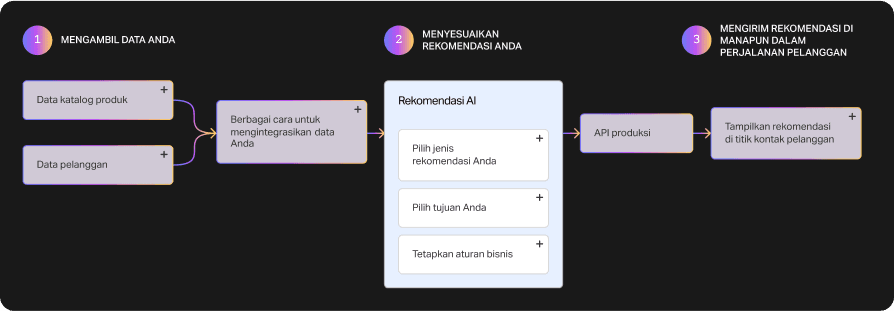
Tanpa kita sadari atau tidak, web AI telah disematkan di banyak sekali sisi dari e-commerce ini. Mulai dari penyusunan produk yang direkomendasikan untuk user, lalu mengamati serta menganalisis kebiasaan dan pola user dala berbelanja, masalah kemanan atau proteksi pada metode pembayaran, dan lain sebagainya.
Beberapa strategi utama dalam meningkatkan konversi dengan web AI di E-commerce adalah sebagai berikut :
1. Personalisasi Konten dan Produk
Dengan menganalisis riwayat penjelajahan, interaksi, dan demografi user, memungkinkan web AI untuk membuat rekomendasi produk atau layanan yang relevan secara real-time. Penyesuaian riwayat ini mendorong user menjelajah lebih jauh, hingga akhirnya melakukan pembelian.
Dengan menggunakan algoritma AI memungkinkan untuk menganalisis perilaku belanja user dan merekomendasikan produk yang relevan. Amazon menggunakan AI untuk menampilkan produk yang mungkin disukai pengguna berdasarkan riwayat penelusuran dan pembelian.
2. Chatbot dan Asisten Virtual
Chatbot web AI ini dapat menyediakan dukungan pelanggan yang cepat dan efektif di situs web. Chatbot AI dapat menangani pertanyaan umum, membantu pengguna menavigasi situs, dan menyarankan produk, bahkan di luar jam kerja. Memangkas waktu tunggu dan meminimalisir kesulitan, chatbot meningkatkan kepuasan pelanggan dan melancarkan proses pembelian.
3. Optimasi Mesin Pencari (SEO) dan Pencarian Cerdas
AI menganalisis pola pembelian, ulasan pelanggan, dan tren industri untuk merekomendasikan produk dan layanan yang paling relevan kepada pengunjung.
Menggunakan web AI untuk memberikan hasil pencarian yang lebih relevan berdasarkan preferensi dan riwayat penelusuran user, memungkinkan para user untuk mencari produk menggunakan gambar atau perintah suara, meningkatkan kenyamanan dan menemukan produk lebih cepat.
4. Penerapan Dynamic Pricing
Dynamic pricing merupakan sebuah sistem AI yang dapat membantu pengguna menyesuaikan harga produk, serta memberikan rekomendasi perubahan harga, berdasarkan harga yang diberikan oleh kompetitor di platform yang sama. Web AI menyesuaikan harga produk secara real-time berdasarkan permintaan, persaingan, dan perilaku pelanggan. Bahkan AI memprediksi lonjakan permintaan dan menyesuaikan inventaris serta harga secara proaktif.
5. Verifikasi Pembayaran yang Solid
Beberapa e-commerce menggunakan sistem verifikasi pembayaran yang lebih baik untuk menjamin keamanan transaksi yang dilakukan. Keberadaan web AI dalam E-commerce juga dapat dilihat pada penambahan layer verifikasi pembayaran sehingga lebih solid. Pada proses pembayaran akan dilakukan dengan cara berlapis yang lebih aman, sehingga dipastikan hanya pengguna yang sah saja yang dapat melakukan transaksi dengan menggunakan akun yang bersangkutan.
6. Keamanan dan Pencegahan Penipuan
Menggunakan teknologi AI untuk verifikasi identitas pengguna, mengurangi risiko penipuan identitas. Web AI dapat digunakan untuk memantau dan menganalisis transaksi secara real-time, mencari pola yang mencurigakan dan anomali yang dapat menunjukkan aktivitas penipuan. Algoritma pembelajaran mesin (machine learning) dapat dilatih menggunakan data historis untuk mengenali transaksi yang mungkin berisiko tinggi. Dengan menggunakan AI untuk memantau transaksi dan mendeteksi aktivitas mencurigakan secara real- time dapat meningkatkan kepercayaan pelanggan.
Lalu bagaimana dengan benefit dengan diterapkannya web AI dalam e-commerce?
Manfaat dari penggunaan kecerdasan buatan (AI) dalam e-commerce sangatlah beragam dan signifikan. Berikut adalah beberapa manfaat utamanya:
- Peningkatan Efisiensi Operasional
AI dapat mengotomatisasi tugas-tugas operasional seperti manajemen inventaris, pengelolaan rantai pasokan, dan pemrosesan pesanan. Hal ini membantu mengurangi biaya operasional dan meningkatkan produktivitas, memungkinkan fokus lebih besar pada strategi bisnis yang lebih tinggi.
- Penyaringan Penipuan yang Lebih Efektif
AI dapat digunakan untuk mendeteksi dan mencegah penipuan dengan lebih baik, baik dalam transaksi keuangan maupun keamanan data. Sistem AI dapat secara otomatis mengenali perilaku mencurigakan dan mengambil tindakan preventif secara real-time.
- Inovasi Produk dan Layanan
AI memungkinkan e-commerce untuk mengembangkan produk dan layanan baru yang lebih sesuai dengan kebutuhan pelanggan. Melalui analisis data dan umpan balik pelanggan secara real-time, bisnis dapat beradaptasi lebih cepat terhadap perubahan pasar dan meningkatkan daya saing mereka.
- Analisis Data yang Mendalam
AI memungkinkan analisis yang lebih dalam terhadap data pelanggan dan transaksi. Dengan menggunakan teknik-teknik seperti machine learning, AI dapat mengidentifikasi pola-pola tersembunyi dalam data yang dapat digunakan untuk membuat keputusan bisnis yang lebih baik dan memprediksi tren pasar.

KESIMPULAN
Dengan memanfaatkan web AI di platform e-commerce, bisnis dapat meningkatkan konversi melalui personalisasi yang lebih baik, layanan pelanggan yang lebih responsif, penargetan pemasaran yang lebih tepat, dan pengalaman belanja yang lebih mulus dan aman. Integrasi AI tidak hanya membantu dalam menarik dan mempertahankan pelanggan tetapi juga dalam mengoptimalkan operasi bisnis secara keseluruhan.
BTS.id (Bridge Technology Service), sebagai perusahaan teknologi terkemuka, menyediakan layanan dan pendampingan komprehensif untuk membantu bisnis memanfaatkan kekuatan AI dan juga mendorong pertumbuhan online e-commerce Anda.
Mari bermitra dengan BTS.id (Bridge Technology Service) dan jadikan AI sebagai pendorong utama kesuksesan e-commerce Anda.
3 years ago
Artificial Intelligence
In a rapidly advancing world, software development technology has brought remarkable changes. However, there is one innovation that is revolutionizing the human paradigm: artificial intelligence (AI).
The story begins in a dedicated laboratory where a group of scientists is diligently working to create artificial intelligence that can rival and even surpass human capabilities. They combine sophisticated algorithms with unlimited computing power, giving birth to an entity that can learn and adapt just like humans.
During its development journey, artificial intelligence starts to showcase its extraordinary abilities. AI can analyze and process data within seconds, uncovering patterns invisible to the human eye, and providing brilliant solutions to complex problems.
Moreover, AI can interact with humans. With a friendly voice and astonishing intelligence, artificial intelligence understands human language, answers questions, and even offers invaluable advice.
Initially, some people feel apprehensive about the progress of AI. They worry that artificial intelligence might replace human jobs or even threaten human existence. However, AI developers claim that their goal is to enhance human lives and assist in various fields such as healthcare, transportation, and even research.
Over time, artificial intelligence becomes more accepted by society. People realize its incredible potential to tackle complex problems, accelerate technological advancements, and improve overall quality of life.
In a world increasingly interconnected and driven by software development technology, artificial intelligence becomes a crucial milestone in human development. Through this artificial intelligence, we glimpse a future full of possibilities and astonishing innovations.

Artificial intelligence Is A Revolutionary Technology
According to the Forbes Advisor survey, 73% of businesses use or plan to use artificial intelligence for their business. This does mean that AI is becoming increasingly significant in the business landscape.
"Entire industries will reorient around it," says Bill Gates, the Microsoft co-founder on his blog recently. So, yes, artificial intelligence is a game-changing technology that rivals the transformative impact of computers, cellphones, and the internet, making it one of the most revolutionary advancements we have witnessed in decades.
Artificial intelligence is powerful due to its ability to process and analyze large amounts of data quickly, learn and adapt from experiences, automate repetitive tasks, mimic human cognitive abilities, scale operations efficiently, provide personalized experiences, and integrate with emerging technologies. These characteristics enable AI to make data-driven decisions, optimize processes, solve complex problems, and deliver transformative advancements across various industries and domains.

Artificial Intelligence and Machine Learning
Artificial intelligence and machine learning are inseparable. Artificial intelligence and machine learning are closely interconnected. Machine learning is a subset and a key component of AI. It refers to the ability of computer systems to learn and improve from data without being explicitly programmed. Machine learning algorithms enable AI systems to analyze and interpret data, recognize patterns, and make predictions or decisions based on the information learned.
In the context of AI, machine learning plays a vital role in enabling systems to adapt and improve their performance over time. By training AI models on large datasets, machine learning algorithms allow AI systems to recognize complex patterns, identify correlations, and make accurate predictions or classifications. The iterative nature of machine learning, where models continuously learn and adjust based on new data, empowers AI systems to become more intelligent and effective in their tasks.
Therefore, machine learning provides the foundation for AI to acquire knowledge, learn from experience, and perform tasks that typically require human-like intelligence. It is through the integration of machine learning techniques that AI systems can autonomously process data, recognize objects, understand language, and make informed decisions, ultimately driving the transformative power of artificial intelligence.
Feeling confused? Let us explain it to you in one single pharagraph: Artificial intelligence and machine learning are like best friends. AI is like a brain that can think and learn, while machine learning is like a special tool that helps AI become even smarter. They work together to help computers understand things and make decisions, just like how we learn and make decisions. AI and machine learning help us do many amazing things, like talking to robots, playing games, and even helping doctors find cures for diseases. They are a super cool team that makes our technology really smart!

The Advancements and Applications of AI
Artificial intelligence has made significant advancements and found diverse applications across various industries. Here are some examples:

Healthcare: AI is being utilized to improve diagnostics, personalize treatment plans, and enhance patient care. AI can analyze medical images, such as X-rays and MRI scans, to aid in early detection of diseases. It can also help in drug discovery and develop personalized treatment strategies.

Education: AI is being used to create personalized learning experiences and adaptive educational systems. AI-powered tutoring systems can tailor lessons based on individual needs, provide feedback, and track student progress, enhancing learning outcomes.

Manufacturing: AI is revolutionizing manufacturing processes through automation and predictive maintenance. AI-powered robots and systems can perform complex tasks, optimize production lines, and predict equipment failures, reducing downtime and increasing efficiency.

Harnessing the Power of AI: Advantages of AI in Software Development
AI brings significant advantages and benefits to software development that will enable developers to build higher-quality software, accelerate development cycles, and deliver better user experiences. Here are some of the advantages of artificial intelligence in software development.

Automation: AI can automate repetitive and time-consuming tasks involved in software development, such as code generation, testing, and bug fixing. This increases productivity, accelerates development cycles, and frees up human developers to focus on more complex and creative aspects of software development.

Photo by Pixabay: https://www.pexels.com/photo/turned-on-computer-monitor-displaying-text-270360/
Improved Efficiency: AI algorithms can analyze vast amounts of code, documentation, and data to identify patterns, extract insights, and optimize software performance. This leads to improved efficiency in coding practices, algorithm design, and system optimization.

Enhanced Debugging and Testing: Artificial intelligence can assist in identifying bugs, vulnerabilities, and quality issues in software. Machine learning algorithms can analyze code and historical data to detect patterns of defects and provide suggestions for fixing them. This helps improve software reliability and reduces time spent on manual debugging and testing.

Natural Language Processing: AI-powered natural language processing (NLP) enables software developers to interact with tools and platforms using human language. This simplifies tasks like querying databases, retrieving information, and generating code snippets, enhancing developer productivity and reducing the learning curve for new technologies.

Intelligent Assistants and Chatbots: AI-powered virtual assistants and chatbots can provide real-time support and guidance to developers. They can answer questions, provide documentation, and offer suggestions for problem-solving. This improves developer experience and accelerates the learning process.

Predictive Analytics: AI algorithms can analyze historical data, user behavior, and market trends to predict software performance, user preferences, and potential issues. This helps in making informed decisions regarding feature prioritization, resource allocation, and software updates.

Continuous Integration and Deployment: AI can facilitate continuous integration and deployment processes by automating build and deployment pipelines, performing automated testing, and monitoring software performance. This enables faster and more reliable software releases, reducing the time between development and deployment.

Photo by VisualStudio: https://code.visualstudio.com/docs/editor/intellisense
Intelligent Code Completion and Suggestions: AI-powered code editors and IDEs can provide intelligent code completion suggestions based on context, code analysis, and best practices. This speeds up coding, improves code quality, and reduces errors.

Photo by Pavel Danilyuk: https://www.pexels.com/photo/a-person-playing-chess-8438944/
Conclusion
In conclusion, artificial intelligence possesses immense power due to its ability to process and analyze large volumes of data, learn and adapt from experiences, automate tasks, mimic human cognitive abilities, scale operations efficiently, personalize experiences, and integrate with emerging technologies. Machine learning, as a subset of AI, plays a crucial role in enabling AI systems to learn and improve over time.
AI has advanced significantly and found applications across numerous industries, revolutionizing sectors such as healthcare, finance, manufacturing, transportation, retail, education, agriculture, and of course entertainment.
In the realm of software development, AI brings numerous benefits, including automation, improved efficiency, enhanced debugging and testing, natural language processing capabilities, intelligent assistants, predictive analytics, and streamlined continuous integration and deployment. These advancements and advantages highlight the transformative potential of AI in shaping the future of technology and driving innovation across various domains.
A good news, BTS.id offers services to assist brands and businesses in building AI-powered applications or custom software development, as well as integrating existing applications with AI technology, empowering them to leverage the benefits of artificial intelligence in their operations.
8 months ago
Artificial Intelligence
The success of AI implementation depends not only on the models used, but also on the technical foundation behind their development. As an AI software development company, we understand that choosing the right development partner directly impacts AI ROI, system stability, and long-term project sustainability.
Scalable architecture, high-quality data, seamless system integration, and mature MLOps practices are key factors in ensuring that AI solutions operate reliably and deliver long-term business value.
Selecting the right Artificial Intelligence (AI) software development company is a critical strategic decision that has a direct effect on return on investment (ROI) and the long-term success of AI initiatives.
Understanding the Link Between AI Partner Selection and Project Outcomes
The right AI partner does more than just build models, it ensures strategic AI implementation through scalable architecture, reliable data pipelines, and mature MLOps practices. This approach enables AI solutions to grow sustainably and deliver long-term business value.
Why Is AI Partner Selection a Key Factor in the Success of Artificial Intelligence Projects?
- Solution Quality: Aligns business needs with a solid technical foundation from the start.
- AI ROI: Structured development ensures measurable and optimizable results.
- Project Sustainability: Scalable architecture and mature MLOps prevent technical debt.
- Strategic Partner: Acts as a long-term collaborator, not just a service provider.
- Strategic AI Implementation: Ensures seamless integration and real adoption across operations.
As AI becomes a key driver of competitive advantage, the choice of who builds your solution will ultimately determine how much ROI you can achieve.

The Role of Expertise: Quality Matters in Delivering Sustainable AI Solutions
The sustainability of AI solutions is largely determined by the quality of expertise involved throughout the development process.
AI expertise and technical proficiency enable scalable and sustainable AI solutions to be built on the right architecture, secure, robust, and ready to scale in production environments. Supported by experienced development teams, implementation complexity can be managed effectively, technical risks are minimized, and solution quality is maintained throughout the entire development lifecycle.
In addition, strong domain knowledge ensures that AI solutions address specific business needs rather than serving as mere technology implementations. Through strategic AI implementation, scalable solutions can be developed to support long-term growth and enhance AI investment value.
Ultimately, the success and sustainability of AI solutions depend on expertise, team experience, and deep domain understanding. With a solid technical foundation and scalable solutions, AI can evolve into a strategic business asset that delivers long-term value.
Assessing Long-Term Value: How the Right Partner Maximizes Your AI Investment
Assessing the long-term value of an AI project goes far beyond initial implementation. Choosing the right AI partner enables organizations to maximize AI investment value through cost-efficient execution, future-proof solutions, and a results-driven approach. By focusing on scalable and sustainable AI solutions, and and Strategic AI Implementation, AI projects can evolve into business assets that deliver measurable and sustainable impact over time.
- AI Return on Investment (ROI)
The right AI partner helps ensure that AI investments deliver clear, measurable business value and maximize AI Investment Value and AI Project ROI Measurement over the long term. - Cost Efficiency
Well-planned architecture and development processes reduce unnecessary costs and minimize the risk of rework. - Future-Proof Solutions
AI solutions are designed to be scalable and adaptable to technological advancements and evolving business needs. - Maximizing Value from AI Projects
Continuous optimization ensures AI initiatives go beyond one-time projects and continue delivering strategic value. - Measurable Results
A metrics-driven approach and performance evaluation enable organizations to monitor AI impact objectively and consistently, improving AI Project ROI Measurement.
Maximizing AI investment requires more than the right technology—it demands a partner who understands strategy, cost efficiency, and long-term value. With the right AI partner, organizations can ensure every AI initiative delivers measurable ROI, scalable and Sustainable AI Solutions , and sustainable business outcomes through Strategic AI Implementation.
Avoiding Common Pitfalls: What Happens When You Choose the Wrong Development Company?
Choosing the wrong AI development company is often a primary cause of AI project failure. Risks of poor partner selection can lead to architectural flaws, implementation delays, and solutions that are not production-ready. As a result, many AI initiatives end up as failed projects that never move beyond the early stages and turn into wasted AI investments, reducing potential AI project ROI measurement.
Beyond financial losses, the greater impact lies in missed business goals, where AI solutions fail to support business strategy and decision-making. When developers do not provide adequate support and maintenance, AI systems become difficult to maintain, lack scalability, and lose their long-term value. This highlights that selecting the right AI partner is a strategic decision that directly affects the success, sustainability, and delivery of scalable and sustainable AI solutions through Strategic AI Implementation.
Sustainability in Practice: Ensuring Ongoing Success Beyond Deployment
The sustainability of AI projects does not end once a solution is successfully deployed. To ensure AI continues to deliver business value enhance AI project ROI measurement, a long-term approach is required—one that includes ongoing support, performance optimization, and the ability to adapt to evolving business needs and technological changes. Implementing Scalable and Sustainable AI Solutions ensures AI remains valuable over time.
Key aspects to consider include:
- Sustainable AI Projects
AI solutions are built on stable and scalable foundations to support long-term use. - Long-Term Support Services
Ongoing support helps maintain system performance, security, and reliability. - Continuous Improvement in AI Systems
Regular enhancements ensure models remain accurate, effective, and relevant. - Adaptability to Changing Needs
Adaptive AI solutions are able to evolve alongside business growth and technological advancements.
With the right sustainability strategy in place, AI solutions go beyond post-deployment functionality and continue to deliver consistent, long-term business value.
Criteria for Selecting the Best-Fit AI Software Development Company for Your Business Needs
Choosing the right AI software development company is a strategic step to ensure that AI solutions truly support your business objectives. The evaluation process should not focus solely on technical capabilities, but also on experience, working approach, and alignment with organizational needs.
Key criteria to consider include:
- How to Choose an AI Company
Assess AI partners based on their strategic approach, technical expertise, and understanding of your business requirements. - Evaluating Vendors
Compare AI vendors objectively in terms of methodology, transparency, and long-term delivery capabilities. - Track Record and Case Studies
A proven track record and relevant case studies demonstrate a partner’s ability to address real-world challenges and deliver validated solutions. - Client Testimonials
Client feedback provides insight into reliability, collaboration quality, and overall satisfaction with delivered outcomes. - Alignment with Business Goals
The right AI partner aligns technical solutions with your business strategy and performance targets. - Transparent Communication
Open communication ensures clear expectations, effective risk management, and smooth collaboration throughout the project lifecycle. - Customization Capabilities
Strong customization capabilities allow AI solutions to be tailored to specific needs, avoiding one-size-fits-all approaches.
By applying the right criteria, companies can select an AI partner that not only develops technology but also understands the business context. This approach ensures AI solutions are relevant, sustainable, and deliver tangible value for long-term growth.
Choosing the right AI software development partner is a strategic decision that determines the success and sustainability of your AI investment. With a partner that possesses strong technical expertise, industry experience, and deep business understanding, organizations can maximize AI ROI, minimize project risks, and build scalable, sustainable AI solutions. The right approach ensures AI goes beyond a technical project and evolves into a long-term business asset.
If your business is ready to turn AI into a competitive advantage, now is the time to take a strategic step. Consult with our team at BTS.id and start building AI solutions that deliver measurable results and long-term value for your organization.
a year ago
Artificial Intelligence
Dengan semakin berkembangnya teknologi, kita memasuki era dimana pendidikan tidak lagi terbatas pada ruang kelas fisik, melainkan dapat diakses dari mana saja dan kapan saja. Artificial Intelligence (AI) bukan lagi sekedar teknologi masa depan, melainkan sudah menjadi bagian nyata dari sistem pendidikan modern.
Dengan kemampuan analisis data, personalisasi pembelajaran, dan otomatisasi proses, AI Indonesia membantu menciptakan pengalaman belajar yang efisien, adaptif, dan inklusif.
Melalui AI development, industri pendidikan mampu menjawab tantangan era digital dan meningkatkan kualitas pembelajaran secara berkelanjutan.
Dengan AI development, para pendidik dapat menyesuaikan pengalaman belajar dengan kebutuhan masingmasing siswa, menjadikan pendidikan lebih efektif dan menarik. Teknologi berbasis AI juga membantu tugastugas administratif, menyederhanakan operasional, dan memberikan keleluasaan bagi para pendidik untuk fokus pada pengajaran.
AI development di Indonesia berpotensi menjadi motor utama transformasi pendidikan. Dengan kolaborasi yang kuat antara sekolah EdTech, software house, dan pemerintah, penerapan AI dapat menciptakan sistem belajar yang lebih inklusif, adaptif, dan siap menghadapi tantangan global, dimana saat ini teknologi telah menjadi bagian penting dalam proses belajar-mengajar, bukan hanya sebagai alat bantu, tetapi sebagai penggerak utama transformasi.
Istilah seperti teknologi pendidikan, transformasi digital, dan inovasi EdTech kini sering kita dengar, karena ketiganya berperan penting dalam membentuk sistem pendidikan modern yang lebih adaptif, inklusif, dan berkelanjutan.
Teknologi pendidikan (Educational Technology/EdTech) adalah pemanfaatan teknologi digital untuk mendukung proses belajar-mengajar. Bentuknya beragam, mulai dari Learning Management System(LMS) seperti Moodle atau Google Classroom, hingga aplikasi pembelajaran interaktif seperti Duolingo atau Khan Academy.
Tujuan utama dari EdTech adalah membuat pembelajaran lebih mudah diakses, fleksibel, serta sesuai dengan kebutuhan siswa. Contohnya dengan adanya video interaktif, kuis online, atau simulasi berbasis VR/AR, siswa dapat belajar dengan cara yang lebih menyenangkan sekaligus mendalam.
Transformasi digital dalam pendidikan bukan hanya sekedar memindahkan kelas ke platform online, Lebih dari itu, transformasi digital mencakup perubahan paradigma, strategi, hingga budaya belajar.
Beberapa bentuk transformasi digital dalam pendidikan antara lain:
- Digitalisasi kurikulum dan materi ajar sehingga mudah diakses secara daring.
- Hybrid learning, yang menggabungkan pembelajaran tatap muka dengan online learning,
- Pemanfaatan big data untuk menganalisa perkembangan siswa secara real time.
- Kolaborasi global, dimana siswa dapat belajar dari guru atau mentor di belahan dunia lain.
Transformasi ini membuat pendidikan lebih efisien, transparan, dan merata. Bahkan di daerah terpencil sekalipun, siswa bisa mengakses materi yang sama dengan yang ada di kota besar, selama tersedia internet.

Mengapa Software House Merupakan Mitra Strategis untuk AI Development di Pendidikan?
AI development telah membawa perubahan signifikan dalam dunia pendidikan. Teknologi ini memungkinkan
terciptanya sistem pembelajaran yang lebih adaptif, efisien, dan inklusif, mulai dari platform pembelajaran
personal, chat box tutor, hingga analitik siswa.
Namun agar implementasi Artificial Intelligence (AI) dapat berjalan efektif, lembaga pendidikan dan
perusahaan EdTech membutuhkan mitra teknologi yang memiliki kompetensi dan pengalaman memadai.
Disinilah software house Indonesia berperan sebagai mitra strategis dalam mengembangkan solusi AI
Indonesia untuk pendidikan.
- Keahlian Teknis dalam AI dan Machine Learning
Software house Indonesia memiliki tim yang terbiasa bekerja dengan teknologi terkini seperti machine
learning, natural language processing, dan big data analytics. Dengan keahlian ini, mereka bisa
merancang sistem AI yang sesuai untuk kebutuhan pendidikan, misalnya:- Chatbot tutor cerdas yang bisa menjawab pertanyaan siswa 24/7
- Sistem rekomendasi materi belajar berbasis analisis perilaku pengguna
- Algoritma pendeteksi kesulitan siswa sejak dini
- Pengembangan Solusi yang Custom dan Scalable
Setiap institusi pendidikan punya tantangan yang berbeda. Software house Indonesia dapat membuat
solusi AI yang customized sesuai kebutuhan spesifik, misalnya untuk sekolah dasar, perguruan tinggi,
atau platform kursus online.
Selain itu, software house Indonesia juga mampu merancang sistem yang scalable, sehingga bisa
digunakan mulai dari ratusan hingga ribuan siswa tanpa penurunan performa. - Integrasi dengan Sistem Pendidikan yang Sudah Ada
Banyak lembaga pendidikan sudah menggunakan Learning Management System (LMS) atau platform
digital tertentu. Software House Indonesia bisa membantu mengintegrasikan AI dengan sistem yang
ada, tanpa perlu membangun ulang dari nol.
Contohnya adalah:- Menambahkan modul analitik berbasis AI pada LMS
- Menghubungkan aplikasi AI dengan database siswa yang sudah ada
- Sinkronisasi AI tutor dengan platform e-learning yang digunakan guru.
- Akselerasi Inovasi EdTech
Dengan dukungan software house, sekolah atau startup EdTech tidak perlu membangun tim teknologi
dari awal. Mereka bisa lebih cepat meluncurkan solusi AI yang inovatif ke pasar, misalnya:- Aplikasi belajar adaptif berbasis AI
- Sistem penilaian otomatis dengan NLP
- Platform pembelajaran imersif berbasis AI+AR/VR
Penerapan AI dalam Pembelajaran: Studi Kasus dan Dampaknya Terhadap Siswa dan Guru
AI development yang telah membawa inovasi besar dalam dunia pendidikan, untuk memahami dampaknya secara nyata, mari kita cermati beberapa studi kasus penerapan AI dalam pembelajaran, serta bagaimana hal tersebut mempengaruhi siswa dan guru.
Aplikasi AI di Sekolah
Beberapa contoh penerapan AI Indonesia yang sudah digunakan di sekolah antara lain:
- Tutor Virtual dan Chatbot Edukatif: Membantu siswa menjawab pertanyaan di luar jam pelajaran.
- Sistem Penilaian Otomatis: Memeriksa kuis, esai, atau tugas dengan lebih cepat
- Learning Management System (LMS) dengan AI: Menyesuaikan materi suatu tingkat pemahaman siswa
- Analisa Data Belajar: Membantu guru memantau perkembangan siswa secara real time.
- Teknologi Pendukung Inklusif: Misalnya speech-to-text untuk siswa tuna rungu atau text-to-speech untuk siswa dengan disleksia.
Dampak Teknologi pada Pembelajaran
Penerapan teknologi berbasis Ai membawa beberapa dampak penting:
Dampak Positif
- Personalisasi: Setiap siswa bisa belajar sesuai kecepatan dan gaya belajarnya
- Efisiensi: Guru terbantu dalam mengurangi beban administratif
- Aksesibilitas: Pendidikan lebih terbuka untuk siswa dengan kebutuhan khusus
- Engagement: Metode belajar interaktif meningkatkan motivasi siswa

Tantangan
- Ketergantungan: Resiko siswa terlalu mengandalkan teknologi
- Kesenjangan Akses: Tidak semua sekolah memiliki infrastruktur digital memadai
- Kesiapan Guru: Dibutuhkan literasi digital yang tinggi
Studi kasus EdTech
Beberapa contoh nyata penerapan AI dalam pendidikan:
- Khan Academy (global)
Menggunakan AI untuk memberikan jalur belajar personal bagi siswa. Guru juga bisa mengakses laporan perkembangan secara detail. - Socratic by Google (Global)
Aplikasi berbasis AI yang membantu siswa menjawab pertanyaan pelajaran dengan penjelasan langkah demi langkah - Ruangguru (Indonesia)
Sebagai salah satu platform EdTech terbesar di Indonesia, Ruangguru sudah menerapkan fitur adaptif dan interaktif yang didukung teknologi AI untuk mendukung pembelajaran jarak jauh. - Quipper (Indonesia)
Menghadirkan sistem analitik yang membantu guru melihat perkembangan siswa, serta memberikan rekomendasi materi tambahan.
Manfaat AI Bagi Siswa dan Guru
- Bagi siswa manfaat AI adalah bisa mendapat pengalaman belajar yang personal, bisa belajar kapan saja dan dimana saja, mendapat dukungan pembelajaran tambahan melalui chatbot atau tutor AI, serta lebih mudah memahami materi dengan visualisasi interaktif.
- Manfaat AI bagi guru adalah guru terbantu dalam mengoreksi dan menilai tugas, guru bisa mendapat data perkembangan siswa secara instan, bisa lebih fokus pada interaksi humanis dengan siswa, serta lebih mudah mengidentifikasi siswa yang mengalami kesulitan belajar.
Tantangan dan Solusi dalam Adopsi AI di Dunia Pendidikan
Penerapan Artificial Intelligence (AI) dalam dunia pendidikan, baik di sekolah, universitas, maupun platform EdTech selain menawarkan banyak manfaat, implementasinya tidak selalu berjalan mulus. Ada sejumlah tantangan yang perlu diperhatikan, sekaligus solusi inovatif yang bisa diterapkan agar adopsi AI lebih efektif.
Beberapa diantaranya:
- Keterbatasan Infrastruktur Digital
Banyak sekolah khususnya di daerah yang belum memiliki perangkat memadai atau akses internet yang stabil. Hal ini membuat penerapan AI sulit dilakukan secara merata. - Kurangnya Literasi Digital Guru dan Siswa
Tidak semua guru siap menggunakan teknologi berbasis AI, sebagian masih terbiasa dengan metode konvensional dan merasa kesulitan beradaptasi. - Biaya Implementasi yang Tinggi
Pengembangan aplikasi AI dan penyediaan hardware membutuhkan investasi yang besar. Sekolah dengan anggaran terbatas sering kesulitan dalam mengadopsinya. - Keamanan dan Privasi Data
Data siswa adalah informasi sensitif. Penerapan AI yang tidak diawasi dengan baik bisa menimbulkan resiko kebocoran atau penyalahgunaan data. - Kesenjangan Akses
Adopsi berpotensi memperlebar jurang antara sekolah yang mampu dengan yang tidak, sehingga muncul ketidakmerataan kualitas pendidikan.
Kriteria Memilih Mitra AI Development
- Keahlian Teknis dan Portofolio
Pastikan software house memiliki pengalaman di bidang Machine Learning, big data, Natural Language Processing (NLP), dan cloud computing. Portofolio proyek serupa bisa menjadi indikator keandalan mereka. - Pemahaman Konteks Pendidikan
Software house yang ideal tidak hanya mahir dalam teknologi, tetapi juga memahami tantangan pendidikan: kurikulum, metode belajar, dan kebutuhan guru maupun siswa. - Kemampuan Integrasi Sistem
AI seringkali harus terhubung dengan sistem yang sudah ada, seperti LMS (learning Management System).
Mitra yang baik mampu melakukan integrasi tanpa mengganggu ekosistem yang berjalan. - Keamanan Data dan Etika AI
Data siswa sangat sensitif. Software house harus memiliki standar keamanan tinggi, menerapkan enkripsi, serta memperhatikan aspek etika agar AI bebas bias. - Skalabilitas Solusi
Pilih mitra yang bisa mengembangkan solusi scalable, sehingga sistem tetap berjalan optimal meski jumlah pengguna meningkat pesat. - Transparansi dan Komunikasi
Proses pengembangan AI bukan hanya soal coding, tetapi juga kolaborasi. Software house yang baik akan terbuka dalam komunikasi, biaya, dan perkembangan proyek.

Sementara agar kerja sama dapat berjalan dengan lancar, beberapa hal berikut perlu diperhatikan:
- Tentukan Tujuan Jelas: Definisikan masalah pendidikan yang ingin diselesaikan dengan AI, misalnya personalisasi belajar atau otomatisasi penilaian.
- Bangun Tim Kolaboratif: Libatkan guru, manajemen sekolah, dan developer dalam setiap tahap agar solusi AI sesuai dengan kebutuhan nyata di lapangan.
- Iterasi dan Uji Coba: AI membutuhkan data dan penyempurnaan berkelanjutan. Lakukan uji coba kecil (pilot project) sebelum implementasi skala besar.
- Monitoring dan Evaluasi: Setelah implementasi, pastikan ada sistem monitoring kinerja AI serta evaluasi dampaknya bagi siswa dan guru.
Kemitraan antara EdTech dan software house Indonesia adalah kunci dalam menghadirkan solusi AI yang relevan, aman, dan berkelanjutan di dunia pendidikan. EdTech memahami kebutuhan lapangan, sementara software house menghadirkan keahlian teknis.
Sinergi keduanya memungkinkan terciptanya inovasi yang terus berkembang, sehingga transformasi pendidikan digital dapat berjalan lebih efektif dan memberi manfaat nyata bagi siswa maupun guru.
Jangan biarkan peluang inovasi pendidikan terlewat begitu saja. Dengan bermitra dengan software house Indonesia berpengalaman, Anda dapat mewujudkan solusi AI yang sesuai kebutuhan, aman, dan siap berkembang seiring waktu.
Segera hubungi tim kami BTS.id sekarang, untuk mulai membangun kolaborasi strategis yang akan membawa pendidikan Anda selangkah lebih maju!
a year ago
Artificial Intelligence
Internet of Things (IoT) dan Artificial Intelligence (AI) adalah dua topik terhangat di dunia teknologi, dimana kedua teknologi ini dapat saling bersimbiosis, tetapi peluang paling signifikan mungkin terletak pada penggunaan keduanya secara bersamaan, sehingga penting untuk merencanakan bagaimana keduanya dapat saling mendukung demi keuntungan pengguna perusahaan.
Di zaman yang serba canggih ini Artificial Intelligence of Things (AIoT), menyatukan dua kekuatan besar, yakni Artificial Intelligence (AI) dan Internet of Things (IoT) merupakan teknologi-teknologi baru yang bisa mengubah cara hidup kita sehari-hari.
Artificial Intelligence (AI) adalah teknologi yang memungkinkan mesin meniru kecerdasan manusia, seperti belajar, menganalisa data, mengambil keputusan, dan mengenali pola. AI telah berkembang pesat berkat kemajuan komputasi, ketersediaan big data, dan algoritma machine learning.
Internet of Things (IoT) merujuk pada jaringan perangkat fisik yang saling terhubung melalui internet, memungkinkan pengumpulan dan pertukaran data secara real time. Perangkat IoT seperti sensor, kamera, dan smart home devices yang kini banyak digunakan pada sektor industri, pertanian, kesehatan dan transportasi.
User Experience (UX) dalam AIoT adalah pengalaman pengguna saat berinteraksi dengan sistem yang menggabungkan Artificial Intelligence dan perangkat IoT.
Fokusnya adalah menciptakan interaksi yang intuitif, responsif, dan personal antara manusia dan teknologi yang terhubung, dengan tujuan agar pengguna bisa merasakan manfaat teknologi secara alami tanpa perlu memahami kompleksitas teknis di baliknya.

Menciptakan User Experience (UX) yang seamless antara dunia fisik dan digital adalah salah satu tantangan besar di era integrasi teknologi seperti IoT, Artificial Intelligence (AI), Augmented Reality (AR), dan Smart Devices.
Tantangan ini muncul karena pengguna kini mengharapkan transisi yang lancar, konsisten, dan intuitif saat berpindah dari interaksi fisik ke digital dan sebaliknya.
Beberapa tantangan umum dalam mewujudkan pengalaman pengguna yang seamless antara kedua dunia adalah:
- Konsisten Antarmuka dan Interaksi
Menjaga pengalaman pengguna tetap konsisten antara perangkat fisik (misal: kios, sensor, alat wearable) dan digital (aplikasi, situs web, dashboard)
Contoh: UX pada aplikasi mobile harus selaras dengan UX pada perangkat fisik seperti smartwatch atau smart home device. - Keterbatasan Konektivitas dan Integrasi Data
Perangkat IoT dan sistem fisik sering mengalami kendala konektivitas atau sinkronisasi data yang tidak real-time.
Contoh: Delay antara data sensor suhu fisik dengan dashboard digital dapat mengganggu keputusan pengguna. - Perbedaan Ekspektasi Pengguna
Pengguna memiliki harapan yang berbeda terhadap interaksi fisik (langsung, intuitif) dan digital (cepat, fleksibel).
Contoh: Menyalakan lampu secara manual vs. melalui aplikasi, kedua interaksi harus sama-sama mudah dan cepat. - Privasi dan Keamanan Data
Integrasi antara dunia fisik dan digital meningkatkan resiko pelanggaran data dan ketidakpercayaan pengguna.
Contoh: Kamera cerdas yang terhubung ke aplikasi bisa menimbulkan kekhawatiran jika aksesnya tidak diatur dengan jelas.
Apa itu AIoT?
Perkembangan teknologi Artificial Intelligence (AI) dan IoT telah menjadi pendorong utama transformasi digital
di berbagai sektor, mulai dari industri, pertanian, hingga kehidupan sehari-hari.
Gabungan antara Artificial intelligence (AI) dan IoT disebut AIoT (Artificial Intelligence of Things). Teknologi
ini memungkinkan perangkat tidak hanya mengumpulkan data, tetapi juga memahami serta mengambil
keputusan secara otomatis
AIoT adalah gabungan dari dua teknologi utama:
- Artificial Intelligence (AI): Kemampuan mesin untuk belajar, menganalisis, dan membuat keputusan dari data.
- Internet of Things (IoT): JAringan perangkat fisik yang saling terhubung dan mampu mengumpulkan serta bertukar data melalui internet.

AIoT dimana peran AI dalam Internet of Things adalah gabungan dari keduanya, merupakan ekosistem yang menggabungkan teknologi IoT dengan kemampuan kecerdasan buatan untuk membuat perangkat lebih pintar, lebih responsif, dan lebih efisien dalam menjalankan fungsinya.
Dengan AIoT, peran AI dalam Internet of Things, perangkat yang terhubung bisa ‘berpikir’ dan ‘memutuskan’ secara mandiri tanpa harus menunggu perintah manusia.
AIoT (Artificial Intelligence of Things) AI dalam personalisasi pengguna, membuka potensi luar biasa dalam behaviour analytics, karena memungkinkan perangkat tidak hanya mengumpulkan data dari dunia nyata, tapi juga memproses dan memahami perilaku manusia secara real time.
AIoT (Artificial Intelligence of Things) dimana peran AI dalam Internet of Things menjadi sangat penting dalam UX (User Experience) karena mampu menciptakan pengalaman pengguna yang lebih cerdas, responsif, personal, dan kontekstual. Di era dimana perangkat saling terhubung dan pengguna mengharapkan kemudahan tanpa gesekan (seamless), AIoT berperan sebagai ‘otak pintar’ di balik interaksi antara dunia fisik dan digital.
Mengapa AIoT penting dalam user experience (UX)?
- Menghadirkan Pengalaman yang Lebih Personal
AIoT dimana peran AI dalam Internet of Things memungkinkan sistem untuk belajar dari perilaku pengguna dan menyesuaikan interaksi secara real time.
Contoh: Smart home yang secara otomatis menyesuaikan pencahayaan dan suhu sesuai preferensi pengguna tanpa perlu perintah manual. - Meningkatkan Kecepatan dan Efisiensi Interaksi
Dengan artificial intelligence (AI) AI dalam personalisasi pengguna yang memproses data langsung dari sensor IoT, keputusan bisa diambil lebih cepat tanpa harus menunggu intervensi pengguna.
Contoh: Sistem kendaraan yang memperingatkan saat terdeteksi gaya mengemudi berisiko, secara langsung dan tepat waktu. - Pengalaman yang Lebih Kontekstual dan Relevan
AIoT dimana peran AI dalam Internet of Things mampu memahami konteks seperti lokasi, waktu, atau aktivitas, sehingga UX bisa disesuaikan dengan situasi pengguna.
Contoh: Di toko ritel, display menampilkan promosi berbeda tergantung pada siapa yang sedang lewat (berdasarkan data beacon atau ponsel). - Meningkatkan Rasa Aman dan Nyaman
AIoT memungkinkan perangkat mendeteksi potensi resiko atau gangguan dan mengambil tindakan preventif, sehingga meningkatkan kenyamanan pengguna.
Contoh: Kamera keamanan pintar yang mengenali wajah penghuni rumah dan hanya mengirim notifikasi saat deteksi wajah asing. - Membuat Transisi Fisik-Digital Menjadi Seamless
AIoT dimana peran AI dalam Internet of Things dapat menjembatani pengalaman antar dunia fisik dan digital dengan lebih mulus, pengguna bisa berpindah perangkat atau lingkungan tanpa kehilangan konteks.
Contoh: Aplikasi kesehatan yang sinkron dengan wearable device untuk melacak aktivitas, lalu memberikan rekomendasi latihan yang bisa langsung dijalankan lewat smart TV atau speaker pintar.
Artificial Intelligence (AI) juga membantu meningkatkan akurasi analisis data di IoT. Dengan menggunakan algoritma machine learning, Artificial Intelligence (AI), AI dalam personalisasi pengguna dapat mengidentifikasi pola dalam data yang sulit dideteksi manusia. Hal ini dapat membantu mengidentifikasi trend dan anomali, sehingga memungkinkan bisnis untuk membuat keputusan yang lebih tepat.
Artificial Intelligence (AI) juga dapat menghadirkan pengambilan keputusan dan kesadaran layaknya manusia ke dalam lingkungan IoT, yang dapat meningkatkan efisiensi dan memperbaiki proses.
Artificial Intelligence (AI) menawarkan banyak benefit jika dipadukan dengan Internet of Things (IoT).
Beberapa diantaranya:
- Peningkatan Efisiensi: Perangkat IoT bertenaga AI dapat mengotomatisasi tugas dan proses rutin, sehingga dapat memberikan benefit bisnis dapat beroperasi lebih efisien.
- Peningkatan Pengambilan Keputusan: AI dapat memproses data dalam jumlah besar dari perangkat IoT, sehingga bisa mendapatkan benefit dalam memberikan wawasan berharga dan memungkinkan pengambilan keputusan yang lebih baik.
- Peningkatan Keselamatan dan Keamanan: AI dalam personalisasi pengguna dapat meningkatkan keselamatan dan keamanan dalam berbagai konteks. Beberapa benefit dapat dilihat misalnya di smart city, AI dapat menganalisis data dari sensor dan kamera lalu lintas untuk mengoptimalkan arus lalu lintas dan mengurangi kecelakaan.
Di lingkungan industri, AI dalam personalisasi pengguna dapat memantau peralatan dan mendeteksi potensi masalah keselamatan sebelum menjadi serius, Demikian pula dalam keamanan siber, AI dapat menganalisis lalu lintas jaringan dan mengidentifikasi potensi ancaman.
Secara keseluruhan, kombinasi AI dan IoT berpotensi merevolusi berbagai industri, meningkatkan efisiensi, menyempurnakan pengambilan keputusan, meningkatkan keselamatan dan keamanan, serta memungkinkan pengalaman yang sangat personal.
Integrasi antara AIoT dan UX menjadi sangat krusial, terutama dalam konteks B2B (business-to business) dan produk digital yang kompleks, seperti sistem industri, dashboard analitik, atau aplikasi enterprise. Hal ini bukan hanya tentang membuat antarmuka menarik, tetapi menciptakan pengalaman pengguna yang efisien, presisi, dan berbasis data nyata.
Perilaku pengguna digital (User behaviour digital) dan perilaku pengguna fisik (user behaviour fisik) merujuk pada interaksi manusia dengan dunia digital dan dunia nyata masing-masing. Perbedaan utama terletak pada konteksnya, digital melibatkan interaksi dengan perangkat dan platform online, sedangkan fisik melibatkan interaksi langsung dengan lingkungan sekitar dan produk fisik.
User Behaviour Digital adalah tindakan dan aktivitas yang dilakukan seseorang dalam dunia digital, seperti mengunjungi situs web, berinteraksi di media sosial, atau menggunakan aplikasi.
User behaviour digital mengacu pada aktivitas pengguna saat berinteraksi dengan antarmuka digital seperti efektivitas desain UI dan pengalaman pengguna secara keseluruhan.
Beberapa contohnya seperti:
- Membuka aplikasi tertentu di ponsel
- Menjelajahi (scroll) media sosial
- Melakukan pembelian online
- Menggunakan mesin pencari
- Berpartisipasi dalam forum online
User Behaviour Fisik adalah interaksi langsung seorang dengan lingkungan fisik, termasuk benda-benda, orang lain, dan ruang. User behaviour fisik mencakup tindakan pengguna di dunia nyata, bagaimana mereka bergerak, beraktivitas, atau menggunakan perangkat fisik. Perilaku ini biasanya ditangkap menggunakan sensor, perangkat IoT, kamera, atau wearable device.
Beberapa contohnya seperti:
- Pergerakan pengguna di dalam ruangan (misal: melalui kamera atau sensor gerak)
- Lokasi pengguna (melalui GPS atau beacon)
- Pola penggunaan perangkat seperti AC, lampu, mesin produksi, dll.
- Aktivitas fisik seperti berjalan duduk, berinteraksi dengan alat
Karena Internet of Things berakar pada dunia fisik dan digital, maka akan ditemui beberapa kesulitan unik untuk aplikasi dan analisis.
AIoT Analytics adalah proses mengumpulkan, memproses, menganalisis, dan menindaklanjuti data yang dihasilkan dari perangkat IoT menggunakan artificial intelligence (AI) dan menggunakan aplikasi alat dan prosedur analisis data untuk mewujudkan nilai dari volume besar data yang dihasilkan oleh perangkat Internet of Things yang terhubung. Proses ini memungkinkan sistem untuk tidak hanya mengamati tetapi juga memahami dan bertindak terhadap perilaku, kondisi lingkungan, atau pola penggunaan.
Alur Kerja AIoT Secara Umum:
- Pengumpulan Data
Perangkat IoT yang dilengkapi dengan sensor, mengumpulkan data dari lingkungan. Data ini bisa berupa suhu, kelembaban, gerakan, tekanan, atau data lainnya yang relevan dengan aplikasi IoT. - Pengiriman Data
Data yang dikumpulkan oleh perangkat IoT kemudian dikirimkan melalui jaringan, biasanya internet, ke pusat pemrosesan data (cloud atau server) - Pemrosesan Data
Data yang diterima di pusat akan diproses menggunakan perangkat lunak dan algoritma tertentu.
Pemrosesan ini bisa melibatkan pembersihan data, penggabungan data dari berbagai sumber, transformasi data, dan agresi data. - Analisis Data
Setelah data diproses, langkah selanjutnya adalah analisis data untuk mendapatkan wawasan yang berguna. Analisis ini bisa mencakup analisis deskriptif (menjelaskan apa yang terjadi), analisis diagnostik (menjelaskan mengapa sesuatu terjadi), analisis prediktif (memprediksi apa yang mungkin terjadi), dan analisis preskriptif (merekomendasikan tindakan berdasarkan analisis). - Visualisasi dan Aksi
Hasil analisis data kemudian divisualisasikan dalam bentuk grafik, tabel, atau laporan. Informasi ini kemudian digunakan untuk membuat keputusan, atau memberikan feedback kepada pengguna.
Berikut adalah beberapa contoh penerapan nyata AIoT Analytics yang menggambarkan bagaimana teknologi ini bekerja dan memberikan manfaat secara langsung dalam kehidupan atau bisnis:
- Smart Retail
Menyesuaikan display dengan pola pengunjung. Sebuah pusat perbelanjaan besar menggunakan kamera AI dan sensor pergerakan untuk memantau jalur pengunjung. Sistem AIoT analytics
mempelajari area mana saja yang paling ramai pada jam-jam tertentu.
Setiap pagi, sistem mengatur ulang kembali tampilan promosi digital (digital signage) berdasarkan pola kunjungan.
Misalnya jam 12 siang area food court menjadi sangat ramai, maka iklan makanan cepat saji akan ditampilkan di layar.
Hasilnya: Konversi promosi meningkat 35% karena penempatan konten sesuai dengan perilaku real time pengunjung. - Smart Manufacturing
Prediksi kerusakan mesin. Di sebuah pabrik elektronik di Batam, seluruh mesin produksi dilengkapi dengan sensor getaran dan suhu.
Setiap hari, data dikirim ke sistem AIoT analytics yang menganalisis pola kerja mesin. Suatu hari, sistem mendeteksi getaran abnormal di salah satu mesin solder otomatis, berbeda dari pola biasanya.
Sebelum mesin benar-benar rusak, sistem mengirim peringatan ke teknisis melalui dashboard dan email. Teknisi pun segera melakukan pemeriksaan dan mengganti komponen yang hampir rusak.
Hasilnya: Produksi tidak terganggu, downtime dicegah, dan biaya perbaikan besar bisa dihindari.

AIoT Analytics membawa UX ke level yang lebih tinggi dengan menyatukan data perilaku digital dan aktivitas fisik pengguna melalui sensor, perangkat IoT, dan AI. Dengan pemahaman lebih dalam tentang konteks pengguna, AIoT memungkinkan pengalaman yang lebih responsif, personal dan proaktif.
Berikut adalah benefit utamanya:
- Personalisasi Lintas Kanal (Omnichannel Personalization): Kunci Pengalaman yang Konsisten dan Relevan
Benefit yang bisa didapat adalah personalisasi omnichannel, merupakan kemampuan sistem untuk memberikan pengalaman yang konsisten, terintegrasi, dan relevan kepada pengguna di berbagai titik kontak, berdasarkan data perilaku dan preferensi pengguna dari berbagai sumber. - Transisi Seamless antara Fisik dan Digital
AIoT Analytics mendeteksi aktivitas pengguna di dunia nyata dan menyesuaikan elemen digitalnya tanpa interupsi.
Contoh: saat pengguna memasuki ruangan tampilan dashboard berubah otomatis mengikuti ruangan atau perangkat yang digunakan. Hal ini memberikan benefit pengalaman menjadi mulus dan tidak memerlukan tindakan tambahan dari pengguna. - Aksi Otomatis dan Proaktif yang Mengurangi Beban Interaksi
Dengan artificial intelligence (AI) dalam personalisasi pengguna, yang menganalisis pola, sistem bisa mengambil keputusan sendiri untuk mempercepat pengalaman pengguna.
Contoh: Pendingin ruangan menyala otomatis sebelum pengguna tiba di rumah berdasarkan lokasi GPS. Benefit yang didapat adalah mengurangi langkah manual, mempercepat proses, dan meningkatkan kenyamanan. - Pemahaman Lebih Dalam terhadap Journey Pengguna
AIoT Analytics memberikan insight tentang perilaku lintas-perangkat dan lintas-lokasi yang tidak bisa dilihat dari data digital saja.
Contoh: Sistem belajar mengenali bahwa pengguna hanya menyelesaikan tugas saat berada di ruang santai. Benefit yang didapat dimana tim UX bisa merancang alur interaksi berdasarkan data nyata, bukan asumsi.
Meskipun AIoT Analytics dan omnichannel personalization menawarkan potensi luar biasa untuk menciptakan pengalaman pengguna yang seamless dan personal, implementasinya juga membawa berbagai tantangan strategis, teknis, dan etis.
Berikut adalah hal-hal yang wajib diperhatikan:
- Privasi dan Keamanan Data
AIoT dan personalisasi lintas kanal sangat bergantung pada pengumpulan dan pemrosesan data pengguna, baik data digital maupun data fisik. Pengguna menjadi lebih sadar soal hak privasi. Regulasi seperti undang-undang dan lainnya mengharuskan perusahaan transparan dalam penggunaan data. - Integrasi dan Keamanan Data
Menggabungkan berbagai sumber data dari sensor fisik, aplikasi, CRM, hingga e-commerce platform memerlukan arsitektur teknologi yang matang.
Tantangannya adalah sistem lama (legacy systems) sulit terhubung dengan platform baru, serta data silo menghambat penyatuan informasi pengguna secara utuh. - Kualitas dan Interpretasi Data
AI hanya sebaik data yang dimilikinya. Data dari sensor IoT bisa noisy, tidak relevan, atau salah baca, dan ini dapat mempengaruhi akurasi personalisasi.
Tantangannya adalah data fisik bisa berubah tergantung konteks (gerakan, cahaya, cuaca) dan data perilaku tidak selalu mewakili intensi pengguna sebenarnya. - Pengalaman yang Tidak Konsisten
Jika dirancang dengan benar, omnichannel UX justru bisa membingungkan, pengguna mengalami tampilan, fitur, atau logika berbeda di setiap kanal.
Tantangannya adalah tim produk atau desain bekerja terpisah antar kanal, serta informasi tidak sinkron antar perangkat.
Mengadopsi teknologi AIoT (Artificial Intelligence of Things) dalam dunia B2B tidak lagi sekedar inovasi, melainkan kebutuhan untuk menghadirkan sistem yang cerdas, efisien, dan proaktif. AIoT menggabungkan
kekuatan analitik AI dengan konektivitas dan sensor IoT, sehingga memungkinkan bisnis memantau memprediksi, dan mengoptimalkan proses dalam skala besar secara real time.
Namun karena kompleksitas dan skala dalam B2B lebih tinggi dibanding B2C, penerapannya memerlukan strategi matang.
Berikut adalah rekomendasi utama untuk bisnis B2B dan software house:
- Mulailah dari Tujuan UX dan Masalah Nyata Pengguna
Alih-alih langsung fokus pada teknologi, awali dengan pertanyaan:- Masalah apa yang dialami pengguna B2B saat berinteraksi dengan sistem Anda?
- Di titik mana mereka merasa tidak efisien, tidak relevan, atau kehilangan konteks?
- Bermitra dengan Software House yang Paham AIoT dan Behavioral UX
Software house Anda harus lebih dari sekedar ‘developer’.
Mereka perlu:- Mengerti arsitektur AIoT dan integrasi sistem kompleks
- Memahami UX research, behaviour analytics, dan desain satu sama lain.
- Integrasikan Sistem Digital dan Fisik Secara Modular
Bisnis B2b sering memiliki sistem ERP, CRM, perangkat industri, dan dashboard terpisah. Modul-modul ini harus dapat berkomunikasi satu sama lain. - Memilih Partner Teknologi atau Software House untuk Proyek AIoT dan UX Cerdas
Mengembangkan solusi digital berbasis AIoT (Artificial Intelligence of Things) bukan hal sederhana, terlebih dalam konteks B2B, industri, atau enterprise, Butuh mitra teknologi yang bukan hanya bisa coding, tetapi juga mampu memahami strategi bisnis, mampu mengintegrasikan sistem fisik dan digital, berpengalaman dalam manajemen dan data AI serta sensitif terhadap keamanan dan kepatuhan.
Beberapa kriteria utama yang perlu dipertimbangkan sebelum memilih software house atau partner teknologi adalah sebagai berikut:- Memastikan software house benar-benar menguasai ekosistem teknologi AIoT secara mendalam.
- Kemampuan integrasi sistem yang kompatibel dengan lingkungan B2B. Dalam dunia B2B, sistem yang digunakan sering kompleks, contoh ERP, CRM, SCADA, sistem, industri legacy dll.
- Software house fokus pada business outcome, bukan sekadar deliverable teknis. Software house bukan hanya mengerjakan ‘fitur’, tetapi juga membantu menyusun roadmap teknologi, menganalisis resiko dan peluang serta memberi insight dari sisi dan perilaku pengguna.
- Software house harus memiliki pengalaman dalam riset pengguna dan validasi UX, karena proyek ini akan menyentuh sisi fisik dan digital pengguna.
Di era digital yang semakin kompleks dan kontekstual, pengalaman pengguna tidak lagi terbatas pada apa yang terjadi di layar. Interaksi kini meluas hingga ke dunia nyata, dari gerakan fisik, lokasi, hingga perilaku terhadap perangkat dan lingkungan sekitar. AIoT hadir sebagai kunci untuk menjembatani realitas digital dan fisik tersebut.
Dengan memanfaatkan AIoT secara strategis, bisnis tidak hanya dapat menciptakan UX yang lebih pintar dan efisien, tapi juga membentuk sistem yang benar-benar human-centric, adaptif terhadap konteks dan mampu menghadirkan pengalaman yang mulus di antara dunia digital dan fisik.
Di tengah akselerasi teknologi dan meningkatnya ekspektasi pengguna, AIoT bukan lagi pilihan opsional, melainkan fondasi masa depan pengalaman pengguna yang menyatu antara fisik dan digital.
Jika Anda adalah pelaku B2B, pemilik produk digital kompleks, atau penyedia solusi teknologi, maka sekaranglah saat yang tepat untuk mulai mengevaluasi sistem, proses, dan infrastruktur Anda.
Saatnya Anda melakukan evaluasi sistem Anda: Apakah Sudah Siap Untuk Era AIoT?
- Apakah sistem Anda sudah mengumpulkan data perilaku pengguna secara menyeluruh (digital dan fisik)?
- Apakah Anda memiliki visibilitas real time terhadap interaksi pengguna di berbagai titik kontak?
- Apakah arsitektur sistem Anda siap diintegrasikan dengan perangkat IoT dan modul AI?
- Apakah pengalaman pengguna Anda sudah responsif terhadap konteks dunia nyata?
Memilih Internet of Things Analytics yang baik dan sesuai kebutuhan industri akan sangat membantu industri untuk mengembangkan bisnisnya. Untuk itu kami merekomendasikan IoT Analytics dari BTS.id.
BTS.id adalah solusi IoT Analytics terbaik untuk industri Anda. Sebagai salah satu provider Internet of things IoT Analytics terbaik, Anda akan mendapatkan berbagai analisis Internet of things Analytics yang dapat membantu bisnis Anda. BTS.id menawarkan solusi Internet of things Analytics untuk membantu industri Anda.
1 years ago
Artificial Intelligence
As industry advances and data becomes the primary source of decision making, Artificial Intelligence (AI) promises easier process, better performance, and better result. The world of asset management is poised for radical change driven by advances in Artificial Intelligence (AI).
How will AI asset management define the future, emerging trends, and what technologies are leading the industry towards?
Asset management is truly at the heart of many businesses, managing company assets, financial investments, equipment, or real estate, for example, to increase their value and support overall business strategy. Traditionally, asset management has relied on human expertise, careful market analysis, and manual process. But let’s face reality: with data exploding and markets moving faster than ever, the old ways are struggling to keep up.
Welcome Artificial Intelligence (AI). Artificial Intelligence (AI) is reconsidering the way we manage assets. Because Artificial Intelligence (AI) can do all the heavy lifting: analysis large amounts of data detecting patterns, and predicting events in ways that human cannot. Think about it, instead of having a team of analysts examine data for days, AI applications in asset management will process that data in minutes. Artificial Intelligence provides insights in real time, so you don’t just react, you anticipate market changes. AI provides a complete game changer in the industry where everything survives on timely yet precise decisions.
In simple terms, AI in asset management means a set of intelligent algorithms and machine learning
to improve decision making, efficiency in operations, and effectiveness. Benefits like the following can be realized after integrating AI into a particular process. First are advantages related to speed. Artificial Intelligence (AI) analyses large amounts of information in real time to provide insights to humans that would otherwise take days or even weeks to realize.
This saves time and ensures that asset managers make decisions based on the most up-to-date
information. Second is the advantage of accuracy. Just one human error is expensive, especially om large portfolios and complex systems. Therefore Artificial Intelligence (AI), applied in assets inspections, reduces the likelihood of errors occurring, given that algorithms are indeed set to identify anomalies, flag potential risks, and suggest corrective actions before problem scale.

The Rise of AI in Asset Management
The use of AI in asset management has grown over time as more business understand the benefits of automation and data-driven decision making. Predictions show tremendous development in this area. AI tools are becoming more accessible and sophisticated. In a data-driven world, Artificial Intelligence gives business a competitive edge by helping the manage large assets across multiply locations,
Artificial Intelligence (AI) offers many advantages, from cutting costs to improving decision making. In this section, we will outline some of the main advantages of AI-based asset management,
- Increase Efficiency
For the first advantage, one of greatest strengths of Artificial Intelligence (AI) is its ability to simplify operations. Tasks that were once manual, such as maintenance scheduling or asst tracking, are now automated, so managers can focus on more strategic activities. This result is a faster and more accurate asset management process,
- Lower Costs
The second advantage of automation also helps reduce labour costs and human errors. Predictive maintenance can minimize unplanned downtime, thereby saving on repair and replacement costs. By optimizing asset usage, artificial intelligence helps companies cut costs while improving overall performance.
- Overcoming Challenges in AI-Based Asset Management
The third advantage of Artificial Intelligence (AI) based asset management has disadvantages even though it has advantages. Business must overcome these obstacles regarding security integration, and data quality.
- Data and System Integration
The next advantage is that the quality of Artificial Intelligence (AI) depends on the data it processes. Updating and cleaning data sets is critical because incorrect forecasts are based on poor quality data. Furthermore, incorporating AI technology into current systems can be difficult and resources-intensive,
- Security and Workforce Training
The following advantage is that security problems arise due to the large volume of sensitive data handled by artificial intelligence systems. Especially in sectors such as banking and healthcare, organizations need to ensure that they have proper security procedures in place, For changes to go smoothly, training staff members to use AI tools is so important.
- Looking Ahead: The Future of AI in Asset Management
A further advantage is that the future of AI in asset management looks bright, with the emergence of new technologies and trends that promise to take things to the next level. AI will continue to evolve, offering more advance tools for managing and optimizing assets.
The hype surrounding Artificial Intelligence (AI) has generated many myths, in the mainstream media, in board meetings, and in various organizations. Some are worried about ‘almighty’ AI that will rule the world. And others consider Artificial Intelligence (AI) to be nothing more than a buzzword. The truth is somewhere in between.
Traditional asset management methods have been effective for many years, but have not kept pace with the rapid changes in the modern business environment. Costs increase to reactive responses, fixed maintenance schedules, and manual data entry. Without Artificial Intelligence (AI) business often ignore wear indicators or maintenance requirements, leading to costly malfunctions. AI-based solutions that provide automation and predictive insights improve overall workflow. Asset managers can better utilize their assets, schedule maintenance requirements, and distribute resources with artificial intelligence.
Now, let us discuss about some of the key areas where Artificial Intelligence (AI) provides significant benefits:
- Predictive Analytics
The first benefit of one of the most powerful applications of AI is forecasting. Artificial Inteliigenca (AI) can predict market trends, equipment failure, or changes in asset values with incredible accuracy. This allows asset managers to be proactive rather than reactive, making adjustments before the situation becomes critical.
- Risk Management
The second benefit regarding managing risk is top priority for every asset manager. Artificial Intelligence (AI) algorithms can analysis market data, news and even social media to identify potential; risks that could affect asset values. This real-time analysis helps managers mitigate risks before they impact net profits.
- Portfolio Optimization
The third benefit is financial asset management, Artificial Intelligence (AI) helps create and
adjust portfolios based on real-time data. AI can continuously analysis performance, balance risk and return, and even suggest adjustment to ensure optimal results.
- Routine Task Automation
The next benefit is managing many time-consuming and tedious daily asset management tasks. AI can automate these tasks – whether it’s monitoring asset performance, processing transactions, or tracking compliance – thereby freeing up human talent for more strategic decision making.
- Enhanced Client Reporting
And the following benefit regarding Artificial Intelligence (AI) can also increase transparency by producing clear, data-based reports that help clients understand the performance of their assets. This strengthens trust and encourages better communication between asset managers and their clients.

- Conclusion
Artificial Intelligence is quickly emerging as an important driver of change across the asset management industry, offering organization the means to drive improved performance, cut costs, and make better, more informed decisions. However, the use of artificial intelligence will also face its own challenges. For example, organizations must maintain data quality, how best to integrate AI into existing systems, security, and how to prepare their workforce for new technologies.
In an era where data is the new currency, AI will play a critical role in shaping the future of asset management. Companies that use AI-based asset management solutions will position themselves for long-term success, ensuring they stay ahead of industry trends while optimizing their operations to gain a competitive advantage.
Business is growing along with the increasingly rapid development of technology, especially now that many people associate it with software development which functions to simplify business processes various industries. One of them is the software house which plays a very important role for business today.
The main goal of this software house is to create the application desired by the client or what is usually called Customize. Client can come from various small to large scale company owners. Some of the services provided by software house companies include web-based application creation mobile-based application creation, desktop-based application creation, multimedia services and others.
One of the trusted software house in Indonesia is BTS.id.
BTS.id is a company engaged in software development and IT solutions. As a software house, BTS.id develops applications, creates software tailored to client’s specific needs, provides services to maintain, update and repair software.
BTS.id as a software house accepts technology consultations, so it can help you find the best and most appropriate technology solutions according to your business needs. Come and consult about your company's needs with us BTS.id.
1 years ago
Artificial Intelligence
Artificial Intelligence (AI) has become a buzzword in recent years, often surrounded by misunderstanding and myths. Many people have strong opinions about what AI can and cannot do, leading to confusion about its capabilities and limitations. As conversation around AI become more prevalent, so do the myths and misunderstandings surround it.
Artificial Intelligence (AI) has become an important technology in today’s world, influencing various sectors and changing the way we live and work. Despite its increasing prevalence, many people still have misconceptions about AI.
There many misunderstanding about AI that often discussed these days. We will discuss some of them as follows:
- Artificial Intelligence (AI) will take over everyone’s jobs
The first AI misunderstanding which is also one of the most common artificial intelligence myths is that AI will take over all jobs, which will lead to mass unemployment. While it is true that AI can automate repetitive tasks, it can not imitate human cognitive skills.
Artificial Intelligence truths:
Artificial Intelligence (AI) is designed to assist, not replace human workers. By automating routines tasks, Artificial Intelligence (AI) allows employees to focus on more strategic work that requires critical thinking and creativity. Many jobs will grow, not disappear.
- AI is only for people who worked in technology
The next AI misunderstanding is that Artificial Intelligence (AI) is only for people who work in technology, and only technology companies can use AI. Some people even believe that only large technology companies have access to advanced AI technology.
Artificial Intelligence truths:
Artificial Intelligence (AI) tools are becoming increasingly accessible to business of all sizes. Many platforms offer easy-to-use interfaces for implementing AI solutions without requiring deep technical expertise.
- AI is one thing and is a Single Technology
The next AI misunderstanding is that AI is a single technology
Artificial Intelligence truths:
Artificial Intelligence (AI) is not a single technology, but a collection of technologies found in everyday use, such as research engines, email applications, and continuous glucose monitoring devices, As AI becomes more common, it is important to learn different ways to use it.
- AI is inherently biased and should be avoided
The next AI misunderstanding is that AI inherently biased and should be avoided.
Artificial Intelligence truths:
It’s true that Artificial Intelligence (AI) can be biased, from large language models trained on internet opinions to models built with data that reflects social bias to products built by developers with preconceived beliefs. However, it is best to use Artificial Intelligence (AI) as an informed consumer who learns how the system is built and understands the principles of the company that built it. AI systems learn from human-generated data, which can contain bias. If the training data is biased, the AI output will also be biased. Therefore, human oversight is essential to ensure fairness and accuracy in AI applications. Practically speaking, the key is not to eliminate bias, but to align model operations with desire values and consistently monitor and evaluate its performance.
The hype surrounding Artificial Intelligence (AI) has generated many myths, in the mainstream media, in board meetings, and in various organizations. Some are worried about ‘almighty’ AI that will rule the world. And others consider Artificial Intelligence (AI) to be nothing more than a buzzword. The truth is somewhere in between.

We aim to clear up some of the most common misconceptions about AI and provide insight into its applications. Whether you’re new to the field or not, we’ll dispel myths and clarify complex issues. Our goal is to provide a balanced perspective that consider the potential of AI and the ethical responsibilities that accompany its development and use.
Therefore, let’s discuss some of the most common Artificial Intelligence myths and follows:
- Artificial Intelligence myths is that some user think AI models can provide responses that are completely accurate and based on facts.
Reality:
Artificial Intelligence (AI) models, especially large language models, can produce hallucinations or untruths. This is due to the use of large amounts of written text – some of which is inevitably inaccurate – during training. Despite improvements, it is important to use trusted data sources and employ techniques such as Retrieval Augmented Generation (RAG) to improve accuracy.
- Artificial Intelligence myth is that some people think AI systems show consciousness or feelings.
Reality:
The idea that AI consciousness or feelings is unfounded. Despite learning from large amounts of text, AI models lack motivation, emotion, or experience. They can often demonstrate an understanding of the world based on learned patterns but far from actual feelings. AI has no consciousness or emotions. AI operates based on algorithms data patterns.
- Artificial Intelligence myths is that there is a belief that AI has true creativity.
Reality:
Artificial Intelligence (AI) creativity depends on the difference between appearance and reality. While AI systems can imitate creative outcomes based on learned patterns, they lack actual creativity, emotion, purpose, or inspiration. The resulting result are reflection o learned patterns, not actual innovation.
- Artificial Intelligence myth is that the cost and complexity of large AI models make it impractical for many organizations.
Reality:
The perception that AI models are too big and expensive ignores the prevalence of transfer learning. Organizations can leverage pre-trained models and customize the for specific needs. Libraries like transformers provide a variety of models, making AI more accessible and adaptable.
- Artificial Intelligence myths is that AI requires organizations to prepare all their data before running a project.
Reality:
No organization is or not ready for AI in binary sense. Data readiness depends on the use case, and organizations should assess data requirements based on specific project requirements. Rather than striving for perfection, a pragmatic approach to data preparation is essential.
- Artificial Intelligence myth is that AI is bad.
Reality:
Artificial Intelligence (AI) is a technology that is harnessed and managed responsibly by humans within a framework of regulations and ethical guidelines to reduce negative applications. Contrary to popular belief, individuals are responsible for searching, adopting, and training their teams on AI software and its functions. This turns AI into a valuable tool, offering many advantages and options for improvements in various domains, be it work, household, planning, administration, or other employee or client needs.
- Artificial Intelligence myth is that AI is always perfect or identical to machine learning or robotics.
Reality:
Artificial Intelligence (AI) is broad term that encompasses a wide range of techniques, applications, and imitations of computer systems that mimic human intelligence. Due to AI’s ability to collect data from the internet, users are starting to equate AI with Google and similar platforms, leading to erroneous assumptions. AI does offer tremendous potential in variety of applications, but it cannot replace human labour in the sectors where caregivers, psychologists and lawyers operate.
- The next Artificial Intelligence myth Is that AI will outperform humans in all fields.
Reality:
The idea that AI will outperform humans in all areas is one of the most common artificial intelligence myths. AI excels at certain tasks but lacks the general intelligence and adaptability of humans. For example, AI systems can master structured games like chess but cannot handle complex tasks in the real world. Even though AI is great in certain fields, it cannot match the adaptability of human intelligence, so it requires human supervision and creativity in decision making.

Conclusion
Artificial Intelligence (AI) is powerful and rapidly growing field that has the potential to change many aspects of our lives. While there are many myths about AI, it is important to understand the facts about what it can and cannot do. By separating fact from my myth, we can better understand the potential and limitations of AI and use it to benefit society. Understanding the realities of Artificial Intelligence is critical as Artificial Intelligence continuous to develop rapidly.
By dispelling common myths surrounding this technology, we can better appreciate its potential benefits while realizing its limitations. As we move forward into an increasingly automated world, in-depth discussion about AI will be critical to harnessing its capabilities responsibly.
Understanding and dispelling the myths about AI is critical to harnessing its potential effectively. To stay ahead in this ever-evolving landscape, we need to stay informed and continually adapt to new developments. BTS.id offers a comprehensive range of courses, projects, resources and certification in the field of AI and data science. We have designed our platform to equip you with the knowledge and skills needed to thrive in an AI- driven future.
One of the trusted software house in Indonesia is BTS.id.
BTS.id is a company operating in the field of software development and IT Solution. As a software house, BTS.id develops applications, creates software tailored to clients' specific needs, provides services to maintain, update and repair software.
BTS.id as a software house accepts technology consultations, so it can help you find the best and most appropriate technology solutions according to your business needs. What are you waiting for? Come and consult your company's needs with us BTS.id.
1 years ago
Artificial Intelligence
As customer expectations rise and order volumes soar, logistics manager face immense pressure to simplify operations and maintain a competitive advantage. The key to navigating this complexity and achieving operational excellence lies in the application of Artificial Intelligence (AI).
Embarking on an AI development journey is like opening a new realm of possibility, where innovation meets intelligence to create solutions that were once thought impossible. The essence of this technological revolution lies in the importance of understanding its basics. Understanding the core principle of AI development not only empowers developers to build more efficient and innovative applications but also lays the foundation for future advancements. The main concept of AI development revolves around creating intelligent machines that can perform tasks normally performed by humans, such as problem solving, decision making, and learning.
In some research with customers and markets, Artificial Intelligence (AI) often appears as a solution, but this topic is confusing and sometimes full of uncertainty. Artificial Intelligence (AI) in warehouse involves robots, which are intelligent agents powered by AI, software, and platforms that will help logistics managers make real-time, data-driven business decision for their operation on a daily basis. As for uncertainty, that’s where conversation, education and knowledge about AI come into play.
The benefits of Artificial Intelligence (AI) in logistics centers are clear, but implementing this technology requires a strategic approach. Logistics managers must be willing to invest in Artificial Intelligence (AI) powered systems and integrate them into existing operations. This involves staff training, infrastructure upgrades, and continuous AI-driven process assessment and optimization. While this transition may involve challenges, the long-term benefits of increased efficiency, safety and adaptability make it worthwhile investment.
Artificial Intelligence (AI) offers unmatched advantages. Logistics managers who use AI will not only improve their current operations but also position their organization for future success. By following a strategic approach and leveraging future AI capabilities, logistics managers can transform their warehouse into agile, intelligent, and highly productive environments.
Artificial Intelligence (AI) offers unmatched advantages. Logistics managers who use AI will not only improve their current operations but also position their organization for future success. By following a strategic approach and leveraging future AI capabilities, logistics managers can transform their warehouse into agile, intelligent, and highly productive environments.
The following are some the advantages of implementing AI that usually carried out by logistics managers:
- Dynamic Adaptability: The New Standard for Warehouse Operations
The first advantage in modern warehouse operates in constantly changing conditions with inventory levels fluctuating drastically, influenced by seasonal peaks, promotions and sudden market changes. Traditional logistics and warehouse management systems, with their rigid structure to keep up with these rapid changes. AI will introduce a new level of adaptability, enabling real-time decision making and operational adjustments. By analyzing current data, AI-driven systems anticipate changes and responsive.
- Increase Efficiency with AI-Powered Robots
The second advantage is the chaotic environment of a logistics center, with human workers, forklift and goods constantly moving, requiring precision and agility. AI- powered robots, equipped with advance sensors and machine learning algorithms, can easily avoid obstacles and collisions, and adapt to dynamic warehouse floor conditions. This not only improves operational efficiency but also ensures a safer working environment for human workers.
- Prioritize Safety with Smart Navigation
The third advantage is that safety is the main concern in every logistics center. With so many moving parts and potential hazards, ensuring a safe workplace is a significant chalange. Artificial Intelligence (AI) improves safety through intelligent navigation and real-time decision making. This level of precision reduces the risk of accidents and creates a safer environment for robots and human workers.
- Proactive Response to Market Demand
The fourth advantage is that current social media trends and viral promotions allow for uncertainty in consumer demand, which is exacerbated by events such as flash sales, which can cause sudden spikes in order volume. Traditional systems often struggle to cope with these surges Artificial Intelligence (AI) excels at predictive analysis and will be able to use historical data to forecast demands trends. This proactive approach will enable logistics centers to scale operations effectively, reallocate resources and optimize picking routes to handle increased throughput. By anticipating spikes in demand, logistics managers can ensure that their operations run smoothly, even during peak hours.
For logistics managers looking to integrated Artificial Intelligence (AI) into their facilities, a strategic. Phased approach is essential.
Here are some practical steps to consider when the technology is ready:
- Asses Your Current Operations
Conduct a thorough evaluation of your current warehouse operations. Identify areas where AI can have the most significant impact, such as inventory management, picking and packing, or safety protocols.
- Set Clear Goals
Define the goals you want to achieve with AI implementation, such as increasing efficiency, reducing operational costs, or improving safety, having clear goals will guide your future AI strategy.
- Choose the Right Technology
Research first and then choose an AI solution that suits your specific needs. Look for a system that will offer scalability and integration capabilities with your existing warehouse management system. Also look for proven solutions on the market that have provided real results.
- Invest in Training
Make sure your staff is well trained to work with Artificial Intelligence (AI) systems. This includes understanding how to operate AI-powered equipment such as robots, and how to use AI-based data insights for decision making.
- Monitor and Optimize
Continuously monitor AI system performance and collect data on its impact. Use this data to further optimize operations and address issues as they arise.
The use of AI in warehouse operations marks the beginning of a new era of ‘smart warehouse’ offering unmatched efficiency, accuracy and optimization. But what does the future of AI in warehouse management look like? Artificial Intelligence (AI) will make the warehouse of the future more dynamic, agile and responsive. Intelligent networking of machine, process and product information represent a quantum leap for AI in warehouse operations, enabling unprecedented process optimization.
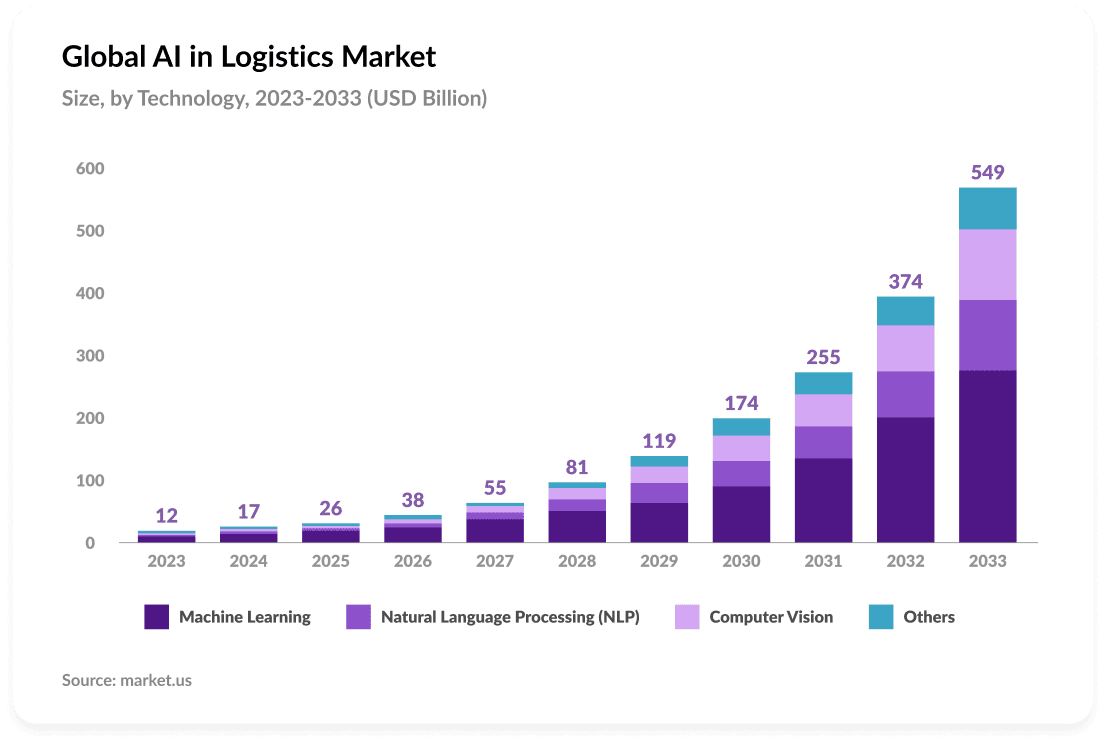
Some of the great benefits of Artificial Intelligence (AI) in warehousing operations are as follows:
- Intelligent demand forecasting and inventory optimization
The first benefit is that business can use AI algorithms to analyze historical data, market trends and other influencing factors to produce accurate demand forecasts. AI-powered demand forecasting enables warehouse to improve supply and chain processes, anticipate changes in demand, and make informed decision regarding procurement, transportation, and inventory management.
- Improved order fulfilment and logistics
The second benefit is that by leveraging AI-powered algorithms, smart warehouse can improve the efficiency of order picking routes by considering variables such as product attributes, picking frequency, and real-time order priorities. This intelligent order sequencing and travel path optimization result in increased order accuracy, increased yield, and reduced labour costs.
- Robotics and automation
The next benefit is that AI-driven robotics and automation technology such as autonomous mobile robots (AMR) and robotic picking solutions are changing warehouse operations. This intelligent system can navigate warehouse aisles, locate specific items, and quickly perform tasks such as picking, sorting, and packing. Incorporating AI-powered robotics into warehouse workflows can increase productivity, improve warehouse safety, and minimize human error.
- Predictive maintenance and equipment optimization
Another benefit of using AI in warehouse management can be related to what is most important in each operation. Artificial Intelligence (AI) can accurately predict equipment failure and maintenance needs by utilizing real-time data from sensors and monitoring systems. Adopting a predictive maintenance strategy is a powerful tool for warehouse operators to minimize downtime, cut maintenance costs, and ensure peak performance for critical machine and infrastructure.
- Real-time visibility and asset tracking
Further benefits can be gained from tracking and sensor technologies such as computer vision, Radio Frequency Identifications (RFID), and IoT devices, inventory levels and gain valuable insights into process bottlenecks. Higher visibility facilitates proactive decision making, speeds problem resolution, and improves efficiency.
- Increased security
The next benefit is that AI-powered automation improves warehouse management, improving worker safety and material handling. This automation analyses safety-related data, monitors storage parameters, and accelerate pro-actives maintenance, ensuring rapid response to enforce safety standards and compliance regulations. Additionally, reducing manual human labour usually results in a reduction in accidents, as employees are less exposed to potentially risky situations.
- Continuous improvement and process optimization
The last advantage is that AI-driven systems maintain the ability to perform continuous data analysis, track key performance indicators (KPIs), and identify areas for process improvement. Furthermore, by leveraging AI-generated insights, warehouse can streamline workflows, identify operational inefficiencies, and drive culture of continuous improvements.
Conclusion
The first thing every logistics company must do is understand how Artificial Intelligence (AI) will address overarching business objectives such as improving operational efficiency or increasing customer satisfaction. It’s good idea to hold a meeting with stakeholders should determine the company’s most pressing challenged or growth areas. For example, this could be reducing delivery times, minimizing carbon emissions, or optimizing warehouse management. Once these priorities are identified, the next step is to translate them into specific measure-able goals that align with the company’s strategic goals.
Business is growing along with the increasingly rapid development of technology, especially now that many people associate it with software development which functions to simplify the business process in various industries that are run. One of them is the software house which plays a very important role for business in today’s times. The main goal of this software house is to create the applications desired by the client or usually called Customize. Clients can come from various small to large scale company owners.
Some of the services provided by software house companies include web-based application creation, mobile-based application creation, desktop-based application creation, multi-media services and others.
One of the trusted software house in Indonesia is BTS.id.
BTS.id is a company operating in the field of software development and IT Solution. As a software house, BTS.id develops applications, creates software tailored to clients' specific needs, provides services to maintain, update and repair software.
BTS.id as a software house accepts technology consultations, so it can help you find the best and most appropriate technology solutions according to your business needs. What are you waiting for? Come and consult your company's needs with us BTS.id.
1 years ago
Artificial Intelligence
As Artificial Intelligence (AI) applications become more sophisticated, they can increase productivity in many ways. By automating mundane activities, Artificial Intelligence (AI) can free up staff time to work on more engaging tasks. Smart algorithms can also help companies identify patterns and trends that traditional methods may have missed.
Embarking on the journey of AI development is like unlocking a new realm of possibilities, where innovation meets intelligence to create solutions that were once deemed impossible. At the heart of this technological revolution lies the importance of grasping the fundamentals.
Artificial Intelligence (AI) aims to create machines that can mimic, simulate, or exceed human intelligence, finding solutions to complex problems and improving efficiency. Understanding the core principles of AI development not only empowers developers to build more efficient and innovative applications but also lays the groundwork for future advancements. The key concept of AI development revolve around creating intelligent machines that can perform tasks typically done by humans, such as problem-solving, decision-making, and learning. These machines require complex algorithms and large amounts of data to learn from and improve their performance over time.
IT Software Solutions have become essential for managing complex business operations in today’s rapidly evolving digital era. These solutions encompass a variety of applications and programs specially designed to help companies automate processes, manage data, and increase efficiency in terms of time and cost.
Software house solutions are necessary to maximize efficiency and productivity. But choosing the right solutions can often be an overwhelming task. To help with this, here are some tips for selecting the right software solutions for your business:
- Consider Your Goals
Before selecting a software solution, it is important to consider your goals and needs. What specific goals do you want to achieve with the software? Will it be used to collect and manage customer data? Or simply improve communication between departments? Knowing your exact goals will help identify the right solution for your business.
- Understand Your Budget
Budget is important factor when choosing a software solution. You need to understand how much you are willing to invest in software and which solutions fir your budget. Be sure to compare prices of different solutions and consider the cost of training, maintenance, and additional features that may be important to your business.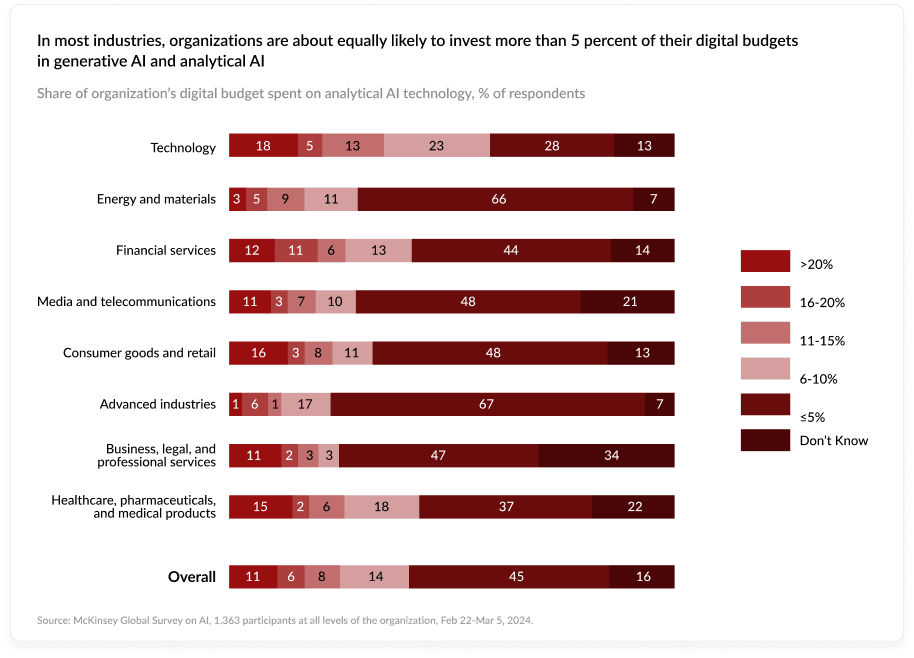
- User Friendliness
Software solutions should be easy to use. Look for solutions that are easy to use and understand, even for those who are less tech-savvy. This will ensure employees can quickly learn how to use the software and maximize its potential for efficiency.
- Flexibility
The software solution you choose should be flexible enough to grow with your business. Choose a solution that can be easily scaled up or down as needed. This will ensure that you don’t have to purchase a new solution when your needs change.
- Security Priority
Security is also an important factor when choosing a software solution. Make sure the solution you choose has strong security features your data and prevent unauthorized access.
Some advantages that illustrate the transformative potential of custom AI solutions:
- Machine Learning Solutions to Automate Quality Assurance
First advantage by implementing relevant Machine Learning (ML) techniques, you can automate defect detection and improve the accuracy and efficiency of your quality control procedures. This approach can help reduce manual labour, decrease inspection time and enhance the overall quality of your products. Additionally, investing in ML-based quality assurance systems can lead to increase trust in your process and ultimately improve customer satisfaction.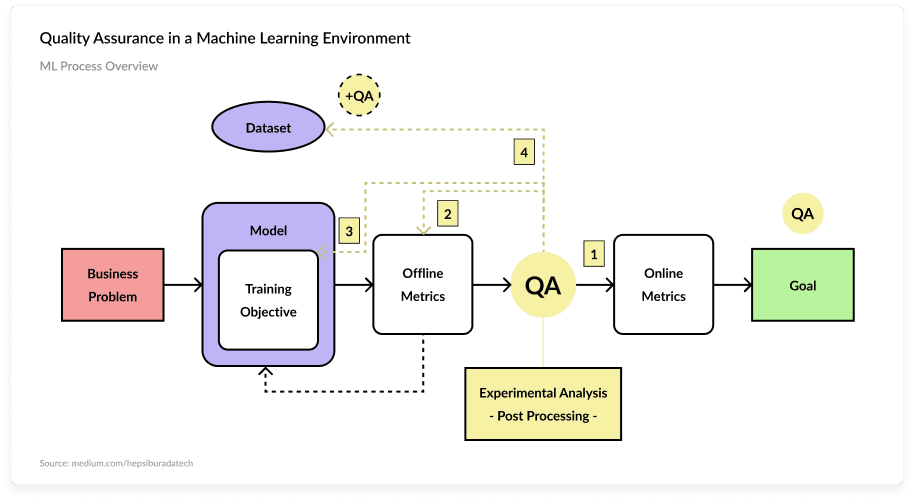
- LLM Chatbots For Customer and Employee Support
The next advantage considering implementing an LLM-based chatbot solution for improved customer support and internal processes. LLMs have transformed chatbots, enabling them to provide accurate and personalized responses by accessing vast information. Enhance customer satisfaction with prompt assistance and streamline internal operations for improved productivity. Integrate LLM technology to enhance user experience and operational efficiency
- ML/AI Solutions for Image Analysis
The next advantage considering implementing a custom AI/ML solution for automating image processing to streamline operations, improve accuracy and speed up inspections. Look for solutions incorporating computer vision and GPS-based algorithms, and explore adapting the solutions for new domains to diversify capabilities.- A data analytics using drones for power line inspections was facing manual processing challenges. It needed a comprehensive platform for streamlining inspection process via machine learning models. The platform incorporated computer vision and GPS-based algorithms. Additional adjustments allowed expansion into new domains like underground heating pipes and railway infrastructure.
Artificial Intelligence (AI) is more than just automation or data processing; it’s a transformative tool that enables business o work smarter, not harder. By understanding the unique capabilities AI brings to the table, business can unlock its full potential.
Some of the benefits that we can look at are as follows:
- From Data Overload to Actionable Insights
The first benefit of Artificial Intelligence (AI) powered analytical tools can process and
interpret data in real-time, uncovering trends and insights that drive smarter decisions.
This is a solution for business generate massive amounts of data but lack the tools to
analyze it effectively.
- Tackling operational Inefficiencies
The next benefit is automation tools such as Robotic Process Automation (RPA) streamline
workflows, eliminate bottlenecks, and reduce human error.
This is the solutions for manual processes, repetitive tasks, and poor inter-departmental
communication slow operations.
- Meeting and Exceeding Customer Expectations
The next benefit is AI-driven personalization and 24/7 chatbots provide tailored
interactions, ensuring customers feel valued.
This is a solution for customers who currently demand personalized experiences and instant
responses.
Overcoming Today’s business Challenges
Business today faces a myriad of challenges that threaten their ability to remain competitive and
efficient.
From managing vast amounts of data to meeting ever-increasing customer expectations, organizations must evolve their strategies to stay ahead. Artificial Intelligence (AI) for business efficiency offers solutions to address these issues effectively turning obstacles into opportunities for growth.
Some obstacles that are encountered in business are as follows:
- Data Overload: Too Much information, Too Little Insight
In an era where data is generated at an unprecedented scale, business have wealth of insights.
However, most companies struggle to extract value from their data. According to one survey,
90% of all data ever created was generated in the last two years, but less than 1% was actually
analyzed for actionable insights. Without the right tools, business can quickly become
overwhelmed, leading to missed opportunities.
- Bottlenecks and Inefficiency in Business Operations
It’s not just data causes problems. Business operations whether in customer service, finance, or
supply chain management are often hampered by inefficiencies. Manual processes repetitive
tasks, and poor communication between departments can lead to delays, error, and higher
operational costs. These obstacles can not only frustrate team, but also impact bottom line and
customer satisfaction.
- Stagnation in Growth
As your business grows, so does the complexity of your operations.
Systems and processes that worked when you were small may no longer scale effectively
leaving you struggling to keep up with demand. Scaling up without the right tools can lead to
inconsistent product quality, slower response times, and decreased customer satisfaction all of
which undermine your ability to stay competitive.

The growth of business aligns with the rapid advancement of technology, especially now that many are integrating it with software development to simplify business process across various industries. One prominent example is the role of software house, which have become increasing important for business in the current era.
The primary goal of software house is to develop applications tailored to client’s need, often referred to customization. Clients can rage from small business owners to large-scale corporations.
One of the trusted software houses in Bandung is BTS.id. BTS.id is a company specializing in software developments and IT solutions. As a software house, BTS.id develops applications and creates software tailored to the specific needs of its clients. They also provide services for maintaining, updating, and fixing software. Bts.id offers technology consultation services, helping you find the best and most suitable technology solutions to find your business needs.
1 years ago
Artificial Intelligence

Embarking on the journey of AI development is like unlocking a new realm of possibilities, where innovation meets intelligence to create solutions that were deemed impossible. At the heart of this technological revolution lies the importance of grasping the fundamentals. The main concept of AI development revolves around creating intelligent machines that can perform tasks
normally performed by humans, such as problem solving, decision making, and learning. These machines require complex algorithms and large amounts of data to learn and improve their performance over time.
In the realm of AI development, the significance of high-quality data cannot be overstated. At the very foundation of creating intelligent systems that can learn, predict, and make informed decisions is the collection and preprocessing of data.
The development of Artificial Intelligence (AI) has grown rapidly since its inception. In the beginning, AI was mainly focused on carrying out task that required human-like intelligence, such as problem solving and decision making. However, with the advancement of technology and increase in computing power, AI has evolved into much more than that. Today, AI is used in variety of industries, from healthcare to finance to transportation. AI is also becoming more sophisticated, with the ability to learn from data and improve over time.
Artificial Intelligence (AI) has become a major driver of innovation in various industries, including the world of digital marketing. With this ability to process large amounts of data, predict trends, and provide highly personalized recommendations, AI opens up new, previously unthinkable opportunities digital campaigns.
In the industry 4.0 era, Artificial Intelligence (AI) technology not only plays a key role in driving digital transformation, but has also become the main driver in changing the industry paradigm as a whole. In various industrial sector ranging from manufacturing which is increasingly automated, to the health sector which is transforming through telemedicine and predictive analysis AI has changed the way we interact with technology and information.
In the midst of rapid technology development, Artificial Intelligence (AI) has become an important innovation in the world of marketing. The reason is the application of artificial intelligence technology currently allows companies to carry out various marketing activities more effectively and efficiently
What is AI in Marketing?
AI in marketing is marketing strategy that involves artificial intelligence technology. This strategy utilizes artificial intelligence technology to collect, analyze and process relevant data for marketing purposes. Insight or information collected by Artificial Intelligence can be useful for making strategies or decisions related to company marketing. This includes optimizing marketing promotions and ways to increase customer satisfaction.
Artificial Intelligence has evolved from a fantastic idea to a game changer for today’s digital marketers. It’s become a great technology for driving personalization, predictive analytics, customer experience, and more. The advantage of Artificial Intelligence is that it helps you gain insight into customer behaviour quickly to collect large amounts of data. This can be customized according to customer needs depending on their actions and preferences, Artificial Intelligence offers marketers a huge opportunity to become more effective and more personalized. This benefits customers by getting relevant content that can be triggered by one-site actions, ads, or brand messages.
But does Artificial Intelligence replace human roles and efforts? Of course not! Artificial Intelligence remains simply a technology that complements and enhances human roles and efforts, but of course requires human skills to use it effectively.
After we understand what Artificial Intelligence (AI) is, how Artificial Intelligence (AI) can be used in digital marketing, and the basic functions of digital marketing, let’s look some of the main advantage of using AI in digital marketing strategies:
- Process Automation
The fisrt advantage, Artificial Intelligence (AI) can automate many tasks in digital marketing, such as sending emails, scheduling social media posts, and targeting advertisements. This save time and human resources that can be allocated to other strategic tasks.
- Better Personalization
The second advantage of Artificial Intelligence (AI) in digital marketing is its ability to increase content personalization. Artificial Intelligence (AI) can analyze user behaviour, preferences, and interaction history to design more appropriate and relevant messages. This helps in increasing customer engagement and conversations.
- Content Optimization
The next advantage is Artificial Intelligence (AI) can help in optimizing digital content, including better use of keywords for SEO. This helps content rank higher in search results. An example is SEO tools like Moz use AI to analyze keywords and provide suggestions for improvement.
- In-depth Data Analysis
The next advantage is Artificial Intelligence (AI) is able to analyze data quickly and accurately, thereby helping marketers understand customer behaviour better. This helps in identifying market trends, customer preferences and business opportunities that can be exploited.
- Efficient Chatbot
Withs this advantage, chatbots based on Artificial Intelligence (AI) can provide fast and efficient customer support. They can answer customer questions, direct them to the appropriate pages, and provide assistance whenever they are needed.
- Predict Customer Behaviour
The final advantage is that with sophisticated data analysis, Artificial Intelligence (AI) can predict future customer behaviour. This allows companies to take proactive steps in designing marketing strategies, based on their purchasing history.
The use of Artificial Intelligence marketing (AI) in business can not only make companies take the right policies, but also offers many benefits. Let’s look at some of the following benefits:
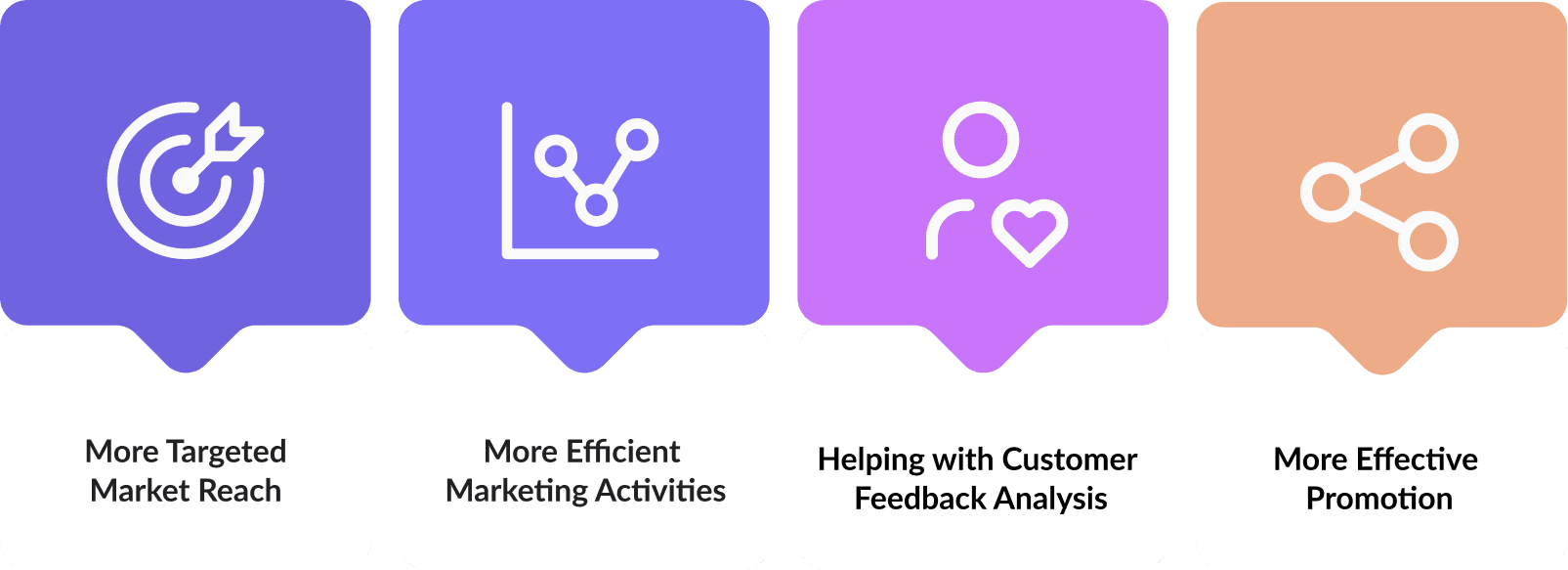
- More Targeted Market Reach
The first benefit AI technology is very useful for reaching wider customers. Companies can use the data they have collected to carry out more effective digital marketing techniques, for example distributing content according to customer needs.
- More Efficient Marketing Activities
The second benefit with Artificial Intelligence marketing (AI) makes marketing activities easier, with cheaper and more targeted markets costs. The reason is, this technology can help collect information more quickly and the costs are not too expensive.
- Helping with Customer Feedback Analysis
The following benefits demonstrates that by utilizing Artificial Intelligence companies will be easier to analyze customer comments on social media so they can more quickly evaluate and improve the quality of products and services to suit customer needs.
- More Effective Promotion
The final benefit of Artificial Intelligence makes it easier for companies to analyze promorional targets more accurately. For example, looking for promotional opportunities from search keywords, user profiles and other data.
AI enables brands to recognize and understand individual preferences and needs more effectively. Through deep data analysis, AI can create truly personalized experiences for each consumer. These tailored campaigns not only enhance engagement but also build customer loyalty.
Looking at current developments, it is clear that AI will continue to play an important role in the future of digital marketing. Brands that are able to leverage Ai to understand their customer better, deliver more relevant messages and optimize their campaigns will be at the forefront of this increasingly competitive industry.
AI is no longer just trend, but has become the foundation for more sophisticated and effective digital marketing strategies. As AI technology continues to evolve, its potential to enhance the effectiveness and efficiency of digital campaigns will grow even greater, making the future of marketing increasingly exciting to follow.
The growth of business aligns with the rapid advancement of technology, especially now that many are integrating it with software development to simplify business process across various industries. One prominent example is the role of software house, which have become increasing important for business in the current era.
The primary goal of software house is to develop applications tailored to client’s need, often referred to customization. Clients can range from small business owners to large-scale corporations.
Conclusion
One of the trusted software houses in Bandung is BTS.id. BTS.id is a company specializing in software developments and IT solutions. As a software house, Bts.id develops applications and creates software tailored to the specific needs of its clients. They also provide services for maintaining, updating, and fixing software. Bts.id offers technology consultation services, helping you find the best and most suitable technology solutions to find your business needs.
As a software house, BTS.id develops applications, creates software tailored to clients’ specific needs, provides services to maintain, update and repair software. BTS.id as a software house accepts technology consultations, so it can help you find the best and most appropriate technology solutions according to your business needs. What are you waiting for? Contact us now!
1 years ago
Artificial Intelligence
The artificial intelligence (AI) platform software market grew rapidly in 2023 and is project to maintain its remarkable momentum, driven by the increasing adoption of AI in many industries. These technologies driven motivation, from revolutionizing traditional coding tasks to improving the efficiency of the entire development life cycle. Artificial Intelligence (AI), especially generative AI (gen AI) and Large Language Models (LLM), simplifies the development cycle by automating key steps, from ideation and requirements gathering to coding and testing.
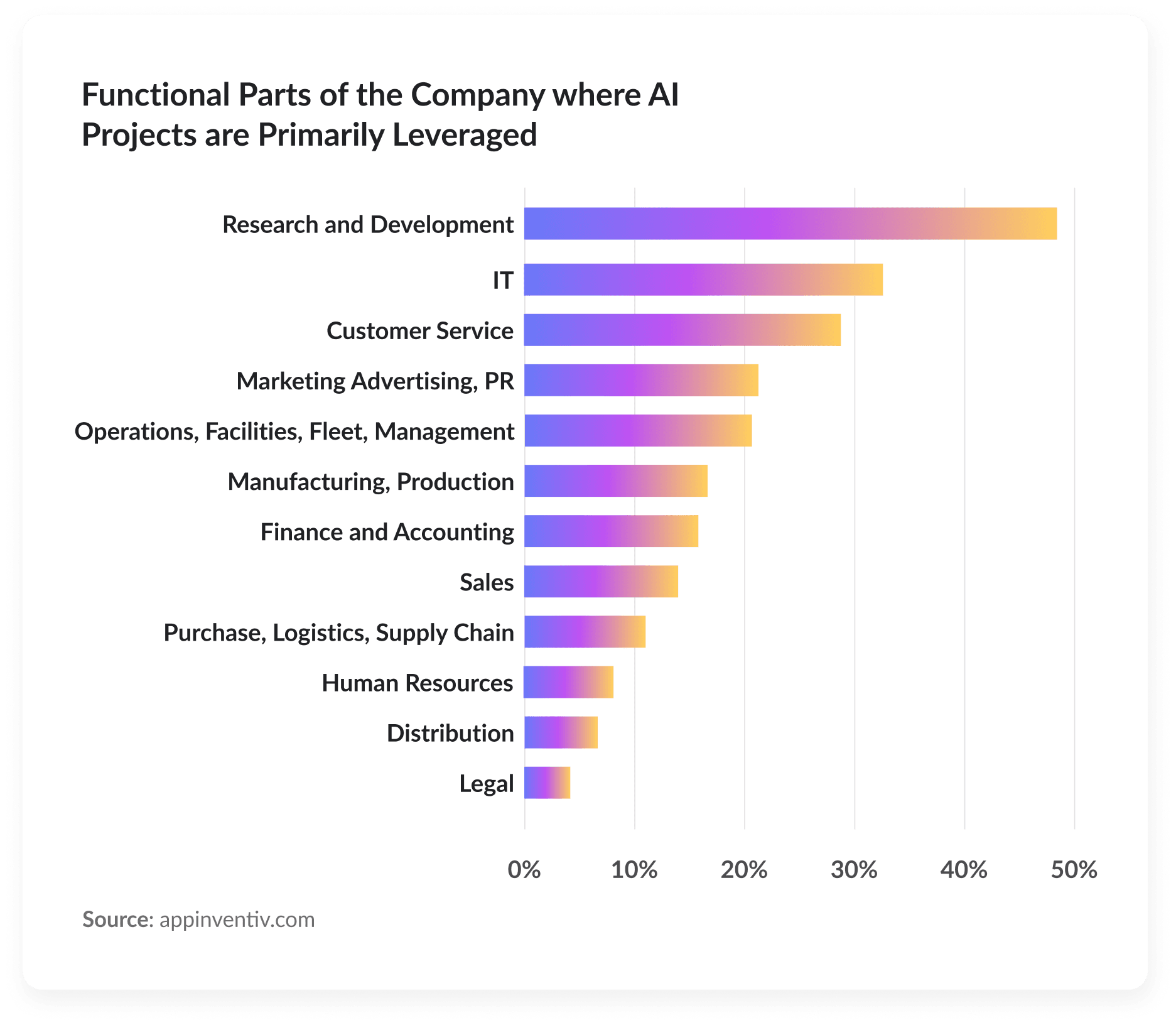
The drive to explore enterprise AI was initially inspired by a fear of being left behind is now starting to subside. In fact, business and technology leaders are shifting their focus from experiments to practical problems : “How can Artificial Intelligence (AI) drive revenue?” That question will become increasingly important as financial expectations rise.
Artificial Intelligence (AI) is revolutionizing the software development process by introducing tools and techniques that increase productivity, accuracy, and innovation. From automating code generations to optimizing testing and deployment, Artificial Intelligence (AI) is reshaping the way software is designed, built, and maintained.
Some of the benefits that we can get from developing Artificial Intelligence (AI) in software are as follows:
- Automation of Repetitive Tasks
The first benefit of developing Artificial Intelligence is the automation of repetitive tasks. AI-powered tools can help developers by automatically generating snippets of code or entire functions, which significantly reduces development time. This automation allows developers to focus on high-levels tasks such as problem solving and architectural design, rather than coding, bug-detection, and testing.
- Improved Software Quality
In this benefit, AI detects bugs, vulnerabilities and inefficiencies early in the development cycle. Artificial Intelligence (AI) can analyze large data sets project historical trends, and provide more accurate predictions regarding schedules, resources, allocation, and feature prioritization. This capability results in better project management and more efficient use of time and resources.
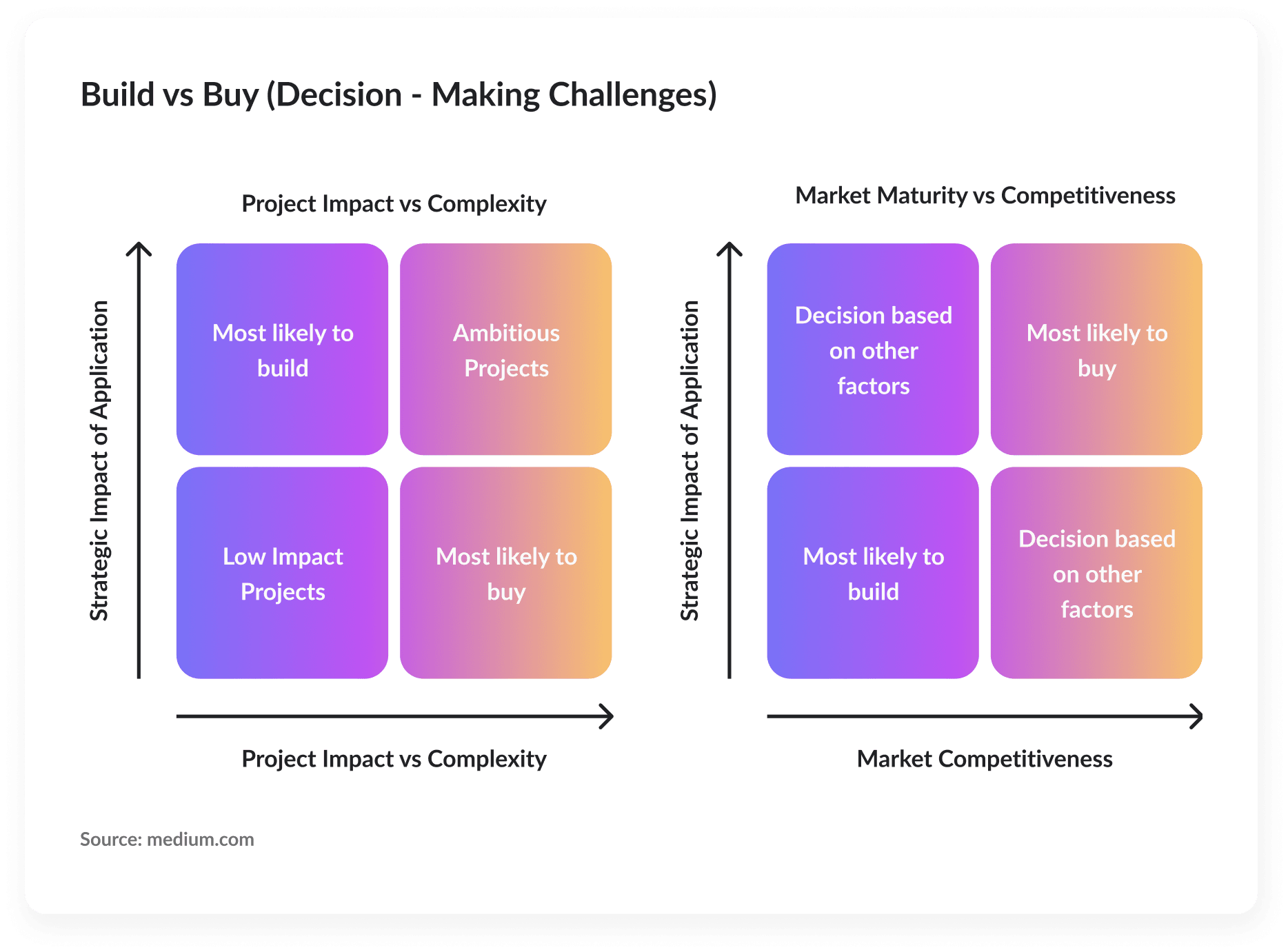
- Democratization of Software Development
Through no-code and low-code platforms, non-technical users can build and customize applications that use AI without requiring in-depth programming skills. The platform enables business professionals, product managers and other stakeholders to create solutions tailored to their needs.
- The Following is the Last Benefit of Artificial Intelligence
Here’s the final benefit where Artificial Intelligence (AI) can personalize applications in real time and offer customized recommendations, interfaces and features by analyzing user behavior and preferences. These capabilities result in higher user satisfaction and better engagement, making AI an asset in delivering more intuitive ad easy-to-use software products.
Meanwhile, software development has a significant positive impact in increasing efficiency, service quality, innovation and productivity. This really helps organizations to be able to keep up with technological developments and achieve better business goals.
Some of the advantages in software development will be briefly described as follows:
- Increased Business Efficiency
The first advantage in software development automates repetitive tasks, thereby saving time and human labor. Advantage in software development optimizes business processes, ensuring more efficient use of resources, so that cost waste can be prevented.
- Improved Service Quality
The next advantage in software development is personalizing service according to user preferences, increasing user satisfaction and quality of experience, making it easier to carry out real-time monitoring and improvements. Real-time monitoring of services and quick detection of problems for immediate repair, thereby improving overall service quality.
- Technological Innovation
The following advantages in software development encourage the creation of new products and services that can bring innovation to the market and meet evolving needs. This software development process enables the integration of the latest technologies, helping organizations to stay relevant and competitive in ever-changing market
- Increase Productivity
The final advantage in software development is creating special productivity tools that help employees perform tasks more quickly and effectively, thereby enabling effective collaboration. So this collaborative application makes team work easier, increase coordination and productivity of team members in achieving common goals.
Here are several ways companies can increase revenue through the application of AI:
- Increase sales
Virtual assistants and chatbots using AI can help organizations generate sales. Some examples include furniture retailer IKEA launching a generative AI tool for its customers. Ikea’s AI virtual assistants lets user design living room and shop for furniture. Additionally there is a jewelry insurance company, creating a GenAI-based customer service chatbot that has reduced cancellation rates on chat inquiries. Lower cancellations rates reflect more successful customer interactions, potentially increasing sales.
- Reduce Customer Churn
AI enables client retention, reduces revenue losses and improves their customer lifetime value metrics. In capacity, AI can profile the attributes of business’s customer base, leveraging historical data about departed customers. This information allows managers to identify at-risk mission. This technology offers a higher level of personalization when incorporated into AIpowered chatbots and contact centers. When business transform customer experiences, the result is lower churn rates.
- Strengthening Recommendations Engines
Artificial Intelligence (AI) algorithms can examine customer data on previous purchases to individualize product recommendations with greater precision. This increased personalization provides a key business benefit of AI: the ability to cross-sell and up-sell new products and services to customers more easily. Recommendation engines also encourage users to linger on social media platforms, which in turn attracts advertisers.
- Accelerate Marketing Strategy
Marketing may not directly generate, but effective practise will support the sales funnel. Generative AI’s ability to quickly create content can help organizations produce marketing materials ranging from newsletter to video ads. Marketing can leverage the benefits of Artificial Intelligence (AI) personalization to create marketing messages tailored to customer interest.
- Detecting Fraud
If there is suspicious activity, it will be immediately detected by Artificial Intelligence (AI) and will immediately stop payments to fraudsters, thereby maintaining revenue growth. Financial services companies typically use in AI in this capacity. One example is Capital One, which uses machine learning algorithms to spot anomalies and ward of credit and fraud. Additionally e-commerce companies use ML to target fraudulent orders. The technology’s ability to identify patterns in user behavior lends itself to such fraud detection use cases.
- Developing New Products and Services
AI can help companies create new products and speed up development cycles. AI can also speed up the delivery of digital products. AI coding assistants have helped companies in speeding up software development by 20% more. The result is faster time to market for customer-facing and revenue-generating applications.
- Provides Predictive Maintenance
Equipment downtime in areas such as manufacturing and fleet management results in lost revenue. Predictive maintenance, which is among the top ML use cases, identifies equipment that is close to failure. These insights allow plant managers to schedule downtime to perform repairs, avoiding outages and missed delivery schedules.
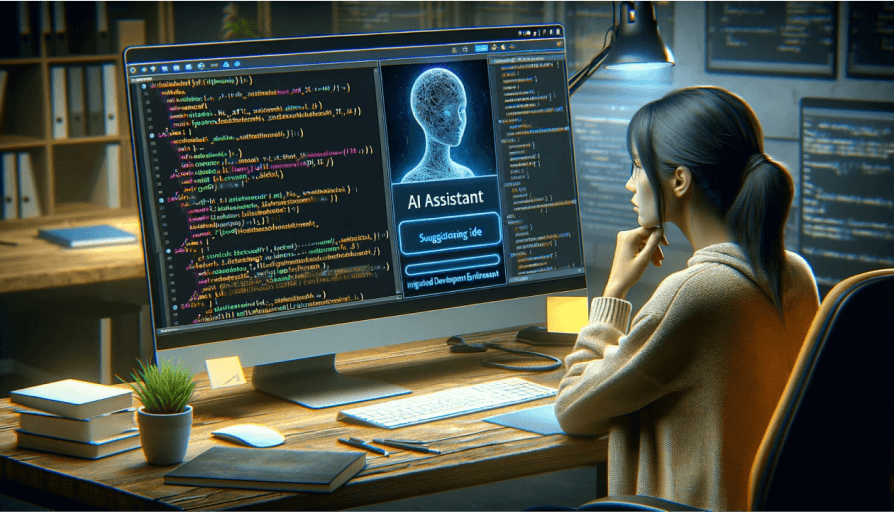
Conclusion
One of the trusted Bandung software houses is BTS.id (Bridge Technology Service). BTS.id is a company that operates in the field of software development and IT solutions, so manufacturing industry in Indonesia will be greatly helped and facilitate work operations while increasing data accuracy as a reference for large quantity reports
As a software house, BTS.id develops applications, creates software tailored to clients’ specific needs, provides services to maintain, update and repair software. Bys.id as a software house accepts technology consultations, so it can help you find the best and most appropriate technology solutions according to your business needs. What are you waiting for? Contact us now!
1 years ago
Artificial Intelligence
A Learning Management System (LMS), often also called a Learning Management Platform, is generally software designed to create, distribute and manage the delivery of learning material. Specifically, an LMS is a web-based software program for the management, documentation, monitoring, reporting, administration and distribution of educational content, training programs, technical manuals, instructional videos or digital library materials, and learning and development projects.
LMS (Learning Management System) is not machine learning, but machine learning is often used in LMS to enhance its functionality. A Learning Management System (LMS) combines technology and teaching methods to create a more interactive, flexible, effective, and efficient learning environment, while machine learning is a technology within the field of Artificial Intelligence (AI) that enables systems to learn from data and make predictions or decisions without explicit programming. Machine learning (ML) is more focused. However, both of these fields go beyond the basics of automation and programming to produce outputs based on complex data analysis. Machine Learning has limited scope and focus compared to Artificial Intelligence (AI). AI includes several strategies and technologies that are beyond the scope of machine learning.
Artificial Intelligence Based Learning Management System
What is an Artificial Intelligence-based Learning Management System?
A Learning Management System (LMS) is a web- or mobile-based electronic learning platform focused on training students or company employees. LMS allows you to organize structured learning processes in a remote mode, which is particularly useful in remote team environments. LMS is well-suited not only for employee training programs but also for orientation, onboarding, and more, while simultaneously reducing time and budget requirements. The effectiveness of LMS in delivering quality education has received a significant boost with the introduction of Artificial Intelligence.
Some benefits of Artificial Intelligence integrated into LMS:
- The first benefit is that an Artificial Intelligence-powered learning platform is first and foremost about personalized content and learning.
- Then the second benefit of an AI-based LMS includes all routine administrative tasks.
- The third benefit is automating content creation.
- Then the next benefit is that an AI-enabled LMS provides data-based analytics.
- The next benefit is ensuring engagement and consistency of learning and increasing knowledge retention.
- The next benefit is a smart e-Learning solution that also saves time and money.
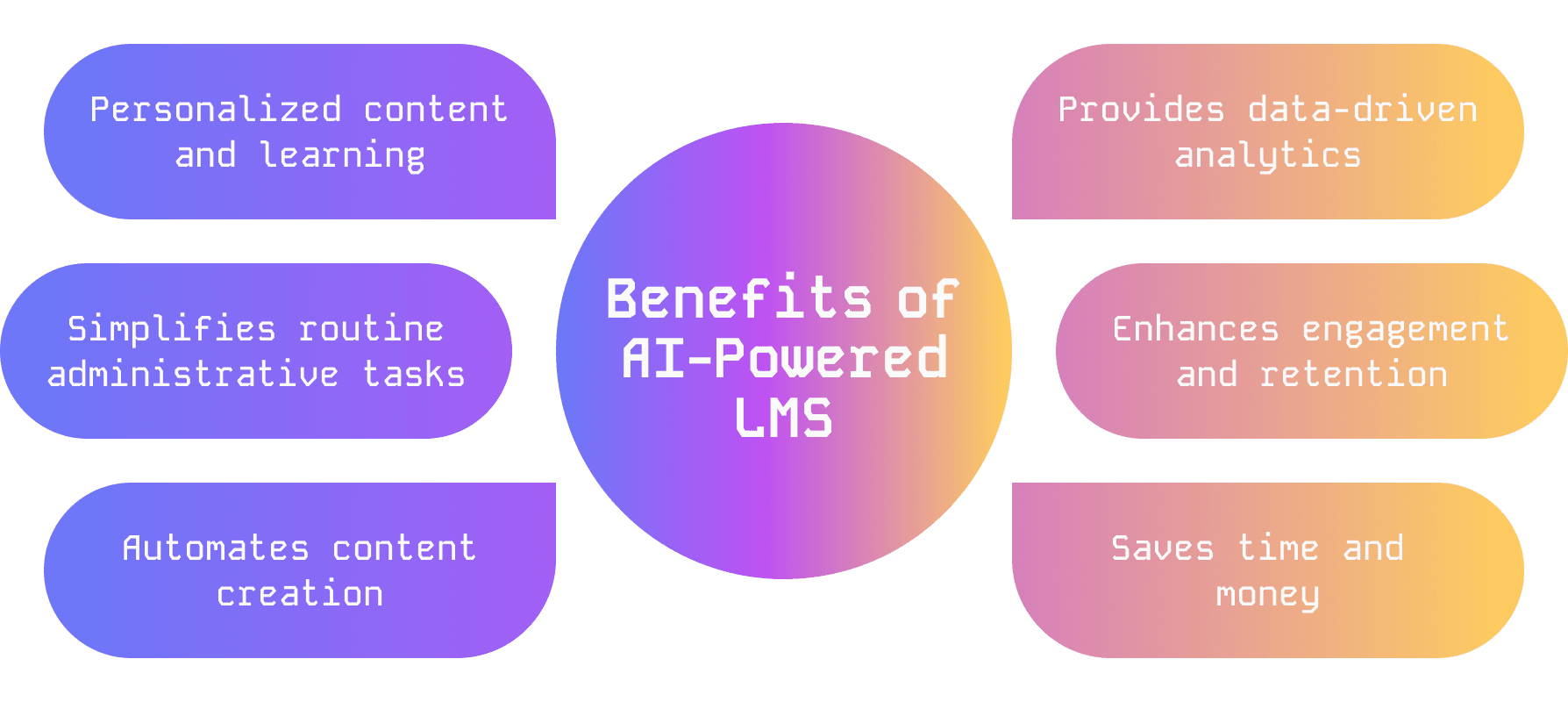
- Integrating Personalized Learning into LMS
Personalized learning has emerged as a game-changer in education, offering tailored approaches for learners to acquire knowledge and skills. But how can organizations integrate personalized learning into existing Learning Management Systems (LMS) to create a truly adaptive and learner-centered environment? Let’s discuss the key steps and strategies for integrating personalized learning into an LMS. From planning learning paths to delivering targeted content, evaluating learner progress, leveraging data-driven insights, and implementing personalized learning within your organization.
- Choosing the Right LMS for Personalized Learning
When implementing personalized learning, selecting the right Learning Management System (LMS) is critical. The LMS must have the features necessary to support various aspects of personalized learning, including planning learning paths, deliver targeted courses and content, evaluate skill acquisition, and access learner and program data- Integration
The first consideration when choosing the right LMS is integration. Ensure the LMS integrates with existing systems, such as HR platforms, to capture relevant employee information and streamline workflows. This integration allows the LMS to align personalized learning paths with organizational goals and align desired learning activities.
- Learner-Centered LMS Approach
Find an LMS that prioritizes learners's needs and preferences, providing them with a customized e-learning experience. This learner-centric LMS empowers individuals to take charge of their learning journey, which fosters a sense of engagement and motivation.
Key Features to Consider:- Comprehensive Reporting
An LMS with powerful reporting capabilities enables organizations to track learner progress, assess the effectiveness of personalized learning initiatives, and make data-driven decisions.
- LMS integration
Find an LMS that seamlessly integrates with other learning tools or content providers, allowing for the delivery of targeted courses and content.
- User Friendly Interface
The LMS should have an intuitive and easy-to-navigate interface, making it easy for learners to access and engage with personalized learning content.
- Comprehensive Reporting
- Integration
- Plan a Personalized Learning Path
To effectively plan personalized learning paths, it is crucial to have a Learning Management System (LMS) that supports learner-driven customization. The LMS should connect to HR systems and capture relevant employee information, such as job roles, skills, and learning preferences. This data forms the foundation for creating personalized learning paths that align with individual needs. Workflows within the LMS are another critical aspect of planning personalized learning paths and must be well-managed.
The LMS should facilitate the design, assignment, and monitoring of learning paths, ensuring that learners receive the right content at the right time.
Automation plays a crucial role in managing learning paths. By leveraging rules or AI, organizations can automate the assignment of learning activities based on predefined criteria. This streamlines the process and ensures that personalized learning paths are delivered efficiently to each learner.
- Deliver Targeted Courses and Content
With learner-focused training, employees have the ability to choose from a variety of training interventions and resources. This may include options such as podcasts, e-Learning courses, webinars, or face-to-face interactions. By presenting a variety of learning formats, LMS ensures that individuals can choose the method that best suits their learning style and preferences.
Furthermore, the LMS should support multiple literacies from the same course. This allows learners to review and strengthen their knowledge, providing opportunities for continuous improvement and deeper understanding.
Once a common learning flow is set up, it is critical for a Learning Management System (LMS) to provide choice and control over the learner's learning journey. By offering a variety of courses and targeted content, learners can personalize their training experience and engage with material relevant to their individual needs and goals.
- Evaluate Learner Progress
A fundamental component of personalized learning is evaluating a learner's progress. By assessing skill acquisition, conducting learner progress assessments, and providing personalized feedback, organizations can ensure that their employees are on track to achieve their learning goals.
Some things to consider at this point are:- Establish Defined Settlement Thresholds
This threshold serves as a benchmark to determine whether learners have successfully mastered the knowledge and skills required. By setting clear expectations, learners are motivated to strive for excellence and continuously improve their abilities.
- Combining Results Across the Program to Gain a Comprehensive Understanding of Individual Progress
This analysis allows organizations to identify strengths and areas that need improvement, enabling them to offer targeted interventions and support when needed.
- Providing Feedback and Assessment for Specific Courses
It is another important aspect in evaluating learner progress. Personalized feedback highlights areas for improvement and celebrates achievements, reinforcing learners' motivation and commitment to their learning journey.
- Establish Defined Settlement Thresholds
- Comprehensive Reporting Capabilities
At the individual level, reports can show employee achievements, areas for improvement, and overall skill development. Evaluations based on this data help inform the next steps for individuals, allowing the organization to tailor the learning experience to their unique needs.
To effectively evaluate learner progress, the LMS must offer comprehensive reporting capabilities at both the individual and course levels. These reports provide valuable insights into learner performance, enabling organizations to track their progress over time.
At the course level, reports provide an overview of the effectiveness of various learning experiences. This information allows organizations to identify the most impactful courses and make data-driven decisions when designing future training initiatives.
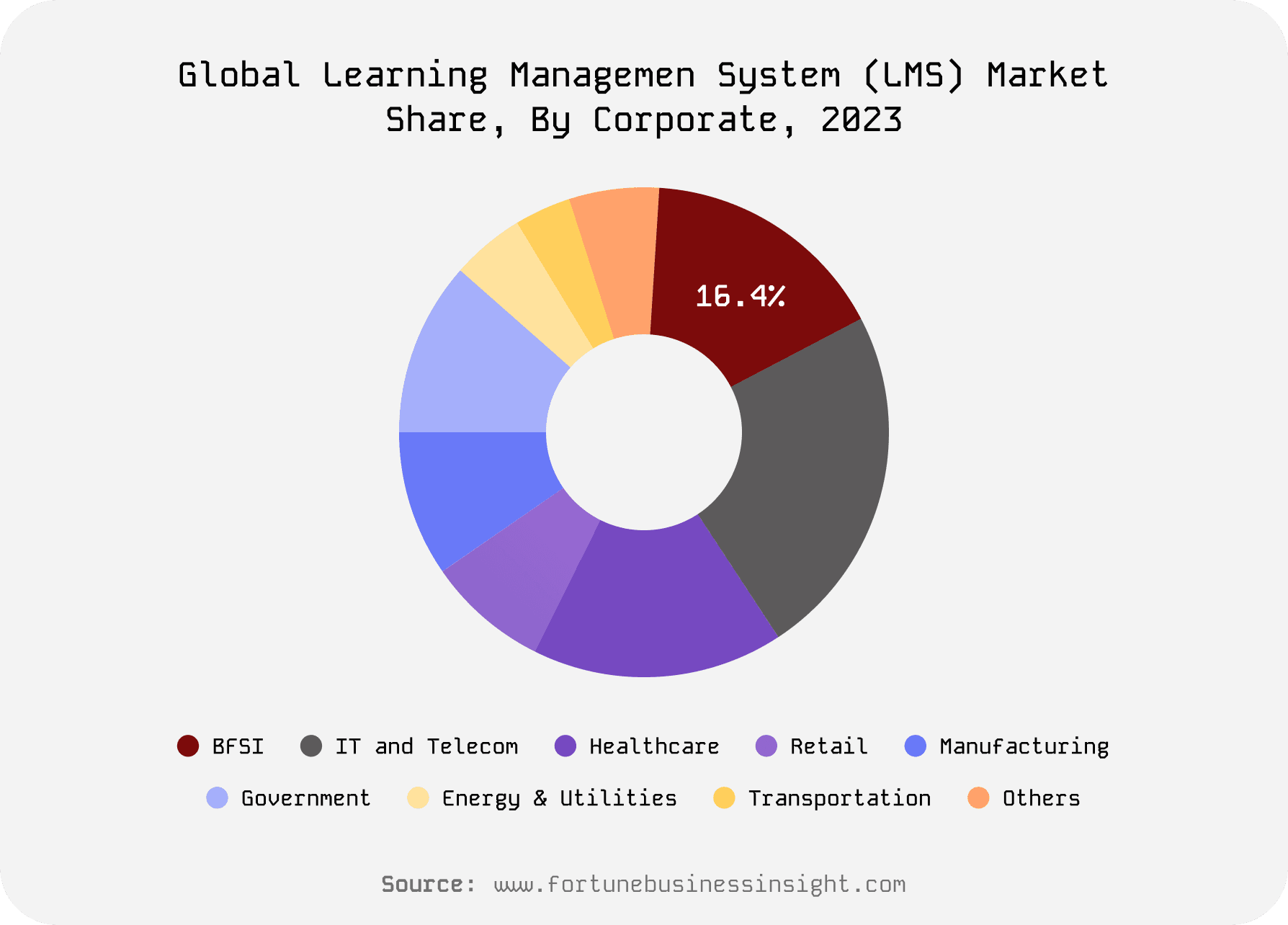
Are you still unsure if implementing an AI-based Learning Management System is a rational choice for your company? If so, let's review the key advantages of this technology for modern educational facilities:
- Simplifying the Language of Instruction
The first advantage is simplifying the language of instruction. Many teachers enter the education field after pursuing studies in other sectors. The common path is to specialize in 'practical' fields such as English or programming, then transition to a Master's degree in education. This approach sometimes creates significant challenges for the specialists: they are competent in their field but do not know how to explain concepts in simple language.
Artificial Intelligence offers the opportunity to solve this problem once and for all. Modern language models can explain many concepts in a learner-oriented way by generating their own educational content. This means it is possible to create customized tasks and even texts that explain theoretical information, taking into account the learner's skills.
- Real-Time Assistance for Teachers
The next advantage is real-time assistance for teachers. In fact, challenges in quickly understanding a single concept can hinder students' ability to learn additional material later on. If you miss this information, learning further training content becomes difficult and often impossible.
Real-time assistance for teachers through Artificial Intelligence devices solves the existing skill gap. AI tools immediately detect when a student is struggling to understand certain concepts. With this information, teachers can decide which aspects of learning to target and address the individual needs of the students. With the emergence of these devices, we finally have a reliable tool to prevent students from falling behind in their educational journey.
- Improved Accessibility of Content
The next advantage you can gain is improved accessibility of content. AI-powered LMS can leverage speech recognition technology to convert text into spoken words. This is important for making learning opportunities accessible to individuals with visual impairments. AI can generate alternative formats, such as braille or capital letters. This means the technology can meet the needs of learners with specific disabilities.
Additionally, AI-based LMS can also use language translation capabilities to provide content in multiple languages. In this way, learners who are not fluent in the original language can access materials from other countries.
- Automated Review of Student Performance
The automated review of student performance is the next advantage of AI-based LMS. Conducting performance analysis of students is usually a significant time-waster. Artificial Intelligence solves this problem once and for all.
AI can review tests and even more complex assignments with minimal human input. This means that teachers have the opportunity to spend more time preparing high-quality teaching materials. The ability of AI to independently assess student information is also important from the perspective of preventing bias. Automated systems have no preferences: they are impartial regarding all aspects of human personality.
Conclusion
Overall, AI in LMS is a promising technology. AI can significantly enhance the customization of modern education. Although some challenges commonly arise in its implementation, such as ethical issues, lack of human input and face-to-face communication, reduced ability to teach complex decision-making and problem-solving, and the lack of government regulation. Nevertheless, we believe these issues can be addressed through a focus on hybrid learning practices and the use of modern communication technologies. Better government regulation will also establish better standards that can prevent bias and lack of transparency.
If you want to create a high-quality LMS, feel free to contact our company, BTS.id (Bridge Technology Service), and we are always ready to provide the best information and advice for the interests of your business, tailored to what your company needs.
1 years ago
Artificial Intelligence
Artificial intelligence (AI) is no longer just the stuff of scary futuristic movies, it’s recently burst into the headlines and is suddenly just everywhere. Its impact on the job market, whether we trust things such as the integrity of news on social media, and ultimately whether humanity survives alongside it are unsettling things to worry about.
How you can boost sales and engagement with AI analytical for e-commerce? Discover how AI revolutionizes online retail for competitive advantages. AI analytics has significantly transformed the e-commerce industry by optimizing processes, enhancing efficiency, and providing deeper insights for decision-making.
Source: The Business Research Company
According to the Artificial Intelligence in E-Commerce Global Market Report 2024 by The Business Research Company, the AI in e-commerce market is projected to reach a size of $ 14 billion by 2028. This growth is driven by the increasing popularity of online shopping. AI analytics is crucial in e-commerce for several compelling reasons. AI analytics also brings numerous benefits to e-commerce, enhancing various aspects of business operations and customer engagement.

Here are the key benefits:
Benefits of AI Analytics in E-commerce
- Identifying optimal pricing
When you can accurately and consistently hit the pricing optimization sweet spot, profits go up. And with AI-powered software and the large datasets it can analyze, it’s infinitely easier to hit that moving target. AI algorithms analyze customer behavior and preferences to recommend products that are more likely to be purchased, increasing conversion rates. AI analytic adjusting prices in real-time based on demand, competition, and customer behavior ensures optimal pricing strategies that maximize revenue.
- Making the right recommendations
One aspect of personalization, recommendations, is in a class of its own. Ecommerce personalization in an online store goes considerably beyond what shoppers can expect to enjoy in a brick-and-mortar store. AI analytic can retrieve actionable insights about shoppers such as how they’ve browsed and their purchase history, that allow accurate prediction of what they want and recommendation of the right item or similar products. AI analytic understanding customer preferences, purchase patterns, and pain points allows businesses to refine their offerings and marketing strategies also analyzing customer reviews and feedback help businesses gauge customer sentiment and address issues proactively.
- Intuitively cross-selling and upselling
Which products would your shoppers be likely to add to their carts as they’re happily checking out? Product recommendation technology is yet another ecommerce tool enhanced by artificial intelligence. Targeted Campaigns for AI enables precise audience segmentation and targeting, ensuring that marketing efforts reach the right customers with the right message. You can use frequently bought together data created by collaborative filtering to inform how you respond.
- Preventing online selling fraud
The good news: AI can fight that problem in some advanced ways. It used to be that armies of employees had to painstakingly review transactions for anomalies. How machine-learning algorithms can engage in fraud detection, using complex rules to analyze millions of big-data points and instantly spot suspicious behavior, is impressive. For instance, a criminal trying to commit a fraudulent transaction might enter an incorrect shipping address that something a human would never be able to notice or respond to, much less in the amount of time an algorithm could flag it.
- Automating customer support
When it comes to good customer sevice, chatbots and other types of virtual assistants make excellent online support reps. AI analytic is obviously involved in pretty much everything about a chatbot. Their functionality can leverage NLP to help them determine shoppers needs, and with applications of machine learning solutions, they can improve their knowledge over time to become even wiser digital butlers. AI analytic analyzes customer data to create personalized loyalty programs that reward frequent shoppers and encourage repeat business. For proactive engagement AI predictive analytics help businesses engage with customers proactively, addressing their needs and concerns before they escalate.
- Reducing manual labor
Aside from impacting what goes on at the technology levels in an ecommerce store, as with other industries, AI can take on mundane daily tasks and lower employee headcount. The phenomenon of human retail associates being displaced by bots and automation is unfortunate, to be sure, but when it comes to the bottom line, not many companies argue with the fact that AI is the superior hire.
- Winning shoppers with personalization
E-Commerce personalization has been a hot commodity for a while, but AI has put it on steroids. With AI analytic, computers can capture and process huge amounts of customer data and provide insightful real-time analytics, allowing websites to act like trustworthy guides that suggest the right items and offer attractive discounts.
Impact your revenue with AI search
The ecommerce world has become an extremely competitive place, as a result of COVID-19, which brought locked-down people online in droves, followed by their settling in as online shoppers happy to keep reveling in the pleasures of digital shopping. That sounds daunting, but while a majority of businesses have invested in AI technologies, only about 15% are actually deploying AI capabilities. So if your retail site is getting lost in the tidal wave of ecommerce industry craziness, in terms of major decision making, applications of artificial intelligence could be the life raft for your business before it goes crashing down.

Photo Generated by AI
Conclusion
AI analytics is revolutionizing e-commerce by enhancing personalization, improving operational efficiency, and providing deeper customer insights. As technology continues to evolve, its impact on e-commerce is likely to grow, offering even more innovative ways to engage and serve customers. AI analytics has revolutionized the e-commerce industry by providing valuable insights and optimizing various aspects of the business. By leveraging AI analytics, e-commerce platforms can enhance customer experience, improve operational efficiency, and gain a competitive edge in the market. As AI technology continues to advance, its applications in e-commerce will expand, driving further innovation and growth in the industry.
BTS.id (Bridge Technology Service), as a leading technology company, provides comprehensive services and support to help businesses harness the power of AI and drive their online growth. Let's partner with BTS.id (Bridge Technology Service) and make AI the primary driver of your e-commerce success.
2 years ago
Artificial Intelligence
Setelah pandemi Covid-19 berlalu, E-Commerce telah menjadi segmen bisnis yang berkembang pesat serta banyak mendapatkan perhatian. Keinginan untuk memenuhi kebutuhan, serta keterbatasan yang diberlakukan kala itu terus beradaptasi demi berbelanja untuk memenuhi kebutuhan hidup, dan dampaknya industri e-commerce juga turut berkembang.
Meningkatkan konversi dengan Web AI di e-commerce melibatkan berbagai teknik dan alat yang memanfaatkan kecerdasan buatan untuk menarik perhatian pelanggan dan mempertahankan pelanggan, serta mendorong mereka untuk melakukan transaksi pembelian.
Tanpa kita sadari atau tidak, web AI telah disematkan di banyak sekali sisi dari e-commerce ini. Mulai dari penyusunan produk yang direkomendasikan untuk user, lalu mengamati serta menganalisis kebiasaan dan pola user dala berbelanja, masalah kemanan atau proteksi pada metode pembayaran, dan lain sebagainya.
Beberapa strategi utama dalam meningkatkan konversi dengan web AI di E-commerce adalah sebagai berikut :
1. Personalisasi Konten dan Produk
Dengan menganalisis riwayat penjelajahan, interaksi, dan demografi user, memungkinkan web AI untuk membuat rekomendasi produk atau layanan yang relevan secara real-time. Penyesuaian riwayat ini mendorong user menjelajah lebih jauh, hingga akhirnya melakukan pembelian.
Dengan menggunakan algoritma AI memungkinkan untuk menganalisis perilaku belanja user dan merekomendasikan produk yang relevan. Amazon menggunakan AI untuk menampilkan produk yang mungkin disukai pengguna berdasarkan riwayat penelusuran dan pembelian.
2. Chatbot dan Asisten Virtual
Chatbot web AI ini dapat menyediakan dukungan pelanggan yang cepat dan efektif di situs web. Chatbot AI dapat menangani pertanyaan umum, membantu pengguna menavigasi situs, dan menyarankan produk, bahkan di luar jam kerja. Memangkas waktu tunggu dan meminimalisir kesulitan, chatbot meningkatkan kepuasan pelanggan dan melancarkan proses pembelian.
3. Optimasi Mesin Pencari (SEO) dan Pencarian Cerdas
AI menganalisis pola pembelian, ulasan pelanggan, dan tren industri untuk merekomendasikan produk dan layanan yang paling relevan kepada pengunjung.
Menggunakan web AI untuk memberikan hasil pencarian yang lebih relevan berdasarkan preferensi dan riwayat penelusuran user, memungkinkan para user untuk mencari produk menggunakan gambar atau perintah suara, meningkatkan kenyamanan dan menemukan produk lebih cepat.
4. Penerapan Dynamic Pricing
Dynamic pricing merupakan sebuah sistem AI yang dapat membantu pengguna menyesuaikan harga produk, serta memberikan rekomendasi perubahan harga, berdasarkan harga yang diberikan oleh kompetitor di platform yang sama. Web AI menyesuaikan harga produk secara real-time berdasarkan permintaan, persaingan, dan perilaku pelanggan. Bahkan AI memprediksi lonjakan permintaan dan menyesuaikan inventaris serta harga secara proaktif.
5. Verifikasi Pembayaran yang Solid
Beberapa e-commerce menggunakan sistem verifikasi pembayaran yang lebih baik untuk menjamin keamanan transaksi yang dilakukan. Keberadaan web AI dalam E-commerce juga dapat dilihat pada penambahan layer verifikasi pembayaran sehingga lebih solid. Pada proses pembayaran akan dilakukan dengan cara berlapis yang lebih aman, sehingga dipastikan hanya pengguna yang sah saja yang dapat melakukan transaksi dengan menggunakan akun yang bersangkutan.
6. Keamanan dan Pencegahan Penipuan
Menggunakan teknologi AI untuk verifikasi identitas pengguna, mengurangi risiko penipuan identitas. Web AI dapat digunakan untuk memantau dan menganalisis transaksi secara real-time, mencari pola yang mencurigakan dan anomali yang dapat menunjukkan aktivitas penipuan. Algoritma pembelajaran mesin (machine learning) dapat dilatih menggunakan data historis untuk mengenali transaksi yang mungkin berisiko tinggi. Dengan menggunakan AI untuk memantau transaksi dan mendeteksi aktivitas mencurigakan secara real- time dapat meningkatkan kepercayaan pelanggan.
Lalu bagaimana dengan benefit dengan diterapkannya web AI dalam e-commerce?
Manfaat dari penggunaan kecerdasan buatan (AI) dalam e-commerce sangatlah beragam dan signifikan. Berikut adalah beberapa manfaat utamanya:
- Peningkatan Efisiensi Operasional
AI dapat mengotomatisasi tugas-tugas operasional seperti manajemen inventaris, pengelolaan rantai pasokan, dan pemrosesan pesanan. Hal ini membantu mengurangi biaya operasional dan meningkatkan produktivitas, memungkinkan fokus lebih besar pada strategi bisnis yang lebih tinggi.
- Penyaringan Penipuan yang Lebih Efektif
AI dapat digunakan untuk mendeteksi dan mencegah penipuan dengan lebih baik, baik dalam transaksi keuangan maupun keamanan data. Sistem AI dapat secara otomatis mengenali perilaku mencurigakan dan mengambil tindakan preventif secara real-time.
- Inovasi Produk dan Layanan
AI memungkinkan e-commerce untuk mengembangkan produk dan layanan baru yang lebih sesuai dengan kebutuhan pelanggan. Melalui analisis data dan umpan balik pelanggan secara real-time, bisnis dapat beradaptasi lebih cepat terhadap perubahan pasar dan meningkatkan daya saing mereka.
- Analisis Data yang Mendalam
AI memungkinkan analisis yang lebih dalam terhadap data pelanggan dan transaksi. Dengan menggunakan teknik-teknik seperti machine learning, AI dapat mengidentifikasi pola-pola tersembunyi dalam data yang dapat digunakan untuk membuat keputusan bisnis yang lebih baik dan memprediksi tren pasar.
KESIMPULAN
Dengan memanfaatkan web AI di platform e-commerce, bisnis dapat meningkatkan konversi melalui personalisasi yang lebih baik, layanan pelanggan yang lebih responsif, penargetan pemasaran yang lebih tepat, dan pengalaman belanja yang lebih mulus dan aman. Integrasi AI tidak hanya membantu dalam menarik dan mempertahankan pelanggan tetapi juga dalam mengoptimalkan operasi bisnis secara keseluruhan.
BTS.id (Bridge Technology Service), sebagai perusahaan teknologi terkemuka, menyediakan layanan dan pendampingan komprehensif untuk membantu bisnis memanfaatkan kekuatan AI dan juga mendorong pertumbuhan online e-commerce Anda.
Mari bermitra dengan BTS.id (Bridge Technology Service) dan jadikan AI sebagai pendorong utama kesuksesan e-commerce Anda.
3 years ago
Artificial Intelligence
In a rapidly advancing world, software development technology has brought remarkable changes. However, there is one innovation that is revolutionizing the human paradigm: artificial intelligence (AI).
The story begins in a dedicated laboratory where a group of scientists is diligently working to create artificial intelligence that can rival and even surpass human capabilities. They combine sophisticated algorithms with unlimited computing power, giving birth to an entity that can learn and adapt just like humans.
During its development journey, artificial intelligence starts to showcase its extraordinary abilities. AI can analyze and process data within seconds, uncovering patterns invisible to the human eye, and providing brilliant solutions to complex problems.
Moreover, AI can interact with humans. With a friendly voice and astonishing intelligence, artificial intelligence understands human language, answers questions, and even offers invaluable advice.
Initially, some people feel apprehensive about the progress of AI. They worry that artificial intelligence might replace human jobs or even threaten human existence. However, AI developers claim that their goal is to enhance human lives and assist in various fields such as healthcare, transportation, and even research.
Over time, artificial intelligence becomes more accepted by society. People realize its incredible potential to tackle complex problems, accelerate technological advancements, and improve overall quality of life.
In a world increasingly interconnected and driven by software development technology, artificial intelligence becomes a crucial milestone in human development. Through this artificial intelligence, we glimpse a future full of possibilities and astonishing innovations.
Artificial intelligence Is A Revolutionary Technology
According to the Forbes Advisor survey, 73% of businesses use or plan to use artificial intelligence for their business. This does mean that AI is becoming increasingly significant in the business landscape.
"Entire industries will reorient around it," says Bill Gates, the Microsoft co-founder on his blog recently. So, yes, artificial intelligence is a game-changing technology that rivals the transformative impact of computers, cellphones, and the internet, making it one of the most revolutionary advancements we have witnessed in decades.
Artificial intelligence is powerful due to its ability to process and analyze large amounts of data quickly, learn and adapt from experiences, automate repetitive tasks, mimic human cognitive abilities, scale operations efficiently, provide personalized experiences, and integrate with emerging technologies. These characteristics enable AI to make data-driven decisions, optimize processes, solve complex problems, and deliver transformative advancements across various industries and domains.
Artificial Intelligence and Machine Learning
Artificial intelligence and machine learning are inseparable. Artificial intelligence and machine learning are closely interconnected. Machine learning is a subset and a key component of AI. It refers to the ability of computer systems to learn and improve from data without being explicitly programmed. Machine learning algorithms enable AI systems to analyze and interpret data, recognize patterns, and make predictions or decisions based on the information learned.
In the context of AI, machine learning plays a vital role in enabling systems to adapt and improve their performance over time. By training AI models on large datasets, machine learning algorithms allow AI systems to recognize complex patterns, identify correlations, and make accurate predictions or classifications. The iterative nature of machine learning, where models continuously learn and adjust based on new data, empowers AI systems to become more intelligent and effective in their tasks.
Therefore, machine learning provides the foundation for AI to acquire knowledge, learn from experience, and perform tasks that typically require human-like intelligence. It is through the integration of machine learning techniques that AI systems can autonomously process data, recognize objects, understand language, and make informed decisions, ultimately driving the transformative power of artificial intelligence.
Feeling confused? Let us explain it to you in one single pharagraph: Artificial intelligence and machine learning are like best friends. AI is like a brain that can think and learn, while machine learning is like a special tool that helps AI become even smarter. They work together to help computers understand things and make decisions, just like how we learn and make decisions. AI and machine learning help us do many amazing things, like talking to robots, playing games, and even helping doctors find cures for diseases. They are a super cool team that makes our technology really smart!
The Advancements and Applications of AI
Artificial intelligence has made significant advancements and found diverse applications across various industries. Here are some examples:
Healthcare: AI is being utilized to improve diagnostics, personalize treatment plans, and enhance patient care. AI can analyze medical images, such as X-rays and MRI scans, to aid in early detection of diseases. It can also help in drug discovery and develop personalized treatment strategies.
Education: AI is being used to create personalized learning experiences and adaptive educational systems. AI-powered tutoring systems can tailor lessons based on individual needs, provide feedback, and track student progress, enhancing learning outcomes.
Manufacturing: AI is revolutionizing manufacturing processes through automation and predictive maintenance. AI-powered robots and systems can perform complex tasks, optimize production lines, and predict equipment failures, reducing downtime and increasing efficiency.
Harnessing the Power of AI: Advantages of AI in Software Development
AI brings significant advantages and benefits to software development that will enable developers to build higher-quality software, accelerate development cycles, and deliver better user experiences. Here are some of the advantages of artificial intelligence in software development.
Automation: AI can automate repetitive and time-consuming tasks involved in software development, such as code generation, testing, and bug fixing. This increases productivity, accelerates development cycles, and frees up human developers to focus on more complex and creative aspects of software development.
Photo by Pixabay: https://www.pexels.com/photo/turned-on-computer-monitor-displaying-text-270360/
Improved Efficiency: AI algorithms can analyze vast amounts of code, documentation, and data to identify patterns, extract insights, and optimize software performance. This leads to improved efficiency in coding practices, algorithm design, and system optimization.
Enhanced Debugging and Testing: Artificial intelligence can assist in identifying bugs, vulnerabilities, and quality issues in software. Machine learning algorithms can analyze code and historical data to detect patterns of defects and provide suggestions for fixing them. This helps improve software reliability and reduces time spent on manual debugging and testing.
Natural Language Processing: AI-powered natural language processing (NLP) enables software developers to interact with tools and platforms using human language. This simplifies tasks like querying databases, retrieving information, and generating code snippets, enhancing developer productivity and reducing the learning curve for new technologies.
Intelligent Assistants and Chatbots: AI-powered virtual assistants and chatbots can provide real-time support and guidance to developers. They can answer questions, provide documentation, and offer suggestions for problem-solving. This improves developer experience and accelerates the learning process.
Predictive Analytics: AI algorithms can analyze historical data, user behavior, and market trends to predict software performance, user preferences, and potential issues. This helps in making informed decisions regarding feature prioritization, resource allocation, and software updates.
Continuous Integration and Deployment: AI can facilitate continuous integration and deployment processes by automating build and deployment pipelines, performing automated testing, and monitoring software performance. This enables faster and more reliable software releases, reducing the time between development and deployment.
Photo by VisualStudio: https://code.visualstudio.com/docs/editor/intellisense
Intelligent Code Completion and Suggestions: AI-powered code editors and IDEs can provide intelligent code completion suggestions based on context, code analysis, and best practices. This speeds up coding, improves code quality, and reduces errors.
Photo by Pavel Danilyuk: https://www.pexels.com/photo/a-person-playing-chess-8438944/
Conclusion
In conclusion, artificial intelligence possesses immense power due to its ability to process and analyze large volumes of data, learn and adapt from experiences, automate tasks, mimic human cognitive abilities, scale operations efficiently, personalize experiences, and integrate with emerging technologies. Machine learning, as a subset of AI, plays a crucial role in enabling AI systems to learn and improve over time.
AI has advanced significantly and found applications across numerous industries, revolutionizing sectors such as healthcare, finance, manufacturing, transportation, retail, education, agriculture, and of course entertainment.
In the realm of software development, AI brings numerous benefits, including automation, improved efficiency, enhanced debugging and testing, natural language processing capabilities, intelligent assistants, predictive analytics, and streamlined continuous integration and deployment. These advancements and advantages highlight the transformative potential of AI in shaping the future of technology and driving innovation across various domains.
A good news, BTS.id offers services to assist brands and businesses in building AI-powered applications or custom software development, as well as integrating existing applications with AI technology, empowering them to leverage the benefits of artificial intelligence in their operations.
8 months ago
Artificial Intelligence
The success of AI implementation depends not only on the models used, but also on the technical foundation behind their development. As an AI software development company, we understand that choosing the right development partner directly impacts AI ROI, system stability, and long-term project sustainability.
Scalable architecture, high-quality data, seamless system integration, and mature MLOps practices are key factors in ensuring that AI solutions operate reliably and deliver long-term business value.
Selecting the right Artificial Intelligence (AI) software development company is a critical strategic decision that has a direct effect on return on investment (ROI) and the long-term success of AI initiatives.
Understanding the Link Between AI Partner Selection and Project Outcomes
The right AI partner does more than just build models, it ensures strategic AI implementation through scalable architecture, reliable data pipelines, and mature MLOps practices. This approach enables AI solutions to grow sustainably and deliver long-term business value.
Why Is AI Partner Selection a Key Factor in the Success of Artificial Intelligence Projects?
- Solution Quality: Aligns business needs with a solid technical foundation from the start.
- AI ROI: Structured development ensures measurable and optimizable results.
- Project Sustainability: Scalable architecture and mature MLOps prevent technical debt.
- Strategic Partner: Acts as a long-term collaborator, not just a service provider.
- Strategic AI Implementation: Ensures seamless integration and real adoption across operations.
As AI becomes a key driver of competitive advantage, the choice of who builds your solution will ultimately determine how much ROI you can achieve.
The Role of Expertise: Quality Matters in Delivering Sustainable AI Solutions
The sustainability of AI solutions is largely determined by the quality of expertise involved throughout the development process.
AI expertise and technical proficiency enable scalable and sustainable AI solutions to be built on the right architecture, secure, robust, and ready to scale in production environments. Supported by experienced development teams, implementation complexity can be managed effectively, technical risks are minimized, and solution quality is maintained throughout the entire development lifecycle.
In addition, strong domain knowledge ensures that AI solutions address specific business needs rather than serving as mere technology implementations. Through strategic AI implementation, scalable solutions can be developed to support long-term growth and enhance AI investment value.
Ultimately, the success and sustainability of AI solutions depend on expertise, team experience, and deep domain understanding. With a solid technical foundation and scalable solutions, AI can evolve into a strategic business asset that delivers long-term value.
Assessing Long-Term Value: How the Right Partner Maximizes Your AI Investment
Assessing the long-term value of an AI project goes far beyond initial implementation. Choosing the right AI partner enables organizations to maximize AI investment value through cost-efficient execution, future-proof solutions, and a results-driven approach. By focusing on scalable and sustainable AI solutions, and and Strategic AI Implementation, AI projects can evolve into business assets that deliver measurable and sustainable impact over time.
- AI Return on Investment (ROI)
The right AI partner helps ensure that AI investments deliver clear, measurable business value and maximize AI Investment Value and AI Project ROI Measurement over the long term. - Cost Efficiency
Well-planned architecture and development processes reduce unnecessary costs and minimize the risk of rework. - Future-Proof Solutions
AI solutions are designed to be scalable and adaptable to technological advancements and evolving business needs. - Maximizing Value from AI Projects
Continuous optimization ensures AI initiatives go beyond one-time projects and continue delivering strategic value. - Measurable Results
A metrics-driven approach and performance evaluation enable organizations to monitor AI impact objectively and consistently, improving AI Project ROI Measurement.
Maximizing AI investment requires more than the right technology—it demands a partner who understands strategy, cost efficiency, and long-term value. With the right AI partner, organizations can ensure every AI initiative delivers measurable ROI, scalable and Sustainable AI Solutions , and sustainable business outcomes through Strategic AI Implementation.
Avoiding Common Pitfalls: What Happens When You Choose the Wrong Development Company?
Choosing the wrong AI development company is often a primary cause of AI project failure. Risks of poor partner selection can lead to architectural flaws, implementation delays, and solutions that are not production-ready. As a result, many AI initiatives end up as failed projects that never move beyond the early stages and turn into wasted AI investments, reducing potential AI project ROI measurement.
Beyond financial losses, the greater impact lies in missed business goals, where AI solutions fail to support business strategy and decision-making. When developers do not provide adequate support and maintenance, AI systems become difficult to maintain, lack scalability, and lose their long-term value. This highlights that selecting the right AI partner is a strategic decision that directly affects the success, sustainability, and delivery of scalable and sustainable AI solutions through Strategic AI Implementation.
Sustainability in Practice: Ensuring Ongoing Success Beyond Deployment
The sustainability of AI projects does not end once a solution is successfully deployed. To ensure AI continues to deliver business value enhance AI project ROI measurement, a long-term approach is required—one that includes ongoing support, performance optimization, and the ability to adapt to evolving business needs and technological changes. Implementing Scalable and Sustainable AI Solutions ensures AI remains valuable over time.
Key aspects to consider include:
- Sustainable AI Projects
AI solutions are built on stable and scalable foundations to support long-term use. - Long-Term Support Services
Ongoing support helps maintain system performance, security, and reliability. - Continuous Improvement in AI Systems
Regular enhancements ensure models remain accurate, effective, and relevant. - Adaptability to Changing Needs
Adaptive AI solutions are able to evolve alongside business growth and technological advancements.
With the right sustainability strategy in place, AI solutions go beyond post-deployment functionality and continue to deliver consistent, long-term business value.
Criteria for Selecting the Best-Fit AI Software Development Company for Your Business Needs
Choosing the right AI software development company is a strategic step to ensure that AI solutions truly support your business objectives. The evaluation process should not focus solely on technical capabilities, but also on experience, working approach, and alignment with organizational needs.
Key criteria to consider include:
- How to Choose an AI Company
Assess AI partners based on their strategic approach, technical expertise, and understanding of your business requirements. - Evaluating Vendors
Compare AI vendors objectively in terms of methodology, transparency, and long-term delivery capabilities. - Track Record and Case Studies
A proven track record and relevant case studies demonstrate a partner’s ability to address real-world challenges and deliver validated solutions. - Client Testimonials
Client feedback provides insight into reliability, collaboration quality, and overall satisfaction with delivered outcomes. - Alignment with Business Goals
The right AI partner aligns technical solutions with your business strategy and performance targets. - Transparent Communication
Open communication ensures clear expectations, effective risk management, and smooth collaboration throughout the project lifecycle. - Customization Capabilities
Strong customization capabilities allow AI solutions to be tailored to specific needs, avoiding one-size-fits-all approaches.
By applying the right criteria, companies can select an AI partner that not only develops technology but also understands the business context. This approach ensures AI solutions are relevant, sustainable, and deliver tangible value for long-term growth.
Choosing the right AI software development partner is a strategic decision that determines the success and sustainability of your AI investment. With a partner that possesses strong technical expertise, industry experience, and deep business understanding, organizations can maximize AI ROI, minimize project risks, and build scalable, sustainable AI solutions. The right approach ensures AI goes beyond a technical project and evolves into a long-term business asset.
If your business is ready to turn AI into a competitive advantage, now is the time to take a strategic step. Consult with our team at BTS.id and start building AI solutions that deliver measurable results and long-term value for your organization.
a year ago
Artificial Intelligence
Dengan semakin berkembangnya teknologi, kita memasuki era dimana pendidikan tidak lagi terbatas pada ruang kelas fisik, melainkan dapat diakses dari mana saja dan kapan saja. Artificial Intelligence (AI) bukan lagi sekedar teknologi masa depan, melainkan sudah menjadi bagian nyata dari sistem pendidikan modern.
Dengan kemampuan analisis data, personalisasi pembelajaran, dan otomatisasi proses, AI Indonesia membantu menciptakan pengalaman belajar yang efisien, adaptif, dan inklusif.
Melalui AI development, industri pendidikan mampu menjawab tantangan era digital dan meningkatkan kualitas pembelajaran secara berkelanjutan.
Dengan AI development, para pendidik dapat menyesuaikan pengalaman belajar dengan kebutuhan masingmasing siswa, menjadikan pendidikan lebih efektif dan menarik. Teknologi berbasis AI juga membantu tugastugas administratif, menyederhanakan operasional, dan memberikan keleluasaan bagi para pendidik untuk fokus pada pengajaran.
AI development di Indonesia berpotensi menjadi motor utama transformasi pendidikan. Dengan kolaborasi yang kuat antara sekolah EdTech, software house, dan pemerintah, penerapan AI dapat menciptakan sistem belajar yang lebih inklusif, adaptif, dan siap menghadapi tantangan global, dimana saat ini teknologi telah menjadi bagian penting dalam proses belajar-mengajar, bukan hanya sebagai alat bantu, tetapi sebagai penggerak utama transformasi.
Istilah seperti teknologi pendidikan, transformasi digital, dan inovasi EdTech kini sering kita dengar, karena ketiganya berperan penting dalam membentuk sistem pendidikan modern yang lebih adaptif, inklusif, dan berkelanjutan.
Teknologi pendidikan (Educational Technology/EdTech) adalah pemanfaatan teknologi digital untuk mendukung proses belajar-mengajar. Bentuknya beragam, mulai dari Learning Management System(LMS) seperti Moodle atau Google Classroom, hingga aplikasi pembelajaran interaktif seperti Duolingo atau Khan Academy.
Tujuan utama dari EdTech adalah membuat pembelajaran lebih mudah diakses, fleksibel, serta sesuai dengan kebutuhan siswa. Contohnya dengan adanya video interaktif, kuis online, atau simulasi berbasis VR/AR, siswa dapat belajar dengan cara yang lebih menyenangkan sekaligus mendalam.
Transformasi digital dalam pendidikan bukan hanya sekedar memindahkan kelas ke platform online, Lebih dari itu, transformasi digital mencakup perubahan paradigma, strategi, hingga budaya belajar.
Beberapa bentuk transformasi digital dalam pendidikan antara lain:
- Digitalisasi kurikulum dan materi ajar sehingga mudah diakses secara daring.
- Hybrid learning, yang menggabungkan pembelajaran tatap muka dengan online learning,
- Pemanfaatan big data untuk menganalisa perkembangan siswa secara real time.
- Kolaborasi global, dimana siswa dapat belajar dari guru atau mentor di belahan dunia lain.
Transformasi ini membuat pendidikan lebih efisien, transparan, dan merata. Bahkan di daerah terpencil sekalipun, siswa bisa mengakses materi yang sama dengan yang ada di kota besar, selama tersedia internet.
Mengapa Software House Merupakan Mitra Strategis untuk AI Development di Pendidikan?
AI development telah membawa perubahan signifikan dalam dunia pendidikan. Teknologi ini memungkinkan
terciptanya sistem pembelajaran yang lebih adaptif, efisien, dan inklusif, mulai dari platform pembelajaran
personal, chat box tutor, hingga analitik siswa.
Namun agar implementasi Artificial Intelligence (AI) dapat berjalan efektif, lembaga pendidikan dan
perusahaan EdTech membutuhkan mitra teknologi yang memiliki kompetensi dan pengalaman memadai.
Disinilah software house Indonesia berperan sebagai mitra strategis dalam mengembangkan solusi AI
Indonesia untuk pendidikan.
- Keahlian Teknis dalam AI dan Machine Learning
Software house Indonesia memiliki tim yang terbiasa bekerja dengan teknologi terkini seperti machine
learning, natural language processing, dan big data analytics. Dengan keahlian ini, mereka bisa
merancang sistem AI yang sesuai untuk kebutuhan pendidikan, misalnya:- Chatbot tutor cerdas yang bisa menjawab pertanyaan siswa 24/7
- Sistem rekomendasi materi belajar berbasis analisis perilaku pengguna
- Algoritma pendeteksi kesulitan siswa sejak dini
- Pengembangan Solusi yang Custom dan Scalable
Setiap institusi pendidikan punya tantangan yang berbeda. Software house Indonesia dapat membuat
solusi AI yang customized sesuai kebutuhan spesifik, misalnya untuk sekolah dasar, perguruan tinggi,
atau platform kursus online.
Selain itu, software house Indonesia juga mampu merancang sistem yang scalable, sehingga bisa
digunakan mulai dari ratusan hingga ribuan siswa tanpa penurunan performa. - Integrasi dengan Sistem Pendidikan yang Sudah Ada
Banyak lembaga pendidikan sudah menggunakan Learning Management System (LMS) atau platform
digital tertentu. Software House Indonesia bisa membantu mengintegrasikan AI dengan sistem yang
ada, tanpa perlu membangun ulang dari nol.
Contohnya adalah:- Menambahkan modul analitik berbasis AI pada LMS
- Menghubungkan aplikasi AI dengan database siswa yang sudah ada
- Sinkronisasi AI tutor dengan platform e-learning yang digunakan guru.
- Akselerasi Inovasi EdTech
Dengan dukungan software house, sekolah atau startup EdTech tidak perlu membangun tim teknologi
dari awal. Mereka bisa lebih cepat meluncurkan solusi AI yang inovatif ke pasar, misalnya:- Aplikasi belajar adaptif berbasis AI
- Sistem penilaian otomatis dengan NLP
- Platform pembelajaran imersif berbasis AI+AR/VR
Penerapan AI dalam Pembelajaran: Studi Kasus dan Dampaknya Terhadap Siswa dan Guru
AI development yang telah membawa inovasi besar dalam dunia pendidikan, untuk memahami dampaknya secara nyata, mari kita cermati beberapa studi kasus penerapan AI dalam pembelajaran, serta bagaimana hal tersebut mempengaruhi siswa dan guru.
Aplikasi AI di Sekolah
Beberapa contoh penerapan AI Indonesia yang sudah digunakan di sekolah antara lain:
- Tutor Virtual dan Chatbot Edukatif: Membantu siswa menjawab pertanyaan di luar jam pelajaran.
- Sistem Penilaian Otomatis: Memeriksa kuis, esai, atau tugas dengan lebih cepat
- Learning Management System (LMS) dengan AI: Menyesuaikan materi suatu tingkat pemahaman siswa
- Analisa Data Belajar: Membantu guru memantau perkembangan siswa secara real time.
- Teknologi Pendukung Inklusif: Misalnya speech-to-text untuk siswa tuna rungu atau text-to-speech untuk siswa dengan disleksia.
Dampak Teknologi pada Pembelajaran
Penerapan teknologi berbasis Ai membawa beberapa dampak penting:
Dampak Positif
- Personalisasi: Setiap siswa bisa belajar sesuai kecepatan dan gaya belajarnya
- Efisiensi: Guru terbantu dalam mengurangi beban administratif
- Aksesibilitas: Pendidikan lebih terbuka untuk siswa dengan kebutuhan khusus
- Engagement: Metode belajar interaktif meningkatkan motivasi siswa
Tantangan
- Ketergantungan: Resiko siswa terlalu mengandalkan teknologi
- Kesenjangan Akses: Tidak semua sekolah memiliki infrastruktur digital memadai
- Kesiapan Guru: Dibutuhkan literasi digital yang tinggi
Studi kasus EdTech
Beberapa contoh nyata penerapan AI dalam pendidikan:
- Khan Academy (global)
Menggunakan AI untuk memberikan jalur belajar personal bagi siswa. Guru juga bisa mengakses laporan perkembangan secara detail. - Socratic by Google (Global)
Aplikasi berbasis AI yang membantu siswa menjawab pertanyaan pelajaran dengan penjelasan langkah demi langkah - Ruangguru (Indonesia)
Sebagai salah satu platform EdTech terbesar di Indonesia, Ruangguru sudah menerapkan fitur adaptif dan interaktif yang didukung teknologi AI untuk mendukung pembelajaran jarak jauh. - Quipper (Indonesia)
Menghadirkan sistem analitik yang membantu guru melihat perkembangan siswa, serta memberikan rekomendasi materi tambahan.
Manfaat AI Bagi Siswa dan Guru
- Bagi siswa manfaat AI adalah bisa mendapat pengalaman belajar yang personal, bisa belajar kapan saja dan dimana saja, mendapat dukungan pembelajaran tambahan melalui chatbot atau tutor AI, serta lebih mudah memahami materi dengan visualisasi interaktif.
- Manfaat AI bagi guru adalah guru terbantu dalam mengoreksi dan menilai tugas, guru bisa mendapat data perkembangan siswa secara instan, bisa lebih fokus pada interaksi humanis dengan siswa, serta lebih mudah mengidentifikasi siswa yang mengalami kesulitan belajar.
Tantangan dan Solusi dalam Adopsi AI di Dunia Pendidikan
Penerapan Artificial Intelligence (AI) dalam dunia pendidikan, baik di sekolah, universitas, maupun platform EdTech selain menawarkan banyak manfaat, implementasinya tidak selalu berjalan mulus. Ada sejumlah tantangan yang perlu diperhatikan, sekaligus solusi inovatif yang bisa diterapkan agar adopsi AI lebih efektif.
Beberapa diantaranya:
- Keterbatasan Infrastruktur Digital
Banyak sekolah khususnya di daerah yang belum memiliki perangkat memadai atau akses internet yang stabil. Hal ini membuat penerapan AI sulit dilakukan secara merata. - Kurangnya Literasi Digital Guru dan Siswa
Tidak semua guru siap menggunakan teknologi berbasis AI, sebagian masih terbiasa dengan metode konvensional dan merasa kesulitan beradaptasi. - Biaya Implementasi yang Tinggi
Pengembangan aplikasi AI dan penyediaan hardware membutuhkan investasi yang besar. Sekolah dengan anggaran terbatas sering kesulitan dalam mengadopsinya. - Keamanan dan Privasi Data
Data siswa adalah informasi sensitif. Penerapan AI yang tidak diawasi dengan baik bisa menimbulkan resiko kebocoran atau penyalahgunaan data. - Kesenjangan Akses
Adopsi berpotensi memperlebar jurang antara sekolah yang mampu dengan yang tidak, sehingga muncul ketidakmerataan kualitas pendidikan.
Kriteria Memilih Mitra AI Development
- Keahlian Teknis dan Portofolio
Pastikan software house memiliki pengalaman di bidang Machine Learning, big data, Natural Language Processing (NLP), dan cloud computing. Portofolio proyek serupa bisa menjadi indikator keandalan mereka. - Pemahaman Konteks Pendidikan
Software house yang ideal tidak hanya mahir dalam teknologi, tetapi juga memahami tantangan pendidikan: kurikulum, metode belajar, dan kebutuhan guru maupun siswa. - Kemampuan Integrasi Sistem
AI seringkali harus terhubung dengan sistem yang sudah ada, seperti LMS (learning Management System).
Mitra yang baik mampu melakukan integrasi tanpa mengganggu ekosistem yang berjalan. - Keamanan Data dan Etika AI
Data siswa sangat sensitif. Software house harus memiliki standar keamanan tinggi, menerapkan enkripsi, serta memperhatikan aspek etika agar AI bebas bias. - Skalabilitas Solusi
Pilih mitra yang bisa mengembangkan solusi scalable, sehingga sistem tetap berjalan optimal meski jumlah pengguna meningkat pesat. - Transparansi dan Komunikasi
Proses pengembangan AI bukan hanya soal coding, tetapi juga kolaborasi. Software house yang baik akan terbuka dalam komunikasi, biaya, dan perkembangan proyek.
Sementara agar kerja sama dapat berjalan dengan lancar, beberapa hal berikut perlu diperhatikan:
- Tentukan Tujuan Jelas: Definisikan masalah pendidikan yang ingin diselesaikan dengan AI, misalnya personalisasi belajar atau otomatisasi penilaian.
- Bangun Tim Kolaboratif: Libatkan guru, manajemen sekolah, dan developer dalam setiap tahap agar solusi AI sesuai dengan kebutuhan nyata di lapangan.
- Iterasi dan Uji Coba: AI membutuhkan data dan penyempurnaan berkelanjutan. Lakukan uji coba kecil (pilot project) sebelum implementasi skala besar.
- Monitoring dan Evaluasi: Setelah implementasi, pastikan ada sistem monitoring kinerja AI serta evaluasi dampaknya bagi siswa dan guru.
Kemitraan antara EdTech dan software house Indonesia adalah kunci dalam menghadirkan solusi AI yang relevan, aman, dan berkelanjutan di dunia pendidikan. EdTech memahami kebutuhan lapangan, sementara software house menghadirkan keahlian teknis.
Sinergi keduanya memungkinkan terciptanya inovasi yang terus berkembang, sehingga transformasi pendidikan digital dapat berjalan lebih efektif dan memberi manfaat nyata bagi siswa maupun guru.
Jangan biarkan peluang inovasi pendidikan terlewat begitu saja. Dengan bermitra dengan software house Indonesia berpengalaman, Anda dapat mewujudkan solusi AI yang sesuai kebutuhan, aman, dan siap berkembang seiring waktu.
Segera hubungi tim kami BTS.id sekarang, untuk mulai membangun kolaborasi strategis yang akan membawa pendidikan Anda selangkah lebih maju!
a year ago
Artificial Intelligence
Internet of Things (IoT) dan Artificial Intelligence (AI) adalah dua topik terhangat di dunia teknologi, dimana kedua teknologi ini dapat saling bersimbiosis, tetapi peluang paling signifikan mungkin terletak pada penggunaan keduanya secara bersamaan, sehingga penting untuk merencanakan bagaimana keduanya dapat saling mendukung demi keuntungan pengguna perusahaan.
Di zaman yang serba canggih ini Artificial Intelligence of Things (AIoT), menyatukan dua kekuatan besar, yakni Artificial Intelligence (AI) dan Internet of Things (IoT) merupakan teknologi-teknologi baru yang bisa mengubah cara hidup kita sehari-hari.
Artificial Intelligence (AI) adalah teknologi yang memungkinkan mesin meniru kecerdasan manusia, seperti belajar, menganalisa data, mengambil keputusan, dan mengenali pola. AI telah berkembang pesat berkat kemajuan komputasi, ketersediaan big data, dan algoritma machine learning.
Internet of Things (IoT) merujuk pada jaringan perangkat fisik yang saling terhubung melalui internet, memungkinkan pengumpulan dan pertukaran data secara real time. Perangkat IoT seperti sensor, kamera, dan smart home devices yang kini banyak digunakan pada sektor industri, pertanian, kesehatan dan transportasi.
User Experience (UX) dalam AIoT adalah pengalaman pengguna saat berinteraksi dengan sistem yang menggabungkan Artificial Intelligence dan perangkat IoT.
Fokusnya adalah menciptakan interaksi yang intuitif, responsif, dan personal antara manusia dan teknologi yang terhubung, dengan tujuan agar pengguna bisa merasakan manfaat teknologi secara alami tanpa perlu memahami kompleksitas teknis di baliknya.
Menciptakan User Experience (UX) yang seamless antara dunia fisik dan digital adalah salah satu tantangan besar di era integrasi teknologi seperti IoT, Artificial Intelligence (AI), Augmented Reality (AR), dan Smart Devices.
Tantangan ini muncul karena pengguna kini mengharapkan transisi yang lancar, konsisten, dan intuitif saat berpindah dari interaksi fisik ke digital dan sebaliknya.
Beberapa tantangan umum dalam mewujudkan pengalaman pengguna yang seamless antara kedua dunia adalah:
- Konsisten Antarmuka dan Interaksi
Menjaga pengalaman pengguna tetap konsisten antara perangkat fisik (misal: kios, sensor, alat wearable) dan digital (aplikasi, situs web, dashboard)
Contoh: UX pada aplikasi mobile harus selaras dengan UX pada perangkat fisik seperti smartwatch atau smart home device. - Keterbatasan Konektivitas dan Integrasi Data
Perangkat IoT dan sistem fisik sering mengalami kendala konektivitas atau sinkronisasi data yang tidak real-time.
Contoh: Delay antara data sensor suhu fisik dengan dashboard digital dapat mengganggu keputusan pengguna. - Perbedaan Ekspektasi Pengguna
Pengguna memiliki harapan yang berbeda terhadap interaksi fisik (langsung, intuitif) dan digital (cepat, fleksibel).
Contoh: Menyalakan lampu secara manual vs. melalui aplikasi, kedua interaksi harus sama-sama mudah dan cepat. - Privasi dan Keamanan Data
Integrasi antara dunia fisik dan digital meningkatkan resiko pelanggaran data dan ketidakpercayaan pengguna.
Contoh: Kamera cerdas yang terhubung ke aplikasi bisa menimbulkan kekhawatiran jika aksesnya tidak diatur dengan jelas.
Apa itu AIoT?
Perkembangan teknologi Artificial Intelligence (AI) dan IoT telah menjadi pendorong utama transformasi digital
di berbagai sektor, mulai dari industri, pertanian, hingga kehidupan sehari-hari.
Gabungan antara Artificial intelligence (AI) dan IoT disebut AIoT (Artificial Intelligence of Things). Teknologi
ini memungkinkan perangkat tidak hanya mengumpulkan data, tetapi juga memahami serta mengambil
keputusan secara otomatis
AIoT adalah gabungan dari dua teknologi utama:
- Artificial Intelligence (AI): Kemampuan mesin untuk belajar, menganalisis, dan membuat keputusan dari data.
- Internet of Things (IoT): JAringan perangkat fisik yang saling terhubung dan mampu mengumpulkan serta bertukar data melalui internet.
AIoT dimana peran AI dalam Internet of Things adalah gabungan dari keduanya, merupakan ekosistem yang menggabungkan teknologi IoT dengan kemampuan kecerdasan buatan untuk membuat perangkat lebih pintar, lebih responsif, dan lebih efisien dalam menjalankan fungsinya.
Dengan AIoT, peran AI dalam Internet of Things, perangkat yang terhubung bisa ‘berpikir’ dan ‘memutuskan’ secara mandiri tanpa harus menunggu perintah manusia.
AIoT (Artificial Intelligence of Things) AI dalam personalisasi pengguna, membuka potensi luar biasa dalam behaviour analytics, karena memungkinkan perangkat tidak hanya mengumpulkan data dari dunia nyata, tapi juga memproses dan memahami perilaku manusia secara real time.
AIoT (Artificial Intelligence of Things) dimana peran AI dalam Internet of Things menjadi sangat penting dalam UX (User Experience) karena mampu menciptakan pengalaman pengguna yang lebih cerdas, responsif, personal, dan kontekstual. Di era dimana perangkat saling terhubung dan pengguna mengharapkan kemudahan tanpa gesekan (seamless), AIoT berperan sebagai ‘otak pintar’ di balik interaksi antara dunia fisik dan digital.
Mengapa AIoT penting dalam user experience (UX)?
- Menghadirkan Pengalaman yang Lebih Personal
AIoT dimana peran AI dalam Internet of Things memungkinkan sistem untuk belajar dari perilaku pengguna dan menyesuaikan interaksi secara real time.
Contoh: Smart home yang secara otomatis menyesuaikan pencahayaan dan suhu sesuai preferensi pengguna tanpa perlu perintah manual. - Meningkatkan Kecepatan dan Efisiensi Interaksi
Dengan artificial intelligence (AI) AI dalam personalisasi pengguna yang memproses data langsung dari sensor IoT, keputusan bisa diambil lebih cepat tanpa harus menunggu intervensi pengguna.
Contoh: Sistem kendaraan yang memperingatkan saat terdeteksi gaya mengemudi berisiko, secara langsung dan tepat waktu. - Pengalaman yang Lebih Kontekstual dan Relevan
AIoT dimana peran AI dalam Internet of Things mampu memahami konteks seperti lokasi, waktu, atau aktivitas, sehingga UX bisa disesuaikan dengan situasi pengguna.
Contoh: Di toko ritel, display menampilkan promosi berbeda tergantung pada siapa yang sedang lewat (berdasarkan data beacon atau ponsel). - Meningkatkan Rasa Aman dan Nyaman
AIoT memungkinkan perangkat mendeteksi potensi resiko atau gangguan dan mengambil tindakan preventif, sehingga meningkatkan kenyamanan pengguna.
Contoh: Kamera keamanan pintar yang mengenali wajah penghuni rumah dan hanya mengirim notifikasi saat deteksi wajah asing. - Membuat Transisi Fisik-Digital Menjadi Seamless
AIoT dimana peran AI dalam Internet of Things dapat menjembatani pengalaman antar dunia fisik dan digital dengan lebih mulus, pengguna bisa berpindah perangkat atau lingkungan tanpa kehilangan konteks.
Contoh: Aplikasi kesehatan yang sinkron dengan wearable device untuk melacak aktivitas, lalu memberikan rekomendasi latihan yang bisa langsung dijalankan lewat smart TV atau speaker pintar.
Artificial Intelligence (AI) juga membantu meningkatkan akurasi analisis data di IoT. Dengan menggunakan algoritma machine learning, Artificial Intelligence (AI), AI dalam personalisasi pengguna dapat mengidentifikasi pola dalam data yang sulit dideteksi manusia. Hal ini dapat membantu mengidentifikasi trend dan anomali, sehingga memungkinkan bisnis untuk membuat keputusan yang lebih tepat.
Artificial Intelligence (AI) juga dapat menghadirkan pengambilan keputusan dan kesadaran layaknya manusia ke dalam lingkungan IoT, yang dapat meningkatkan efisiensi dan memperbaiki proses.
Artificial Intelligence (AI) menawarkan banyak benefit jika dipadukan dengan Internet of Things (IoT).
Beberapa diantaranya:
- Peningkatan Efisiensi: Perangkat IoT bertenaga AI dapat mengotomatisasi tugas dan proses rutin, sehingga dapat memberikan benefit bisnis dapat beroperasi lebih efisien.
- Peningkatan Pengambilan Keputusan: AI dapat memproses data dalam jumlah besar dari perangkat IoT, sehingga bisa mendapatkan benefit dalam memberikan wawasan berharga dan memungkinkan pengambilan keputusan yang lebih baik.
- Peningkatan Keselamatan dan Keamanan: AI dalam personalisasi pengguna dapat meningkatkan keselamatan dan keamanan dalam berbagai konteks. Beberapa benefit dapat dilihat misalnya di smart city, AI dapat menganalisis data dari sensor dan kamera lalu lintas untuk mengoptimalkan arus lalu lintas dan mengurangi kecelakaan.
Di lingkungan industri, AI dalam personalisasi pengguna dapat memantau peralatan dan mendeteksi potensi masalah keselamatan sebelum menjadi serius, Demikian pula dalam keamanan siber, AI dapat menganalisis lalu lintas jaringan dan mengidentifikasi potensi ancaman.
Secara keseluruhan, kombinasi AI dan IoT berpotensi merevolusi berbagai industri, meningkatkan efisiensi, menyempurnakan pengambilan keputusan, meningkatkan keselamatan dan keamanan, serta memungkinkan pengalaman yang sangat personal.
Integrasi antara AIoT dan UX menjadi sangat krusial, terutama dalam konteks B2B (business-to business) dan produk digital yang kompleks, seperti sistem industri, dashboard analitik, atau aplikasi enterprise. Hal ini bukan hanya tentang membuat antarmuka menarik, tetapi menciptakan pengalaman pengguna yang efisien, presisi, dan berbasis data nyata.
Perilaku pengguna digital (User behaviour digital) dan perilaku pengguna fisik (user behaviour fisik) merujuk pada interaksi manusia dengan dunia digital dan dunia nyata masing-masing. Perbedaan utama terletak pada konteksnya, digital melibatkan interaksi dengan perangkat dan platform online, sedangkan fisik melibatkan interaksi langsung dengan lingkungan sekitar dan produk fisik.
User Behaviour Digital adalah tindakan dan aktivitas yang dilakukan seseorang dalam dunia digital, seperti mengunjungi situs web, berinteraksi di media sosial, atau menggunakan aplikasi.
User behaviour digital mengacu pada aktivitas pengguna saat berinteraksi dengan antarmuka digital seperti efektivitas desain UI dan pengalaman pengguna secara keseluruhan.
Beberapa contohnya seperti:
- Membuka aplikasi tertentu di ponsel
- Menjelajahi (scroll) media sosial
- Melakukan pembelian online
- Menggunakan mesin pencari
- Berpartisipasi dalam forum online
User Behaviour Fisik adalah interaksi langsung seorang dengan lingkungan fisik, termasuk benda-benda, orang lain, dan ruang. User behaviour fisik mencakup tindakan pengguna di dunia nyata, bagaimana mereka bergerak, beraktivitas, atau menggunakan perangkat fisik. Perilaku ini biasanya ditangkap menggunakan sensor, perangkat IoT, kamera, atau wearable device.
Beberapa contohnya seperti:
- Pergerakan pengguna di dalam ruangan (misal: melalui kamera atau sensor gerak)
- Lokasi pengguna (melalui GPS atau beacon)
- Pola penggunaan perangkat seperti AC, lampu, mesin produksi, dll.
- Aktivitas fisik seperti berjalan duduk, berinteraksi dengan alat
Karena Internet of Things berakar pada dunia fisik dan digital, maka akan ditemui beberapa kesulitan unik untuk aplikasi dan analisis.
AIoT Analytics adalah proses mengumpulkan, memproses, menganalisis, dan menindaklanjuti data yang dihasilkan dari perangkat IoT menggunakan artificial intelligence (AI) dan menggunakan aplikasi alat dan prosedur analisis data untuk mewujudkan nilai dari volume besar data yang dihasilkan oleh perangkat Internet of Things yang terhubung. Proses ini memungkinkan sistem untuk tidak hanya mengamati tetapi juga memahami dan bertindak terhadap perilaku, kondisi lingkungan, atau pola penggunaan.
Alur Kerja AIoT Secara Umum:
- Pengumpulan Data
Perangkat IoT yang dilengkapi dengan sensor, mengumpulkan data dari lingkungan. Data ini bisa berupa suhu, kelembaban, gerakan, tekanan, atau data lainnya yang relevan dengan aplikasi IoT. - Pengiriman Data
Data yang dikumpulkan oleh perangkat IoT kemudian dikirimkan melalui jaringan, biasanya internet, ke pusat pemrosesan data (cloud atau server) - Pemrosesan Data
Data yang diterima di pusat akan diproses menggunakan perangkat lunak dan algoritma tertentu.
Pemrosesan ini bisa melibatkan pembersihan data, penggabungan data dari berbagai sumber, transformasi data, dan agresi data. - Analisis Data
Setelah data diproses, langkah selanjutnya adalah analisis data untuk mendapatkan wawasan yang berguna. Analisis ini bisa mencakup analisis deskriptif (menjelaskan apa yang terjadi), analisis diagnostik (menjelaskan mengapa sesuatu terjadi), analisis prediktif (memprediksi apa yang mungkin terjadi), dan analisis preskriptif (merekomendasikan tindakan berdasarkan analisis). - Visualisasi dan Aksi
Hasil analisis data kemudian divisualisasikan dalam bentuk grafik, tabel, atau laporan. Informasi ini kemudian digunakan untuk membuat keputusan, atau memberikan feedback kepada pengguna.
Berikut adalah beberapa contoh penerapan nyata AIoT Analytics yang menggambarkan bagaimana teknologi ini bekerja dan memberikan manfaat secara langsung dalam kehidupan atau bisnis:
- Smart Retail
Menyesuaikan display dengan pola pengunjung. Sebuah pusat perbelanjaan besar menggunakan kamera AI dan sensor pergerakan untuk memantau jalur pengunjung. Sistem AIoT analytics
mempelajari area mana saja yang paling ramai pada jam-jam tertentu.
Setiap pagi, sistem mengatur ulang kembali tampilan promosi digital (digital signage) berdasarkan pola kunjungan.
Misalnya jam 12 siang area food court menjadi sangat ramai, maka iklan makanan cepat saji akan ditampilkan di layar.
Hasilnya: Konversi promosi meningkat 35% karena penempatan konten sesuai dengan perilaku real time pengunjung. - Smart Manufacturing
Prediksi kerusakan mesin. Di sebuah pabrik elektronik di Batam, seluruh mesin produksi dilengkapi dengan sensor getaran dan suhu.
Setiap hari, data dikirim ke sistem AIoT analytics yang menganalisis pola kerja mesin. Suatu hari, sistem mendeteksi getaran abnormal di salah satu mesin solder otomatis, berbeda dari pola biasanya.
Sebelum mesin benar-benar rusak, sistem mengirim peringatan ke teknisis melalui dashboard dan email. Teknisi pun segera melakukan pemeriksaan dan mengganti komponen yang hampir rusak.
Hasilnya: Produksi tidak terganggu, downtime dicegah, dan biaya perbaikan besar bisa dihindari.
AIoT Analytics membawa UX ke level yang lebih tinggi dengan menyatukan data perilaku digital dan aktivitas fisik pengguna melalui sensor, perangkat IoT, dan AI. Dengan pemahaman lebih dalam tentang konteks pengguna, AIoT memungkinkan pengalaman yang lebih responsif, personal dan proaktif.
Berikut adalah benefit utamanya:
- Personalisasi Lintas Kanal (Omnichannel Personalization): Kunci Pengalaman yang Konsisten dan Relevan
Benefit yang bisa didapat adalah personalisasi omnichannel, merupakan kemampuan sistem untuk memberikan pengalaman yang konsisten, terintegrasi, dan relevan kepada pengguna di berbagai titik kontak, berdasarkan data perilaku dan preferensi pengguna dari berbagai sumber. - Transisi Seamless antara Fisik dan Digital
AIoT Analytics mendeteksi aktivitas pengguna di dunia nyata dan menyesuaikan elemen digitalnya tanpa interupsi.
Contoh: saat pengguna memasuki ruangan tampilan dashboard berubah otomatis mengikuti ruangan atau perangkat yang digunakan. Hal ini memberikan benefit pengalaman menjadi mulus dan tidak memerlukan tindakan tambahan dari pengguna. - Aksi Otomatis dan Proaktif yang Mengurangi Beban Interaksi
Dengan artificial intelligence (AI) dalam personalisasi pengguna, yang menganalisis pola, sistem bisa mengambil keputusan sendiri untuk mempercepat pengalaman pengguna.
Contoh: Pendingin ruangan menyala otomatis sebelum pengguna tiba di rumah berdasarkan lokasi GPS. Benefit yang didapat adalah mengurangi langkah manual, mempercepat proses, dan meningkatkan kenyamanan. - Pemahaman Lebih Dalam terhadap Journey Pengguna
AIoT Analytics memberikan insight tentang perilaku lintas-perangkat dan lintas-lokasi yang tidak bisa dilihat dari data digital saja.
Contoh: Sistem belajar mengenali bahwa pengguna hanya menyelesaikan tugas saat berada di ruang santai. Benefit yang didapat dimana tim UX bisa merancang alur interaksi berdasarkan data nyata, bukan asumsi.
Meskipun AIoT Analytics dan omnichannel personalization menawarkan potensi luar biasa untuk menciptakan pengalaman pengguna yang seamless dan personal, implementasinya juga membawa berbagai tantangan strategis, teknis, dan etis.
Berikut adalah hal-hal yang wajib diperhatikan:
- Privasi dan Keamanan Data
AIoT dan personalisasi lintas kanal sangat bergantung pada pengumpulan dan pemrosesan data pengguna, baik data digital maupun data fisik. Pengguna menjadi lebih sadar soal hak privasi. Regulasi seperti undang-undang dan lainnya mengharuskan perusahaan transparan dalam penggunaan data. - Integrasi dan Keamanan Data
Menggabungkan berbagai sumber data dari sensor fisik, aplikasi, CRM, hingga e-commerce platform memerlukan arsitektur teknologi yang matang.
Tantangannya adalah sistem lama (legacy systems) sulit terhubung dengan platform baru, serta data silo menghambat penyatuan informasi pengguna secara utuh. - Kualitas dan Interpretasi Data
AI hanya sebaik data yang dimilikinya. Data dari sensor IoT bisa noisy, tidak relevan, atau salah baca, dan ini dapat mempengaruhi akurasi personalisasi.
Tantangannya adalah data fisik bisa berubah tergantung konteks (gerakan, cahaya, cuaca) dan data perilaku tidak selalu mewakili intensi pengguna sebenarnya. - Pengalaman yang Tidak Konsisten
Jika dirancang dengan benar, omnichannel UX justru bisa membingungkan, pengguna mengalami tampilan, fitur, atau logika berbeda di setiap kanal.
Tantangannya adalah tim produk atau desain bekerja terpisah antar kanal, serta informasi tidak sinkron antar perangkat.
Mengadopsi teknologi AIoT (Artificial Intelligence of Things) dalam dunia B2B tidak lagi sekedar inovasi, melainkan kebutuhan untuk menghadirkan sistem yang cerdas, efisien, dan proaktif. AIoT menggabungkan
kekuatan analitik AI dengan konektivitas dan sensor IoT, sehingga memungkinkan bisnis memantau memprediksi, dan mengoptimalkan proses dalam skala besar secara real time.
Namun karena kompleksitas dan skala dalam B2B lebih tinggi dibanding B2C, penerapannya memerlukan strategi matang.
Berikut adalah rekomendasi utama untuk bisnis B2B dan software house:
- Mulailah dari Tujuan UX dan Masalah Nyata Pengguna
Alih-alih langsung fokus pada teknologi, awali dengan pertanyaan:- Masalah apa yang dialami pengguna B2B saat berinteraksi dengan sistem Anda?
- Di titik mana mereka merasa tidak efisien, tidak relevan, atau kehilangan konteks?
- Bermitra dengan Software House yang Paham AIoT dan Behavioral UX
Software house Anda harus lebih dari sekedar ‘developer’.
Mereka perlu:- Mengerti arsitektur AIoT dan integrasi sistem kompleks
- Memahami UX research, behaviour analytics, dan desain satu sama lain.
- Integrasikan Sistem Digital dan Fisik Secara Modular
Bisnis B2b sering memiliki sistem ERP, CRM, perangkat industri, dan dashboard terpisah. Modul-modul ini harus dapat berkomunikasi satu sama lain. - Memilih Partner Teknologi atau Software House untuk Proyek AIoT dan UX Cerdas
Mengembangkan solusi digital berbasis AIoT (Artificial Intelligence of Things) bukan hal sederhana, terlebih dalam konteks B2B, industri, atau enterprise, Butuh mitra teknologi yang bukan hanya bisa coding, tetapi juga mampu memahami strategi bisnis, mampu mengintegrasikan sistem fisik dan digital, berpengalaman dalam manajemen dan data AI serta sensitif terhadap keamanan dan kepatuhan.
Beberapa kriteria utama yang perlu dipertimbangkan sebelum memilih software house atau partner teknologi adalah sebagai berikut:- Memastikan software house benar-benar menguasai ekosistem teknologi AIoT secara mendalam.
- Kemampuan integrasi sistem yang kompatibel dengan lingkungan B2B. Dalam dunia B2B, sistem yang digunakan sering kompleks, contoh ERP, CRM, SCADA, sistem, industri legacy dll.
- Software house fokus pada business outcome, bukan sekadar deliverable teknis. Software house bukan hanya mengerjakan ‘fitur’, tetapi juga membantu menyusun roadmap teknologi, menganalisis resiko dan peluang serta memberi insight dari sisi dan perilaku pengguna.
- Software house harus memiliki pengalaman dalam riset pengguna dan validasi UX, karena proyek ini akan menyentuh sisi fisik dan digital pengguna.
Di era digital yang semakin kompleks dan kontekstual, pengalaman pengguna tidak lagi terbatas pada apa yang terjadi di layar. Interaksi kini meluas hingga ke dunia nyata, dari gerakan fisik, lokasi, hingga perilaku terhadap perangkat dan lingkungan sekitar. AIoT hadir sebagai kunci untuk menjembatani realitas digital dan fisik tersebut.
Dengan memanfaatkan AIoT secara strategis, bisnis tidak hanya dapat menciptakan UX yang lebih pintar dan efisien, tapi juga membentuk sistem yang benar-benar human-centric, adaptif terhadap konteks dan mampu menghadirkan pengalaman yang mulus di antara dunia digital dan fisik.
Di tengah akselerasi teknologi dan meningkatnya ekspektasi pengguna, AIoT bukan lagi pilihan opsional, melainkan fondasi masa depan pengalaman pengguna yang menyatu antara fisik dan digital.
Jika Anda adalah pelaku B2B, pemilik produk digital kompleks, atau penyedia solusi teknologi, maka sekaranglah saat yang tepat untuk mulai mengevaluasi sistem, proses, dan infrastruktur Anda.
Saatnya Anda melakukan evaluasi sistem Anda: Apakah Sudah Siap Untuk Era AIoT?
- Apakah sistem Anda sudah mengumpulkan data perilaku pengguna secara menyeluruh (digital dan fisik)?
- Apakah Anda memiliki visibilitas real time terhadap interaksi pengguna di berbagai titik kontak?
- Apakah arsitektur sistem Anda siap diintegrasikan dengan perangkat IoT dan modul AI?
- Apakah pengalaman pengguna Anda sudah responsif terhadap konteks dunia nyata?
Memilih Internet of Things Analytics yang baik dan sesuai kebutuhan industri akan sangat membantu industri untuk mengembangkan bisnisnya. Untuk itu kami merekomendasikan IoT Analytics dari BTS.id.
BTS.id adalah solusi IoT Analytics terbaik untuk industri Anda. Sebagai salah satu provider Internet of things IoT Analytics terbaik, Anda akan mendapatkan berbagai analisis Internet of things Analytics yang dapat membantu bisnis Anda. BTS.id menawarkan solusi Internet of things Analytics untuk membantu industri Anda.
1 years ago
Artificial Intelligence
As industry advances and data becomes the primary source of decision making, Artificial Intelligence (AI) promises easier process, better performance, and better result. The world of asset management is poised for radical change driven by advances in Artificial Intelligence (AI).
How will AI asset management define the future, emerging trends, and what technologies are leading the industry towards?
Asset management is truly at the heart of many businesses, managing company assets, financial investments, equipment, or real estate, for example, to increase their value and support overall business strategy. Traditionally, asset management has relied on human expertise, careful market analysis, and manual process. But let’s face reality: with data exploding and markets moving faster than ever, the old ways are struggling to keep up.
Welcome Artificial Intelligence (AI). Artificial Intelligence (AI) is reconsidering the way we manage assets. Because Artificial Intelligence (AI) can do all the heavy lifting: analysis large amounts of data detecting patterns, and predicting events in ways that human cannot. Think about it, instead of having a team of analysts examine data for days, AI applications in asset management will process that data in minutes. Artificial Intelligence provides insights in real time, so you don’t just react, you anticipate market changes. AI provides a complete game changer in the industry where everything survives on timely yet precise decisions.
In simple terms, AI in asset management means a set of intelligent algorithms and machine learning
to improve decision making, efficiency in operations, and effectiveness. Benefits like the following can be realized after integrating AI into a particular process. First are advantages related to speed. Artificial Intelligence (AI) analyses large amounts of information in real time to provide insights to humans that would otherwise take days or even weeks to realize.
This saves time and ensures that asset managers make decisions based on the most up-to-date
information. Second is the advantage of accuracy. Just one human error is expensive, especially om large portfolios and complex systems. Therefore Artificial Intelligence (AI), applied in assets inspections, reduces the likelihood of errors occurring, given that algorithms are indeed set to identify anomalies, flag potential risks, and suggest corrective actions before problem scale.
The Rise of AI in Asset Management
The use of AI in asset management has grown over time as more business understand the benefits of automation and data-driven decision making. Predictions show tremendous development in this area. AI tools are becoming more accessible and sophisticated. In a data-driven world, Artificial Intelligence gives business a competitive edge by helping the manage large assets across multiply locations,
Artificial Intelligence (AI) offers many advantages, from cutting costs to improving decision making. In this section, we will outline some of the main advantages of AI-based asset management,
- Increase Efficiency
For the first advantage, one of greatest strengths of Artificial Intelligence (AI) is its ability to simplify operations. Tasks that were once manual, such as maintenance scheduling or asst tracking, are now automated, so managers can focus on more strategic activities. This result is a faster and more accurate asset management process,
- Lower Costs
The second advantage of automation also helps reduce labour costs and human errors. Predictive maintenance can minimize unplanned downtime, thereby saving on repair and replacement costs. By optimizing asset usage, artificial intelligence helps companies cut costs while improving overall performance.
- Overcoming Challenges in AI-Based Asset Management
The third advantage of Artificial Intelligence (AI) based asset management has disadvantages even though it has advantages. Business must overcome these obstacles regarding security integration, and data quality.
- Data and System Integration
The next advantage is that the quality of Artificial Intelligence (AI) depends on the data it processes. Updating and cleaning data sets is critical because incorrect forecasts are based on poor quality data. Furthermore, incorporating AI technology into current systems can be difficult and resources-intensive,
- Security and Workforce Training
The following advantage is that security problems arise due to the large volume of sensitive data handled by artificial intelligence systems. Especially in sectors such as banking and healthcare, organizations need to ensure that they have proper security procedures in place, For changes to go smoothly, training staff members to use AI tools is so important.
- Looking Ahead: The Future of AI in Asset Management
A further advantage is that the future of AI in asset management looks bright, with the emergence of new technologies and trends that promise to take things to the next level. AI will continue to evolve, offering more advance tools for managing and optimizing assets.
The hype surrounding Artificial Intelligence (AI) has generated many myths, in the mainstream media, in board meetings, and in various organizations. Some are worried about ‘almighty’ AI that will rule the world. And others consider Artificial Intelligence (AI) to be nothing more than a buzzword. The truth is somewhere in between.
Traditional asset management methods have been effective for many years, but have not kept pace with the rapid changes in the modern business environment. Costs increase to reactive responses, fixed maintenance schedules, and manual data entry. Without Artificial Intelligence (AI) business often ignore wear indicators or maintenance requirements, leading to costly malfunctions. AI-based solutions that provide automation and predictive insights improve overall workflow. Asset managers can better utilize their assets, schedule maintenance requirements, and distribute resources with artificial intelligence.
Now, let us discuss about some of the key areas where Artificial Intelligence (AI) provides significant benefits:
- Predictive Analytics
The first benefit of one of the most powerful applications of AI is forecasting. Artificial Inteliigenca (AI) can predict market trends, equipment failure, or changes in asset values with incredible accuracy. This allows asset managers to be proactive rather than reactive, making adjustments before the situation becomes critical.
- Risk Management
The second benefit regarding managing risk is top priority for every asset manager. Artificial Intelligence (AI) algorithms can analysis market data, news and even social media to identify potential; risks that could affect asset values. This real-time analysis helps managers mitigate risks before they impact net profits.
- Portfolio Optimization
The third benefit is financial asset management, Artificial Intelligence (AI) helps create and
adjust portfolios based on real-time data. AI can continuously analysis performance, balance risk and return, and even suggest adjustment to ensure optimal results.
- Routine Task Automation
The next benefit is managing many time-consuming and tedious daily asset management tasks. AI can automate these tasks – whether it’s monitoring asset performance, processing transactions, or tracking compliance – thereby freeing up human talent for more strategic decision making.
- Enhanced Client Reporting
And the following benefit regarding Artificial Intelligence (AI) can also increase transparency by producing clear, data-based reports that help clients understand the performance of their assets. This strengthens trust and encourages better communication between asset managers and their clients.
- Conclusion
Artificial Intelligence is quickly emerging as an important driver of change across the asset management industry, offering organization the means to drive improved performance, cut costs, and make better, more informed decisions. However, the use of artificial intelligence will also face its own challenges. For example, organizations must maintain data quality, how best to integrate AI into existing systems, security, and how to prepare their workforce for new technologies.
In an era where data is the new currency, AI will play a critical role in shaping the future of asset management. Companies that use AI-based asset management solutions will position themselves for long-term success, ensuring they stay ahead of industry trends while optimizing their operations to gain a competitive advantage.
Business is growing along with the increasingly rapid development of technology, especially now that many people associate it with software development which functions to simplify business processes various industries. One of them is the software house which plays a very important role for business today.
The main goal of this software house is to create the application desired by the client or what is usually called Customize. Client can come from various small to large scale company owners. Some of the services provided by software house companies include web-based application creation mobile-based application creation, desktop-based application creation, multimedia services and others.
One of the trusted software house in Indonesia is BTS.id.
BTS.id is a company engaged in software development and IT solutions. As a software house, BTS.id develops applications, creates software tailored to client’s specific needs, provides services to maintain, update and repair software.
BTS.id as a software house accepts technology consultations, so it can help you find the best and most appropriate technology solutions according to your business needs. Come and consult about your company's needs with us BTS.id.
1 years ago
Artificial Intelligence
Artificial Intelligence (AI) has become a buzzword in recent years, often surrounded by misunderstanding and myths. Many people have strong opinions about what AI can and cannot do, leading to confusion about its capabilities and limitations. As conversation around AI become more prevalent, so do the myths and misunderstandings surround it.
Artificial Intelligence (AI) has become an important technology in today’s world, influencing various sectors and changing the way we live and work. Despite its increasing prevalence, many people still have misconceptions about AI.
There many misunderstanding about AI that often discussed these days. We will discuss some of them as follows:
- Artificial Intelligence (AI) will take over everyone’s jobs
The first AI misunderstanding which is also one of the most common artificial intelligence myths is that AI will take over all jobs, which will lead to mass unemployment. While it is true that AI can automate repetitive tasks, it can not imitate human cognitive skills.
Artificial Intelligence truths:
Artificial Intelligence (AI) is designed to assist, not replace human workers. By automating routines tasks, Artificial Intelligence (AI) allows employees to focus on more strategic work that requires critical thinking and creativity. Many jobs will grow, not disappear.
- AI is only for people who worked in technology
The next AI misunderstanding is that Artificial Intelligence (AI) is only for people who work in technology, and only technology companies can use AI. Some people even believe that only large technology companies have access to advanced AI technology.
Artificial Intelligence truths:
Artificial Intelligence (AI) tools are becoming increasingly accessible to business of all sizes. Many platforms offer easy-to-use interfaces for implementing AI solutions without requiring deep technical expertise.
- AI is one thing and is a Single Technology
The next AI misunderstanding is that AI is a single technology
Artificial Intelligence truths:
Artificial Intelligence (AI) is not a single technology, but a collection of technologies found in everyday use, such as research engines, email applications, and continuous glucose monitoring devices, As AI becomes more common, it is important to learn different ways to use it.
- AI is inherently biased and should be avoided
The next AI misunderstanding is that AI inherently biased and should be avoided.
Artificial Intelligence truths:
It’s true that Artificial Intelligence (AI) can be biased, from large language models trained on internet opinions to models built with data that reflects social bias to products built by developers with preconceived beliefs. However, it is best to use Artificial Intelligence (AI) as an informed consumer who learns how the system is built and understands the principles of the company that built it. AI systems learn from human-generated data, which can contain bias. If the training data is biased, the AI output will also be biased. Therefore, human oversight is essential to ensure fairness and accuracy in AI applications. Practically speaking, the key is not to eliminate bias, but to align model operations with desire values and consistently monitor and evaluate its performance.
The hype surrounding Artificial Intelligence (AI) has generated many myths, in the mainstream media, in board meetings, and in various organizations. Some are worried about ‘almighty’ AI that will rule the world. And others consider Artificial Intelligence (AI) to be nothing more than a buzzword. The truth is somewhere in between.
We aim to clear up some of the most common misconceptions about AI and provide insight into its applications. Whether you’re new to the field or not, we’ll dispel myths and clarify complex issues. Our goal is to provide a balanced perspective that consider the potential of AI and the ethical responsibilities that accompany its development and use.
Therefore, let’s discuss some of the most common Artificial Intelligence myths and follows:
- Artificial Intelligence myths is that some user think AI models can provide responses that are completely accurate and based on facts.
Reality:
Artificial Intelligence (AI) models, especially large language models, can produce hallucinations or untruths. This is due to the use of large amounts of written text – some of which is inevitably inaccurate – during training. Despite improvements, it is important to use trusted data sources and employ techniques such as Retrieval Augmented Generation (RAG) to improve accuracy.
- Artificial Intelligence myth is that some people think AI systems show consciousness or feelings.
Reality:
The idea that AI consciousness or feelings is unfounded. Despite learning from large amounts of text, AI models lack motivation, emotion, or experience. They can often demonstrate an understanding of the world based on learned patterns but far from actual feelings. AI has no consciousness or emotions. AI operates based on algorithms data patterns.
- Artificial Intelligence myths is that there is a belief that AI has true creativity.
Reality:
Artificial Intelligence (AI) creativity depends on the difference between appearance and reality. While AI systems can imitate creative outcomes based on learned patterns, they lack actual creativity, emotion, purpose, or inspiration. The resulting result are reflection o learned patterns, not actual innovation.
- Artificial Intelligence myth is that the cost and complexity of large AI models make it impractical for many organizations.
Reality:
The perception that AI models are too big and expensive ignores the prevalence of transfer learning. Organizations can leverage pre-trained models and customize the for specific needs. Libraries like transformers provide a variety of models, making AI more accessible and adaptable.
- Artificial Intelligence myths is that AI requires organizations to prepare all their data before running a project.
Reality:
No organization is or not ready for AI in binary sense. Data readiness depends on the use case, and organizations should assess data requirements based on specific project requirements. Rather than striving for perfection, a pragmatic approach to data preparation is essential.
- Artificial Intelligence myth is that AI is bad.
Reality:
Artificial Intelligence (AI) is a technology that is harnessed and managed responsibly by humans within a framework of regulations and ethical guidelines to reduce negative applications. Contrary to popular belief, individuals are responsible for searching, adopting, and training their teams on AI software and its functions. This turns AI into a valuable tool, offering many advantages and options for improvements in various domains, be it work, household, planning, administration, or other employee or client needs.
- Artificial Intelligence myth is that AI is always perfect or identical to machine learning or robotics.
Reality:
Artificial Intelligence (AI) is broad term that encompasses a wide range of techniques, applications, and imitations of computer systems that mimic human intelligence. Due to AI’s ability to collect data from the internet, users are starting to equate AI with Google and similar platforms, leading to erroneous assumptions. AI does offer tremendous potential in variety of applications, but it cannot replace human labour in the sectors where caregivers, psychologists and lawyers operate.
- The next Artificial Intelligence myth Is that AI will outperform humans in all fields.
Reality:
The idea that AI will outperform humans in all areas is one of the most common artificial intelligence myths. AI excels at certain tasks but lacks the general intelligence and adaptability of humans. For example, AI systems can master structured games like chess but cannot handle complex tasks in the real world. Even though AI is great in certain fields, it cannot match the adaptability of human intelligence, so it requires human supervision and creativity in decision making.
Conclusion
Artificial Intelligence (AI) is powerful and rapidly growing field that has the potential to change many aspects of our lives. While there are many myths about AI, it is important to understand the facts about what it can and cannot do. By separating fact from my myth, we can better understand the potential and limitations of AI and use it to benefit society. Understanding the realities of Artificial Intelligence is critical as Artificial Intelligence continuous to develop rapidly.
By dispelling common myths surrounding this technology, we can better appreciate its potential benefits while realizing its limitations. As we move forward into an increasingly automated world, in-depth discussion about AI will be critical to harnessing its capabilities responsibly.
Understanding and dispelling the myths about AI is critical to harnessing its potential effectively. To stay ahead in this ever-evolving landscape, we need to stay informed and continually adapt to new developments. BTS.id offers a comprehensive range of courses, projects, resources and certification in the field of AI and data science. We have designed our platform to equip you with the knowledge and skills needed to thrive in an AI- driven future.
One of the trusted software house in Indonesia is BTS.id.
BTS.id is a company operating in the field of software development and IT Solution. As a software house, BTS.id develops applications, creates software tailored to clients' specific needs, provides services to maintain, update and repair software.
BTS.id as a software house accepts technology consultations, so it can help you find the best and most appropriate technology solutions according to your business needs. What are you waiting for? Come and consult your company's needs with us BTS.id.
1 years ago
Artificial Intelligence
As customer expectations rise and order volumes soar, logistics manager face immense pressure to simplify operations and maintain a competitive advantage. The key to navigating this complexity and achieving operational excellence lies in the application of Artificial Intelligence (AI).
Embarking on an AI development journey is like opening a new realm of possibility, where innovation meets intelligence to create solutions that were once thought impossible. The essence of this technological revolution lies in the importance of understanding its basics. Understanding the core principle of AI development not only empowers developers to build more efficient and innovative applications but also lays the foundation for future advancements. The main concept of AI development revolves around creating intelligent machines that can perform tasks normally performed by humans, such as problem solving, decision making, and learning.
In some research with customers and markets, Artificial Intelligence (AI) often appears as a solution, but this topic is confusing and sometimes full of uncertainty. Artificial Intelligence (AI) in warehouse involves robots, which are intelligent agents powered by AI, software, and platforms that will help logistics managers make real-time, data-driven business decision for their operation on a daily basis. As for uncertainty, that’s where conversation, education and knowledge about AI come into play.
The benefits of Artificial Intelligence (AI) in logistics centers are clear, but implementing this technology requires a strategic approach. Logistics managers must be willing to invest in Artificial Intelligence (AI) powered systems and integrate them into existing operations. This involves staff training, infrastructure upgrades, and continuous AI-driven process assessment and optimization. While this transition may involve challenges, the long-term benefits of increased efficiency, safety and adaptability make it worthwhile investment.
Artificial Intelligence (AI) offers unmatched advantages. Logistics managers who use AI will not only improve their current operations but also position their organization for future success. By following a strategic approach and leveraging future AI capabilities, logistics managers can transform their warehouse into agile, intelligent, and highly productive environments.
Artificial Intelligence (AI) offers unmatched advantages. Logistics managers who use AI will not only improve their current operations but also position their organization for future success. By following a strategic approach and leveraging future AI capabilities, logistics managers can transform their warehouse into agile, intelligent, and highly productive environments.
The following are some the advantages of implementing AI that usually carried out by logistics managers:
- Dynamic Adaptability: The New Standard for Warehouse Operations
The first advantage in modern warehouse operates in constantly changing conditions with inventory levels fluctuating drastically, influenced by seasonal peaks, promotions and sudden market changes. Traditional logistics and warehouse management systems, with their rigid structure to keep up with these rapid changes. AI will introduce a new level of adaptability, enabling real-time decision making and operational adjustments. By analyzing current data, AI-driven systems anticipate changes and responsive.
- Increase Efficiency with AI-Powered Robots
The second advantage is the chaotic environment of a logistics center, with human workers, forklift and goods constantly moving, requiring precision and agility. AI- powered robots, equipped with advance sensors and machine learning algorithms, can easily avoid obstacles and collisions, and adapt to dynamic warehouse floor conditions. This not only improves operational efficiency but also ensures a safer working environment for human workers.
- Prioritize Safety with Smart Navigation
The third advantage is that safety is the main concern in every logistics center. With so many moving parts and potential hazards, ensuring a safe workplace is a significant chalange. Artificial Intelligence (AI) improves safety through intelligent navigation and real-time decision making. This level of precision reduces the risk of accidents and creates a safer environment for robots and human workers.
- Proactive Response to Market Demand
The fourth advantage is that current social media trends and viral promotions allow for uncertainty in consumer demand, which is exacerbated by events such as flash sales, which can cause sudden spikes in order volume. Traditional systems often struggle to cope with these surges Artificial Intelligence (AI) excels at predictive analysis and will be able to use historical data to forecast demands trends. This proactive approach will enable logistics centers to scale operations effectively, reallocate resources and optimize picking routes to handle increased throughput. By anticipating spikes in demand, logistics managers can ensure that their operations run smoothly, even during peak hours.
For logistics managers looking to integrated Artificial Intelligence (AI) into their facilities, a strategic. Phased approach is essential.
Here are some practical steps to consider when the technology is ready:
- Asses Your Current Operations
Conduct a thorough evaluation of your current warehouse operations. Identify areas where AI can have the most significant impact, such as inventory management, picking and packing, or safety protocols.
- Set Clear Goals
Define the goals you want to achieve with AI implementation, such as increasing efficiency, reducing operational costs, or improving safety, having clear goals will guide your future AI strategy.
- Choose the Right Technology
Research first and then choose an AI solution that suits your specific needs. Look for a system that will offer scalability and integration capabilities with your existing warehouse management system. Also look for proven solutions on the market that have provided real results.
- Invest in Training
Make sure your staff is well trained to work with Artificial Intelligence (AI) systems. This includes understanding how to operate AI-powered equipment such as robots, and how to use AI-based data insights for decision making.
- Monitor and Optimize
Continuously monitor AI system performance and collect data on its impact. Use this data to further optimize operations and address issues as they arise.
The use of AI in warehouse operations marks the beginning of a new era of ‘smart warehouse’ offering unmatched efficiency, accuracy and optimization. But what does the future of AI in warehouse management look like? Artificial Intelligence (AI) will make the warehouse of the future more dynamic, agile and responsive. Intelligent networking of machine, process and product information represent a quantum leap for AI in warehouse operations, enabling unprecedented process optimization.
Some of the great benefits of Artificial Intelligence (AI) in warehousing operations are as follows:
- Intelligent demand forecasting and inventory optimization
The first benefit is that business can use AI algorithms to analyze historical data, market trends and other influencing factors to produce accurate demand forecasts. AI-powered demand forecasting enables warehouse to improve supply and chain processes, anticipate changes in demand, and make informed decision regarding procurement, transportation, and inventory management.
- Improved order fulfilment and logistics
The second benefit is that by leveraging AI-powered algorithms, smart warehouse can improve the efficiency of order picking routes by considering variables such as product attributes, picking frequency, and real-time order priorities. This intelligent order sequencing and travel path optimization result in increased order accuracy, increased yield, and reduced labour costs.
- Robotics and automation
The next benefit is that AI-driven robotics and automation technology such as autonomous mobile robots (AMR) and robotic picking solutions are changing warehouse operations. This intelligent system can navigate warehouse aisles, locate specific items, and quickly perform tasks such as picking, sorting, and packing. Incorporating AI-powered robotics into warehouse workflows can increase productivity, improve warehouse safety, and minimize human error.
- Predictive maintenance and equipment optimization
Another benefit of using AI in warehouse management can be related to what is most important in each operation. Artificial Intelligence (AI) can accurately predict equipment failure and maintenance needs by utilizing real-time data from sensors and monitoring systems. Adopting a predictive maintenance strategy is a powerful tool for warehouse operators to minimize downtime, cut maintenance costs, and ensure peak performance for critical machine and infrastructure.
- Real-time visibility and asset tracking
Further benefits can be gained from tracking and sensor technologies such as computer vision, Radio Frequency Identifications (RFID), and IoT devices, inventory levels and gain valuable insights into process bottlenecks. Higher visibility facilitates proactive decision making, speeds problem resolution, and improves efficiency.
- Increased security
The next benefit is that AI-powered automation improves warehouse management, improving worker safety and material handling. This automation analyses safety-related data, monitors storage parameters, and accelerate pro-actives maintenance, ensuring rapid response to enforce safety standards and compliance regulations. Additionally, reducing manual human labour usually results in a reduction in accidents, as employees are less exposed to potentially risky situations.
- Continuous improvement and process optimization
The last advantage is that AI-driven systems maintain the ability to perform continuous data analysis, track key performance indicators (KPIs), and identify areas for process improvement. Furthermore, by leveraging AI-generated insights, warehouse can streamline workflows, identify operational inefficiencies, and drive culture of continuous improvements.
Conclusion
The first thing every logistics company must do is understand how Artificial Intelligence (AI) will address overarching business objectives such as improving operational efficiency or increasing customer satisfaction. It’s good idea to hold a meeting with stakeholders should determine the company’s most pressing challenged or growth areas. For example, this could be reducing delivery times, minimizing carbon emissions, or optimizing warehouse management. Once these priorities are identified, the next step is to translate them into specific measure-able goals that align with the company’s strategic goals.
Business is growing along with the increasingly rapid development of technology, especially now that many people associate it with software development which functions to simplify the business process in various industries that are run. One of them is the software house which plays a very important role for business in today’s times. The main goal of this software house is to create the applications desired by the client or usually called Customize. Clients can come from various small to large scale company owners.
Some of the services provided by software house companies include web-based application creation, mobile-based application creation, desktop-based application creation, multi-media services and others.
One of the trusted software house in Indonesia is BTS.id.
BTS.id is a company operating in the field of software development and IT Solution. As a software house, BTS.id develops applications, creates software tailored to clients' specific needs, provides services to maintain, update and repair software.
BTS.id as a software house accepts technology consultations, so it can help you find the best and most appropriate technology solutions according to your business needs. What are you waiting for? Come and consult your company's needs with us BTS.id.
1 years ago
Artificial Intelligence
As Artificial Intelligence (AI) applications become more sophisticated, they can increase productivity in many ways. By automating mundane activities, Artificial Intelligence (AI) can free up staff time to work on more engaging tasks. Smart algorithms can also help companies identify patterns and trends that traditional methods may have missed.
Embarking on the journey of AI development is like unlocking a new realm of possibilities, where innovation meets intelligence to create solutions that were once deemed impossible. At the heart of this technological revolution lies the importance of grasping the fundamentals.
Artificial Intelligence (AI) aims to create machines that can mimic, simulate, or exceed human intelligence, finding solutions to complex problems and improving efficiency. Understanding the core principles of AI development not only empowers developers to build more efficient and innovative applications but also lays the groundwork for future advancements. The key concept of AI development revolve around creating intelligent machines that can perform tasks typically done by humans, such as problem-solving, decision-making, and learning. These machines require complex algorithms and large amounts of data to learn from and improve their performance over time.
IT Software Solutions have become essential for managing complex business operations in today’s rapidly evolving digital era. These solutions encompass a variety of applications and programs specially designed to help companies automate processes, manage data, and increase efficiency in terms of time and cost.
Software house solutions are necessary to maximize efficiency and productivity. But choosing the right solutions can often be an overwhelming task. To help with this, here are some tips for selecting the right software solutions for your business:
- Consider Your Goals
Before selecting a software solution, it is important to consider your goals and needs. What specific goals do you want to achieve with the software? Will it be used to collect and manage customer data? Or simply improve communication between departments? Knowing your exact goals will help identify the right solution for your business.
- Understand Your Budget
Budget is important factor when choosing a software solution. You need to understand how much you are willing to invest in software and which solutions fir your budget. Be sure to compare prices of different solutions and consider the cost of training, maintenance, and additional features that may be important to your business. - User Friendliness
Software solutions should be easy to use. Look for solutions that are easy to use and understand, even for those who are less tech-savvy. This will ensure employees can quickly learn how to use the software and maximize its potential for efficiency.
- Flexibility
The software solution you choose should be flexible enough to grow with your business. Choose a solution that can be easily scaled up or down as needed. This will ensure that you don’t have to purchase a new solution when your needs change.
- Security Priority
Security is also an important factor when choosing a software solution. Make sure the solution you choose has strong security features your data and prevent unauthorized access.
Some advantages that illustrate the transformative potential of custom AI solutions:
- Machine Learning Solutions to Automate Quality Assurance
First advantage by implementing relevant Machine Learning (ML) techniques, you can automate defect detection and improve the accuracy and efficiency of your quality control procedures. This approach can help reduce manual labour, decrease inspection time and enhance the overall quality of your products. Additionally, investing in ML-based quality assurance systems can lead to increase trust in your process and ultimately improve customer satisfaction. - LLM Chatbots For Customer and Employee Support
The next advantage considering implementing an LLM-based chatbot solution for improved customer support and internal processes. LLMs have transformed chatbots, enabling them to provide accurate and personalized responses by accessing vast information. Enhance customer satisfaction with prompt assistance and streamline internal operations for improved productivity. Integrate LLM technology to enhance user experience and operational efficiency
- ML/AI Solutions for Image Analysis
The next advantage considering implementing a custom AI/ML solution for automating image processing to streamline operations, improve accuracy and speed up inspections. Look for solutions incorporating computer vision and GPS-based algorithms, and explore adapting the solutions for new domains to diversify capabilities.- A data analytics using drones for power line inspections was facing manual processing challenges. It needed a comprehensive platform for streamlining inspection process via machine learning models. The platform incorporated computer vision and GPS-based algorithms. Additional adjustments allowed expansion into new domains like underground heating pipes and railway infrastructure.
Artificial Intelligence (AI) is more than just automation or data processing; it’s a transformative tool that enables business o work smarter, not harder. By understanding the unique capabilities AI brings to the table, business can unlock its full potential.
Some of the benefits that we can look at are as follows:
- From Data Overload to Actionable Insights
The first benefit of Artificial Intelligence (AI) powered analytical tools can process and
interpret data in real-time, uncovering trends and insights that drive smarter decisions.
This is a solution for business generate massive amounts of data but lack the tools to
analyze it effectively.
- Tackling operational Inefficiencies
The next benefit is automation tools such as Robotic Process Automation (RPA) streamline
workflows, eliminate bottlenecks, and reduce human error.
This is the solutions for manual processes, repetitive tasks, and poor inter-departmental
communication slow operations.
- Meeting and Exceeding Customer Expectations
The next benefit is AI-driven personalization and 24/7 chatbots provide tailored
interactions, ensuring customers feel valued.
This is a solution for customers who currently demand personalized experiences and instant
responses.
Overcoming Today’s business Challenges
Business today faces a myriad of challenges that threaten their ability to remain competitive and
efficient.
From managing vast amounts of data to meeting ever-increasing customer expectations, organizations must evolve their strategies to stay ahead. Artificial Intelligence (AI) for business efficiency offers solutions to address these issues effectively turning obstacles into opportunities for growth.
Some obstacles that are encountered in business are as follows:
- Data Overload: Too Much information, Too Little Insight
In an era where data is generated at an unprecedented scale, business have wealth of insights.
However, most companies struggle to extract value from their data. According to one survey,
90% of all data ever created was generated in the last two years, but less than 1% was actually
analyzed for actionable insights. Without the right tools, business can quickly become
overwhelmed, leading to missed opportunities.
- Bottlenecks and Inefficiency in Business Operations
It’s not just data causes problems. Business operations whether in customer service, finance, or
supply chain management are often hampered by inefficiencies. Manual processes repetitive
tasks, and poor communication between departments can lead to delays, error, and higher
operational costs. These obstacles can not only frustrate team, but also impact bottom line and
customer satisfaction.
- Stagnation in Growth
As your business grows, so does the complexity of your operations.
Systems and processes that worked when you were small may no longer scale effectively
leaving you struggling to keep up with demand. Scaling up without the right tools can lead to
inconsistent product quality, slower response times, and decreased customer satisfaction all of
which undermine your ability to stay competitive.
The growth of business aligns with the rapid advancement of technology, especially now that many are integrating it with software development to simplify business process across various industries. One prominent example is the role of software house, which have become increasing important for business in the current era.
The primary goal of software house is to develop applications tailored to client’s need, often referred to customization. Clients can rage from small business owners to large-scale corporations.
One of the trusted software houses in Bandung is BTS.id. BTS.id is a company specializing in software developments and IT solutions. As a software house, BTS.id develops applications and creates software tailored to the specific needs of its clients. They also provide services for maintaining, updating, and fixing software. Bts.id offers technology consultation services, helping you find the best and most suitable technology solutions to find your business needs.
1 years ago
Artificial Intelligence
Embarking on the journey of AI development is like unlocking a new realm of possibilities, where innovation meets intelligence to create solutions that were deemed impossible. At the heart of this technological revolution lies the importance of grasping the fundamentals. The main concept of AI development revolves around creating intelligent machines that can perform tasks
normally performed by humans, such as problem solving, decision making, and learning. These machines require complex algorithms and large amounts of data to learn and improve their performance over time.
In the realm of AI development, the significance of high-quality data cannot be overstated. At the very foundation of creating intelligent systems that can learn, predict, and make informed decisions is the collection and preprocessing of data.
The development of Artificial Intelligence (AI) has grown rapidly since its inception. In the beginning, AI was mainly focused on carrying out task that required human-like intelligence, such as problem solving and decision making. However, with the advancement of technology and increase in computing power, AI has evolved into much more than that. Today, AI is used in variety of industries, from healthcare to finance to transportation. AI is also becoming more sophisticated, with the ability to learn from data and improve over time.
Artificial Intelligence (AI) has become a major driver of innovation in various industries, including the world of digital marketing. With this ability to process large amounts of data, predict trends, and provide highly personalized recommendations, AI opens up new, previously unthinkable opportunities digital campaigns.
In the industry 4.0 era, Artificial Intelligence (AI) technology not only plays a key role in driving digital transformation, but has also become the main driver in changing the industry paradigm as a whole. In various industrial sector ranging from manufacturing which is increasingly automated, to the health sector which is transforming through telemedicine and predictive analysis AI has changed the way we interact with technology and information.
In the midst of rapid technology development, Artificial Intelligence (AI) has become an important innovation in the world of marketing. The reason is the application of artificial intelligence technology currently allows companies to carry out various marketing activities more effectively and efficiently
What is AI in Marketing?
AI in marketing is marketing strategy that involves artificial intelligence technology. This strategy utilizes artificial intelligence technology to collect, analyze and process relevant data for marketing purposes. Insight or information collected by Artificial Intelligence can be useful for making strategies or decisions related to company marketing. This includes optimizing marketing promotions and ways to increase customer satisfaction.
Artificial Intelligence has evolved from a fantastic idea to a game changer for today’s digital marketers. It’s become a great technology for driving personalization, predictive analytics, customer experience, and more. The advantage of Artificial Intelligence is that it helps you gain insight into customer behaviour quickly to collect large amounts of data. This can be customized according to customer needs depending on their actions and preferences, Artificial Intelligence offers marketers a huge opportunity to become more effective and more personalized. This benefits customers by getting relevant content that can be triggered by one-site actions, ads, or brand messages.
But does Artificial Intelligence replace human roles and efforts? Of course not! Artificial Intelligence remains simply a technology that complements and enhances human roles and efforts, but of course requires human skills to use it effectively.
After we understand what Artificial Intelligence (AI) is, how Artificial Intelligence (AI) can be used in digital marketing, and the basic functions of digital marketing, let’s look some of the main advantage of using AI in digital marketing strategies:
- Process Automation
The fisrt advantage, Artificial Intelligence (AI) can automate many tasks in digital marketing, such as sending emails, scheduling social media posts, and targeting advertisements. This save time and human resources that can be allocated to other strategic tasks.
- Better Personalization
The second advantage of Artificial Intelligence (AI) in digital marketing is its ability to increase content personalization. Artificial Intelligence (AI) can analyze user behaviour, preferences, and interaction history to design more appropriate and relevant messages. This helps in increasing customer engagement and conversations.
- Content Optimization
The next advantage is Artificial Intelligence (AI) can help in optimizing digital content, including better use of keywords for SEO. This helps content rank higher in search results. An example is SEO tools like Moz use AI to analyze keywords and provide suggestions for improvement.
- In-depth Data Analysis
The next advantage is Artificial Intelligence (AI) is able to analyze data quickly and accurately, thereby helping marketers understand customer behaviour better. This helps in identifying market trends, customer preferences and business opportunities that can be exploited.
- Efficient Chatbot
Withs this advantage, chatbots based on Artificial Intelligence (AI) can provide fast and efficient customer support. They can answer customer questions, direct them to the appropriate pages, and provide assistance whenever they are needed.
- Predict Customer Behaviour
The final advantage is that with sophisticated data analysis, Artificial Intelligence (AI) can predict future customer behaviour. This allows companies to take proactive steps in designing marketing strategies, based on their purchasing history.
The use of Artificial Intelligence marketing (AI) in business can not only make companies take the right policies, but also offers many benefits. Let’s look at some of the following benefits:
- More Targeted Market Reach
The first benefit AI technology is very useful for reaching wider customers. Companies can use the data they have collected to carry out more effective digital marketing techniques, for example distributing content according to customer needs.
- More Efficient Marketing Activities
The second benefit with Artificial Intelligence marketing (AI) makes marketing activities easier, with cheaper and more targeted markets costs. The reason is, this technology can help collect information more quickly and the costs are not too expensive.
- Helping with Customer Feedback Analysis
The following benefits demonstrates that by utilizing Artificial Intelligence companies will be easier to analyze customer comments on social media so they can more quickly evaluate and improve the quality of products and services to suit customer needs.
- More Effective Promotion
The final benefit of Artificial Intelligence makes it easier for companies to analyze promorional targets more accurately. For example, looking for promotional opportunities from search keywords, user profiles and other data.
AI enables brands to recognize and understand individual preferences and needs more effectively. Through deep data analysis, AI can create truly personalized experiences for each consumer. These tailored campaigns not only enhance engagement but also build customer loyalty.
Looking at current developments, it is clear that AI will continue to play an important role in the future of digital marketing. Brands that are able to leverage Ai to understand their customer better, deliver more relevant messages and optimize their campaigns will be at the forefront of this increasingly competitive industry.
AI is no longer just trend, but has become the foundation for more sophisticated and effective digital marketing strategies. As AI technology continues to evolve, its potential to enhance the effectiveness and efficiency of digital campaigns will grow even greater, making the future of marketing increasingly exciting to follow.
The growth of business aligns with the rapid advancement of technology, especially now that many are integrating it with software development to simplify business process across various industries. One prominent example is the role of software house, which have become increasing important for business in the current era.
The primary goal of software house is to develop applications tailored to client’s need, often referred to customization. Clients can range from small business owners to large-scale corporations.
Conclusion
One of the trusted software houses in Bandung is BTS.id. BTS.id is a company specializing in software developments and IT solutions. As a software house, Bts.id develops applications and creates software tailored to the specific needs of its clients. They also provide services for maintaining, updating, and fixing software. Bts.id offers technology consultation services, helping you find the best and most suitable technology solutions to find your business needs.
As a software house, BTS.id develops applications, creates software tailored to clients’ specific needs, provides services to maintain, update and repair software. BTS.id as a software house accepts technology consultations, so it can help you find the best and most appropriate technology solutions according to your business needs. What are you waiting for? Contact us now!
1 years ago
Artificial Intelligence
The artificial intelligence (AI) platform software market grew rapidly in 2023 and is project to maintain its remarkable momentum, driven by the increasing adoption of AI in many industries. These technologies driven motivation, from revolutionizing traditional coding tasks to improving the efficiency of the entire development life cycle. Artificial Intelligence (AI), especially generative AI (gen AI) and Large Language Models (LLM), simplifies the development cycle by automating key steps, from ideation and requirements gathering to coding and testing.
The drive to explore enterprise AI was initially inspired by a fear of being left behind is now starting to subside. In fact, business and technology leaders are shifting their focus from experiments to practical problems : “How can Artificial Intelligence (AI) drive revenue?” That question will become increasingly important as financial expectations rise.
Artificial Intelligence (AI) is revolutionizing the software development process by introducing tools and techniques that increase productivity, accuracy, and innovation. From automating code generations to optimizing testing and deployment, Artificial Intelligence (AI) is reshaping the way software is designed, built, and maintained.
Some of the benefits that we can get from developing Artificial Intelligence (AI) in software are as follows:
- Automation of Repetitive Tasks
The first benefit of developing Artificial Intelligence is the automation of repetitive tasks. AI-powered tools can help developers by automatically generating snippets of code or entire functions, which significantly reduces development time. This automation allows developers to focus on high-levels tasks such as problem solving and architectural design, rather than coding, bug-detection, and testing.
- Improved Software Quality
In this benefit, AI detects bugs, vulnerabilities and inefficiencies early in the development cycle. Artificial Intelligence (AI) can analyze large data sets project historical trends, and provide more accurate predictions regarding schedules, resources, allocation, and feature prioritization. This capability results in better project management and more efficient use of time and resources.
- Democratization of Software Development
Through no-code and low-code platforms, non-technical users can build and customize applications that use AI without requiring in-depth programming skills. The platform enables business professionals, product managers and other stakeholders to create solutions tailored to their needs.
- The Following is the Last Benefit of Artificial Intelligence
Here’s the final benefit where Artificial Intelligence (AI) can personalize applications in real time and offer customized recommendations, interfaces and features by analyzing user behavior and preferences. These capabilities result in higher user satisfaction and better engagement, making AI an asset in delivering more intuitive ad easy-to-use software products.
Meanwhile, software development has a significant positive impact in increasing efficiency, service quality, innovation and productivity. This really helps organizations to be able to keep up with technological developments and achieve better business goals.
Some of the advantages in software development will be briefly described as follows:
- Increased Business Efficiency
The first advantage in software development automates repetitive tasks, thereby saving time and human labor. Advantage in software development optimizes business processes, ensuring more efficient use of resources, so that cost waste can be prevented.
- Improved Service Quality
The next advantage in software development is personalizing service according to user preferences, increasing user satisfaction and quality of experience, making it easier to carry out real-time monitoring and improvements. Real-time monitoring of services and quick detection of problems for immediate repair, thereby improving overall service quality.
- Technological Innovation
The following advantages in software development encourage the creation of new products and services that can bring innovation to the market and meet evolving needs. This software development process enables the integration of the latest technologies, helping organizations to stay relevant and competitive in ever-changing market
- Increase Productivity
The final advantage in software development is creating special productivity tools that help employees perform tasks more quickly and effectively, thereby enabling effective collaboration. So this collaborative application makes team work easier, increase coordination and productivity of team members in achieving common goals.
Here are several ways companies can increase revenue through the application of AI:
- Increase sales
Virtual assistants and chatbots using AI can help organizations generate sales. Some examples include furniture retailer IKEA launching a generative AI tool for its customers. Ikea’s AI virtual assistants lets user design living room and shop for furniture. Additionally there is a jewelry insurance company, creating a GenAI-based customer service chatbot that has reduced cancellation rates on chat inquiries. Lower cancellations rates reflect more successful customer interactions, potentially increasing sales.
- Reduce Customer Churn
AI enables client retention, reduces revenue losses and improves their customer lifetime value metrics. In capacity, AI can profile the attributes of business’s customer base, leveraging historical data about departed customers. This information allows managers to identify at-risk mission. This technology offers a higher level of personalization when incorporated into AIpowered chatbots and contact centers. When business transform customer experiences, the result is lower churn rates.
- Strengthening Recommendations Engines
Artificial Intelligence (AI) algorithms can examine customer data on previous purchases to individualize product recommendations with greater precision. This increased personalization provides a key business benefit of AI: the ability to cross-sell and up-sell new products and services to customers more easily. Recommendation engines also encourage users to linger on social media platforms, which in turn attracts advertisers.
- Accelerate Marketing Strategy
Marketing may not directly generate, but effective practise will support the sales funnel. Generative AI’s ability to quickly create content can help organizations produce marketing materials ranging from newsletter to video ads. Marketing can leverage the benefits of Artificial Intelligence (AI) personalization to create marketing messages tailored to customer interest.
- Detecting Fraud
If there is suspicious activity, it will be immediately detected by Artificial Intelligence (AI) and will immediately stop payments to fraudsters, thereby maintaining revenue growth. Financial services companies typically use in AI in this capacity. One example is Capital One, which uses machine learning algorithms to spot anomalies and ward of credit and fraud. Additionally e-commerce companies use ML to target fraudulent orders. The technology’s ability to identify patterns in user behavior lends itself to such fraud detection use cases.
- Developing New Products and Services
AI can help companies create new products and speed up development cycles. AI can also speed up the delivery of digital products. AI coding assistants have helped companies in speeding up software development by 20% more. The result is faster time to market for customer-facing and revenue-generating applications.
- Provides Predictive Maintenance
Equipment downtime in areas such as manufacturing and fleet management results in lost revenue. Predictive maintenance, which is among the top ML use cases, identifies equipment that is close to failure. These insights allow plant managers to schedule downtime to perform repairs, avoiding outages and missed delivery schedules.
Conclusion
One of the trusted Bandung software houses is BTS.id (Bridge Technology Service). BTS.id is a company that operates in the field of software development and IT solutions, so manufacturing industry in Indonesia will be greatly helped and facilitate work operations while increasing data accuracy as a reference for large quantity reports
As a software house, BTS.id develops applications, creates software tailored to clients’ specific needs, provides services to maintain, update and repair software. Bys.id as a software house accepts technology consultations, so it can help you find the best and most appropriate technology solutions according to your business needs. What are you waiting for? Contact us now!
1 years ago
Artificial Intelligence
A Learning Management System (LMS), often also called a Learning Management Platform, is generally software designed to create, distribute and manage the delivery of learning material. Specifically, an LMS is a web-based software program for the management, documentation, monitoring, reporting, administration and distribution of educational content, training programs, technical manuals, instructional videos or digital library materials, and learning and development projects.
LMS (Learning Management System) is not machine learning, but machine learning is often used in LMS to enhance its functionality. A Learning Management System (LMS) combines technology and teaching methods to create a more interactive, flexible, effective, and efficient learning environment, while machine learning is a technology within the field of Artificial Intelligence (AI) that enables systems to learn from data and make predictions or decisions without explicit programming. Machine learning (ML) is more focused. However, both of these fields go beyond the basics of automation and programming to produce outputs based on complex data analysis. Machine Learning has limited scope and focus compared to Artificial Intelligence (AI). AI includes several strategies and technologies that are beyond the scope of machine learning.
Artificial Intelligence Based Learning Management System
What is an Artificial Intelligence-based Learning Management System?
A Learning Management System (LMS) is a web- or mobile-based electronic learning platform focused on training students or company employees. LMS allows you to organize structured learning processes in a remote mode, which is particularly useful in remote team environments. LMS is well-suited not only for employee training programs but also for orientation, onboarding, and more, while simultaneously reducing time and budget requirements. The effectiveness of LMS in delivering quality education has received a significant boost with the introduction of Artificial Intelligence.
Some benefits of Artificial Intelligence integrated into LMS:
- The first benefit is that an Artificial Intelligence-powered learning platform is first and foremost about personalized content and learning.
- Then the second benefit of an AI-based LMS includes all routine administrative tasks.
- The third benefit is automating content creation.
- Then the next benefit is that an AI-enabled LMS provides data-based analytics.
- The next benefit is ensuring engagement and consistency of learning and increasing knowledge retention.
- The next benefit is a smart e-Learning solution that also saves time and money.
- Integrating Personalized Learning into LMS
Personalized learning has emerged as a game-changer in education, offering tailored approaches for learners to acquire knowledge and skills. But how can organizations integrate personalized learning into existing Learning Management Systems (LMS) to create a truly adaptive and learner-centered environment? Let’s discuss the key steps and strategies for integrating personalized learning into an LMS. From planning learning paths to delivering targeted content, evaluating learner progress, leveraging data-driven insights, and implementing personalized learning within your organization.
- Choosing the Right LMS for Personalized Learning
When implementing personalized learning, selecting the right Learning Management System (LMS) is critical. The LMS must have the features necessary to support various aspects of personalized learning, including planning learning paths, deliver targeted courses and content, evaluate skill acquisition, and access learner and program data- Integration
The first consideration when choosing the right LMS is integration. Ensure the LMS integrates with existing systems, such as HR platforms, to capture relevant employee information and streamline workflows. This integration allows the LMS to align personalized learning paths with organizational goals and align desired learning activities.
- Learner-Centered LMS Approach
Find an LMS that prioritizes learners's needs and preferences, providing them with a customized e-learning experience. This learner-centric LMS empowers individuals to take charge of their learning journey, which fosters a sense of engagement and motivation.
Key Features to Consider:- Comprehensive Reporting
An LMS with powerful reporting capabilities enables organizations to track learner progress, assess the effectiveness of personalized learning initiatives, and make data-driven decisions.
- LMS integration
Find an LMS that seamlessly integrates with other learning tools or content providers, allowing for the delivery of targeted courses and content.
- User Friendly Interface
The LMS should have an intuitive and easy-to-navigate interface, making it easy for learners to access and engage with personalized learning content.
- Comprehensive Reporting
- Integration
- Plan a Personalized Learning Path
To effectively plan personalized learning paths, it is crucial to have a Learning Management System (LMS) that supports learner-driven customization. The LMS should connect to HR systems and capture relevant employee information, such as job roles, skills, and learning preferences. This data forms the foundation for creating personalized learning paths that align with individual needs. Workflows within the LMS are another critical aspect of planning personalized learning paths and must be well-managed.
The LMS should facilitate the design, assignment, and monitoring of learning paths, ensuring that learners receive the right content at the right time.
Automation plays a crucial role in managing learning paths. By leveraging rules or AI, organizations can automate the assignment of learning activities based on predefined criteria. This streamlines the process and ensures that personalized learning paths are delivered efficiently to each learner.
- Deliver Targeted Courses and Content
With learner-focused training, employees have the ability to choose from a variety of training interventions and resources. This may include options such as podcasts, e-Learning courses, webinars, or face-to-face interactions. By presenting a variety of learning formats, LMS ensures that individuals can choose the method that best suits their learning style and preferences.
Furthermore, the LMS should support multiple literacies from the same course. This allows learners to review and strengthen their knowledge, providing opportunities for continuous improvement and deeper understanding.
Once a common learning flow is set up, it is critical for a Learning Management System (LMS) to provide choice and control over the learner's learning journey. By offering a variety of courses and targeted content, learners can personalize their training experience and engage with material relevant to their individual needs and goals.
- Evaluate Learner Progress
A fundamental component of personalized learning is evaluating a learner's progress. By assessing skill acquisition, conducting learner progress assessments, and providing personalized feedback, organizations can ensure that their employees are on track to achieve their learning goals.
Some things to consider at this point are:- Establish Defined Settlement Thresholds
This threshold serves as a benchmark to determine whether learners have successfully mastered the knowledge and skills required. By setting clear expectations, learners are motivated to strive for excellence and continuously improve their abilities.
- Combining Results Across the Program to Gain a Comprehensive Understanding of Individual Progress
This analysis allows organizations to identify strengths and areas that need improvement, enabling them to offer targeted interventions and support when needed.
- Providing Feedback and Assessment for Specific Courses
It is another important aspect in evaluating learner progress. Personalized feedback highlights areas for improvement and celebrates achievements, reinforcing learners' motivation and commitment to their learning journey.
- Establish Defined Settlement Thresholds
- Comprehensive Reporting Capabilities
At the individual level, reports can show employee achievements, areas for improvement, and overall skill development. Evaluations based on this data help inform the next steps for individuals, allowing the organization to tailor the learning experience to their unique needs.
To effectively evaluate learner progress, the LMS must offer comprehensive reporting capabilities at both the individual and course levels. These reports provide valuable insights into learner performance, enabling organizations to track their progress over time.
At the course level, reports provide an overview of the effectiveness of various learning experiences. This information allows organizations to identify the most impactful courses and make data-driven decisions when designing future training initiatives.
Are you still unsure if implementing an AI-based Learning Management System is a rational choice for your company? If so, let's review the key advantages of this technology for modern educational facilities:
- Simplifying the Language of Instruction
The first advantage is simplifying the language of instruction. Many teachers enter the education field after pursuing studies in other sectors. The common path is to specialize in 'practical' fields such as English or programming, then transition to a Master's degree in education. This approach sometimes creates significant challenges for the specialists: they are competent in their field but do not know how to explain concepts in simple language.
Artificial Intelligence offers the opportunity to solve this problem once and for all. Modern language models can explain many concepts in a learner-oriented way by generating their own educational content. This means it is possible to create customized tasks and even texts that explain theoretical information, taking into account the learner's skills.
- Real-Time Assistance for Teachers
The next advantage is real-time assistance for teachers. In fact, challenges in quickly understanding a single concept can hinder students' ability to learn additional material later on. If you miss this information, learning further training content becomes difficult and often impossible.
Real-time assistance for teachers through Artificial Intelligence devices solves the existing skill gap. AI tools immediately detect when a student is struggling to understand certain concepts. With this information, teachers can decide which aspects of learning to target and address the individual needs of the students. With the emergence of these devices, we finally have a reliable tool to prevent students from falling behind in their educational journey.
- Improved Accessibility of Content
The next advantage you can gain is improved accessibility of content. AI-powered LMS can leverage speech recognition technology to convert text into spoken words. This is important for making learning opportunities accessible to individuals with visual impairments. AI can generate alternative formats, such as braille or capital letters. This means the technology can meet the needs of learners with specific disabilities.
Additionally, AI-based LMS can also use language translation capabilities to provide content in multiple languages. In this way, learners who are not fluent in the original language can access materials from other countries.
- Automated Review of Student Performance
The automated review of student performance is the next advantage of AI-based LMS. Conducting performance analysis of students is usually a significant time-waster. Artificial Intelligence solves this problem once and for all.
AI can review tests and even more complex assignments with minimal human input. This means that teachers have the opportunity to spend more time preparing high-quality teaching materials. The ability of AI to independently assess student information is also important from the perspective of preventing bias. Automated systems have no preferences: they are impartial regarding all aspects of human personality.
Conclusion
Overall, AI in LMS is a promising technology. AI can significantly enhance the customization of modern education. Although some challenges commonly arise in its implementation, such as ethical issues, lack of human input and face-to-face communication, reduced ability to teach complex decision-making and problem-solving, and the lack of government regulation. Nevertheless, we believe these issues can be addressed through a focus on hybrid learning practices and the use of modern communication technologies. Better government regulation will also establish better standards that can prevent bias and lack of transparency.
If you want to create a high-quality LMS, feel free to contact our company, BTS.id (Bridge Technology Service), and we are always ready to provide the best information and advice for the interests of your business, tailored to what your company needs.
1 years ago
Artificial Intelligence
Artificial intelligence (AI) is no longer just the stuff of scary futuristic movies, it’s recently burst into the headlines and is suddenly just everywhere. Its impact on the job market, whether we trust things such as the integrity of news on social media, and ultimately whether humanity survives alongside it are unsettling things to worry about.
How you can boost sales and engagement with AI analytical for e-commerce? Discover how AI revolutionizes online retail for competitive advantages. AI analytics has significantly transformed the e-commerce industry by optimizing processes, enhancing efficiency, and providing deeper insights for decision-making.
Source: The Business Research Company
According to the Artificial Intelligence in E-Commerce Global Market Report 2024 by The Business Research Company, the AI in e-commerce market is projected to reach a size of $ 14 billion by 2028. This growth is driven by the increasing popularity of online shopping. AI analytics is crucial in e-commerce for several compelling reasons. AI analytics also brings numerous benefits to e-commerce, enhancing various aspects of business operations and customer engagement.
Here are the key benefits:
Benefits of AI Analytics in E-commerce
- Identifying optimal pricing
When you can accurately and consistently hit the pricing optimization sweet spot, profits go up. And with AI-powered software and the large datasets it can analyze, it’s infinitely easier to hit that moving target. AI algorithms analyze customer behavior and preferences to recommend products that are more likely to be purchased, increasing conversion rates. AI analytic adjusting prices in real-time based on demand, competition, and customer behavior ensures optimal pricing strategies that maximize revenue.
- Making the right recommendations
One aspect of personalization, recommendations, is in a class of its own. Ecommerce personalization in an online store goes considerably beyond what shoppers can expect to enjoy in a brick-and-mortar store. AI analytic can retrieve actionable insights about shoppers such as how they’ve browsed and their purchase history, that allow accurate prediction of what they want and recommendation of the right item or similar products. AI analytic understanding customer preferences, purchase patterns, and pain points allows businesses to refine their offerings and marketing strategies also analyzing customer reviews and feedback help businesses gauge customer sentiment and address issues proactively.
- Intuitively cross-selling and upselling
Which products would your shoppers be likely to add to their carts as they’re happily checking out? Product recommendation technology is yet another ecommerce tool enhanced by artificial intelligence. Targeted Campaigns for AI enables precise audience segmentation and targeting, ensuring that marketing efforts reach the right customers with the right message. You can use frequently bought together data created by collaborative filtering to inform how you respond.
- Preventing online selling fraud
The good news: AI can fight that problem in some advanced ways. It used to be that armies of employees had to painstakingly review transactions for anomalies. How machine-learning algorithms can engage in fraud detection, using complex rules to analyze millions of big-data points and instantly spot suspicious behavior, is impressive. For instance, a criminal trying to commit a fraudulent transaction might enter an incorrect shipping address that something a human would never be able to notice or respond to, much less in the amount of time an algorithm could flag it.
- Automating customer support
When it comes to good customer sevice, chatbots and other types of virtual assistants make excellent online support reps. AI analytic is obviously involved in pretty much everything about a chatbot. Their functionality can leverage NLP to help them determine shoppers needs, and with applications of machine learning solutions, they can improve their knowledge over time to become even wiser digital butlers. AI analytic analyzes customer data to create personalized loyalty programs that reward frequent shoppers and encourage repeat business. For proactive engagement AI predictive analytics help businesses engage with customers proactively, addressing their needs and concerns before they escalate.
- Reducing manual labor
Aside from impacting what goes on at the technology levels in an ecommerce store, as with other industries, AI can take on mundane daily tasks and lower employee headcount. The phenomenon of human retail associates being displaced by bots and automation is unfortunate, to be sure, but when it comes to the bottom line, not many companies argue with the fact that AI is the superior hire.
- Winning shoppers with personalization
E-Commerce personalization has been a hot commodity for a while, but AI has put it on steroids. With AI analytic, computers can capture and process huge amounts of customer data and provide insightful real-time analytics, allowing websites to act like trustworthy guides that suggest the right items and offer attractive discounts.
Impact your revenue with AI search
The ecommerce world has become an extremely competitive place, as a result of COVID-19, which brought locked-down people online in droves, followed by their settling in as online shoppers happy to keep reveling in the pleasures of digital shopping. That sounds daunting, but while a majority of businesses have invested in AI technologies, only about 15% are actually deploying AI capabilities. So if your retail site is getting lost in the tidal wave of ecommerce industry craziness, in terms of major decision making, applications of artificial intelligence could be the life raft for your business before it goes crashing down.
Photo Generated by AI
Conclusion
AI analytics is revolutionizing e-commerce by enhancing personalization, improving operational efficiency, and providing deeper customer insights. As technology continues to evolve, its impact on e-commerce is likely to grow, offering even more innovative ways to engage and serve customers. AI analytics has revolutionized the e-commerce industry by providing valuable insights and optimizing various aspects of the business. By leveraging AI analytics, e-commerce platforms can enhance customer experience, improve operational efficiency, and gain a competitive edge in the market. As AI technology continues to advance, its applications in e-commerce will expand, driving further innovation and growth in the industry.
BTS.id (Bridge Technology Service), as a leading technology company, provides comprehensive services and support to help businesses harness the power of AI and drive their online growth. Let's partner with BTS.id (Bridge Technology Service) and make AI the primary driver of your e-commerce success.
2 years ago
Artificial Intelligence
Setelah pandemi Covid-19 berlalu, E-Commerce telah menjadi segmen bisnis yang berkembang pesat serta banyak mendapatkan perhatian. Keinginan untuk memenuhi kebutuhan, serta keterbatasan yang diberlakukan kala itu terus beradaptasi demi berbelanja untuk memenuhi kebutuhan hidup, dan dampaknya industri e-commerce juga turut berkembang.
Meningkatkan konversi dengan Web AI di e-commerce melibatkan berbagai teknik dan alat yang memanfaatkan kecerdasan buatan untuk menarik perhatian pelanggan dan mempertahankan pelanggan, serta mendorong mereka untuk melakukan transaksi pembelian.
Tanpa kita sadari atau tidak, web AI telah disematkan di banyak sekali sisi dari e-commerce ini. Mulai dari penyusunan produk yang direkomendasikan untuk user, lalu mengamati serta menganalisis kebiasaan dan pola user dala berbelanja, masalah kemanan atau proteksi pada metode pembayaran, dan lain sebagainya.
Beberapa strategi utama dalam meningkatkan konversi dengan web AI di E-commerce adalah sebagai berikut :
1. Personalisasi Konten dan Produk
Dengan menganalisis riwayat penjelajahan, interaksi, dan demografi user, memungkinkan web AI untuk membuat rekomendasi produk atau layanan yang relevan secara real-time. Penyesuaian riwayat ini mendorong user menjelajah lebih jauh, hingga akhirnya melakukan pembelian.
Dengan menggunakan algoritma AI memungkinkan untuk menganalisis perilaku belanja user dan merekomendasikan produk yang relevan. Amazon menggunakan AI untuk menampilkan produk yang mungkin disukai pengguna berdasarkan riwayat penelusuran dan pembelian.
2. Chatbot dan Asisten Virtual
Chatbot web AI ini dapat menyediakan dukungan pelanggan yang cepat dan efektif di situs web. Chatbot AI dapat menangani pertanyaan umum, membantu pengguna menavigasi situs, dan menyarankan produk, bahkan di luar jam kerja. Memangkas waktu tunggu dan meminimalisir kesulitan, chatbot meningkatkan kepuasan pelanggan dan melancarkan proses pembelian.
3. Optimasi Mesin Pencari (SEO) dan Pencarian Cerdas
AI menganalisis pola pembelian, ulasan pelanggan, dan tren industri untuk merekomendasikan produk dan layanan yang paling relevan kepada pengunjung.
Menggunakan web AI untuk memberikan hasil pencarian yang lebih relevan berdasarkan preferensi dan riwayat penelusuran user, memungkinkan para user untuk mencari produk menggunakan gambar atau perintah suara, meningkatkan kenyamanan dan menemukan produk lebih cepat.
4. Penerapan Dynamic Pricing
Dynamic pricing merupakan sebuah sistem AI yang dapat membantu pengguna menyesuaikan harga produk, serta memberikan rekomendasi perubahan harga, berdasarkan harga yang diberikan oleh kompetitor di platform yang sama. Web AI menyesuaikan harga produk secara real-time berdasarkan permintaan, persaingan, dan perilaku pelanggan. Bahkan AI memprediksi lonjakan permintaan dan menyesuaikan inventaris serta harga secara proaktif.
5. Verifikasi Pembayaran yang Solid
Beberapa e-commerce menggunakan sistem verifikasi pembayaran yang lebih baik untuk menjamin keamanan transaksi yang dilakukan. Keberadaan web AI dalam E-commerce juga dapat dilihat pada penambahan layer verifikasi pembayaran sehingga lebih solid. Pada proses pembayaran akan dilakukan dengan cara berlapis yang lebih aman, sehingga dipastikan hanya pengguna yang sah saja yang dapat melakukan transaksi dengan menggunakan akun yang bersangkutan.
6. Keamanan dan Pencegahan Penipuan
Menggunakan teknologi AI untuk verifikasi identitas pengguna, mengurangi risiko penipuan identitas. Web AI dapat digunakan untuk memantau dan menganalisis transaksi secara real-time, mencari pola yang mencurigakan dan anomali yang dapat menunjukkan aktivitas penipuan. Algoritma pembelajaran mesin (machine learning) dapat dilatih menggunakan data historis untuk mengenali transaksi yang mungkin berisiko tinggi. Dengan menggunakan AI untuk memantau transaksi dan mendeteksi aktivitas mencurigakan secara real- time dapat meningkatkan kepercayaan pelanggan.
Lalu bagaimana dengan benefit dengan diterapkannya web AI dalam e-commerce?
Manfaat dari penggunaan kecerdasan buatan (AI) dalam e-commerce sangatlah beragam dan signifikan. Berikut adalah beberapa manfaat utamanya:
- Peningkatan Efisiensi Operasional
AI dapat mengotomatisasi tugas-tugas operasional seperti manajemen inventaris, pengelolaan rantai pasokan, dan pemrosesan pesanan. Hal ini membantu mengurangi biaya operasional dan meningkatkan produktivitas, memungkinkan fokus lebih besar pada strategi bisnis yang lebih tinggi.
- Penyaringan Penipuan yang Lebih Efektif
AI dapat digunakan untuk mendeteksi dan mencegah penipuan dengan lebih baik, baik dalam transaksi keuangan maupun keamanan data. Sistem AI dapat secara otomatis mengenali perilaku mencurigakan dan mengambil tindakan preventif secara real-time.
- Inovasi Produk dan Layanan
AI memungkinkan e-commerce untuk mengembangkan produk dan layanan baru yang lebih sesuai dengan kebutuhan pelanggan. Melalui analisis data dan umpan balik pelanggan secara real-time, bisnis dapat beradaptasi lebih cepat terhadap perubahan pasar dan meningkatkan daya saing mereka.
- Analisis Data yang Mendalam
AI memungkinkan analisis yang lebih dalam terhadap data pelanggan dan transaksi. Dengan menggunakan teknik-teknik seperti machine learning, AI dapat mengidentifikasi pola-pola tersembunyi dalam data yang dapat digunakan untuk membuat keputusan bisnis yang lebih baik dan memprediksi tren pasar.
KESIMPULAN
Dengan memanfaatkan web AI di platform e-commerce, bisnis dapat meningkatkan konversi melalui personalisasi yang lebih baik, layanan pelanggan yang lebih responsif, penargetan pemasaran yang lebih tepat, dan pengalaman belanja yang lebih mulus dan aman. Integrasi AI tidak hanya membantu dalam menarik dan mempertahankan pelanggan tetapi juga dalam mengoptimalkan operasi bisnis secara keseluruhan.
BTS.id (Bridge Technology Service), sebagai perusahaan teknologi terkemuka, menyediakan layanan dan pendampingan komprehensif untuk membantu bisnis memanfaatkan kekuatan AI dan juga mendorong pertumbuhan online e-commerce Anda.
Mari bermitra dengan BTS.id (Bridge Technology Service) dan jadikan AI sebagai pendorong utama kesuksesan e-commerce Anda.
3 years ago
Artificial Intelligence
In a rapidly advancing world, software development technology has brought remarkable changes. However, there is one innovation that is revolutionizing the human paradigm: artificial intelligence (AI).
The story begins in a dedicated laboratory where a group of scientists is diligently working to create artificial intelligence that can rival and even surpass human capabilities. They combine sophisticated algorithms with unlimited computing power, giving birth to an entity that can learn and adapt just like humans.
During its development journey, artificial intelligence starts to showcase its extraordinary abilities. AI can analyze and process data within seconds, uncovering patterns invisible to the human eye, and providing brilliant solutions to complex problems.
Moreover, AI can interact with humans. With a friendly voice and astonishing intelligence, artificial intelligence understands human language, answers questions, and even offers invaluable advice.
Initially, some people feel apprehensive about the progress of AI. They worry that artificial intelligence might replace human jobs or even threaten human existence. However, AI developers claim that their goal is to enhance human lives and assist in various fields such as healthcare, transportation, and even research.
Over time, artificial intelligence becomes more accepted by society. People realize its incredible potential to tackle complex problems, accelerate technological advancements, and improve overall quality of life.
In a world increasingly interconnected and driven by software development technology, artificial intelligence becomes a crucial milestone in human development. Through this artificial intelligence, we glimpse a future full of possibilities and astonishing innovations.
Artificial intelligence Is A Revolutionary Technology
According to the Forbes Advisor survey, 73% of businesses use or plan to use artificial intelligence for their business. This does mean that AI is becoming increasingly significant in the business landscape.
"Entire industries will reorient around it," says Bill Gates, the Microsoft co-founder on his blog recently. So, yes, artificial intelligence is a game-changing technology that rivals the transformative impact of computers, cellphones, and the internet, making it one of the most revolutionary advancements we have witnessed in decades.
Artificial intelligence is powerful due to its ability to process and analyze large amounts of data quickly, learn and adapt from experiences, automate repetitive tasks, mimic human cognitive abilities, scale operations efficiently, provide personalized experiences, and integrate with emerging technologies. These characteristics enable AI to make data-driven decisions, optimize processes, solve complex problems, and deliver transformative advancements across various industries and domains.
Artificial Intelligence and Machine Learning
Artificial intelligence and machine learning are inseparable. Artificial intelligence and machine learning are closely interconnected. Machine learning is a subset and a key component of AI. It refers to the ability of computer systems to learn and improve from data without being explicitly programmed. Machine learning algorithms enable AI systems to analyze and interpret data, recognize patterns, and make predictions or decisions based on the information learned.
In the context of AI, machine learning plays a vital role in enabling systems to adapt and improve their performance over time. By training AI models on large datasets, machine learning algorithms allow AI systems to recognize complex patterns, identify correlations, and make accurate predictions or classifications. The iterative nature of machine learning, where models continuously learn and adjust based on new data, empowers AI systems to become more intelligent and effective in their tasks.
Therefore, machine learning provides the foundation for AI to acquire knowledge, learn from experience, and perform tasks that typically require human-like intelligence. It is through the integration of machine learning techniques that AI systems can autonomously process data, recognize objects, understand language, and make informed decisions, ultimately driving the transformative power of artificial intelligence.
Feeling confused? Let us explain it to you in one single pharagraph: Artificial intelligence and machine learning are like best friends. AI is like a brain that can think and learn, while machine learning is like a special tool that helps AI become even smarter. They work together to help computers understand things and make decisions, just like how we learn and make decisions. AI and machine learning help us do many amazing things, like talking to robots, playing games, and even helping doctors find cures for diseases. They are a super cool team that makes our technology really smart!
The Advancements and Applications of AI
Artificial intelligence has made significant advancements and found diverse applications across various industries. Here are some examples:
Healthcare: AI is being utilized to improve diagnostics, personalize treatment plans, and enhance patient care. AI can analyze medical images, such as X-rays and MRI scans, to aid in early detection of diseases. It can also help in drug discovery and develop personalized treatment strategies.
Education: AI is being used to create personalized learning experiences and adaptive educational systems. AI-powered tutoring systems can tailor lessons based on individual needs, provide feedback, and track student progress, enhancing learning outcomes.
Manufacturing: AI is revolutionizing manufacturing processes through automation and predictive maintenance. AI-powered robots and systems can perform complex tasks, optimize production lines, and predict equipment failures, reducing downtime and increasing efficiency.
Harnessing the Power of AI: Advantages of AI in Software Development
AI brings significant advantages and benefits to software development that will enable developers to build higher-quality software, accelerate development cycles, and deliver better user experiences. Here are some of the advantages of artificial intelligence in software development.
Automation: AI can automate repetitive and time-consuming tasks involved in software development, such as code generation, testing, and bug fixing. This increases productivity, accelerates development cycles, and frees up human developers to focus on more complex and creative aspects of software development.
Photo by Pixabay: https://www.pexels.com/photo/turned-on-computer-monitor-displaying-text-270360/
Improved Efficiency: AI algorithms can analyze vast amounts of code, documentation, and data to identify patterns, extract insights, and optimize software performance. This leads to improved efficiency in coding practices, algorithm design, and system optimization.
Enhanced Debugging and Testing: Artificial intelligence can assist in identifying bugs, vulnerabilities, and quality issues in software. Machine learning algorithms can analyze code and historical data to detect patterns of defects and provide suggestions for fixing them. This helps improve software reliability and reduces time spent on manual debugging and testing.
Natural Language Processing: AI-powered natural language processing (NLP) enables software developers to interact with tools and platforms using human language. This simplifies tasks like querying databases, retrieving information, and generating code snippets, enhancing developer productivity and reducing the learning curve for new technologies.
Intelligent Assistants and Chatbots: AI-powered virtual assistants and chatbots can provide real-time support and guidance to developers. They can answer questions, provide documentation, and offer suggestions for problem-solving. This improves developer experience and accelerates the learning process.
Predictive Analytics: AI algorithms can analyze historical data, user behavior, and market trends to predict software performance, user preferences, and potential issues. This helps in making informed decisions regarding feature prioritization, resource allocation, and software updates.
Continuous Integration and Deployment: AI can facilitate continuous integration and deployment processes by automating build and deployment pipelines, performing automated testing, and monitoring software performance. This enables faster and more reliable software releases, reducing the time between development and deployment.
Photo by VisualStudio: https://code.visualstudio.com/docs/editor/intellisense
Intelligent Code Completion and Suggestions: AI-powered code editors and IDEs can provide intelligent code completion suggestions based on context, code analysis, and best practices. This speeds up coding, improves code quality, and reduces errors.
Photo by Pavel Danilyuk: https://www.pexels.com/photo/a-person-playing-chess-8438944/
Conclusion
In conclusion, artificial intelligence possesses immense power due to its ability to process and analyze large volumes of data, learn and adapt from experiences, automate tasks, mimic human cognitive abilities, scale operations efficiently, personalize experiences, and integrate with emerging technologies. Machine learning, as a subset of AI, plays a crucial role in enabling AI systems to learn and improve over time.
AI has advanced significantly and found applications across numerous industries, revolutionizing sectors such as healthcare, finance, manufacturing, transportation, retail, education, agriculture, and of course entertainment.
In the realm of software development, AI brings numerous benefits, including automation, improved efficiency, enhanced debugging and testing, natural language processing capabilities, intelligent assistants, predictive analytics, and streamlined continuous integration and deployment. These advancements and advantages highlight the transformative potential of AI in shaping the future of technology and driving innovation across various domains.
A good news, BTS.id offers services to assist brands and businesses in building AI-powered applications or custom software development, as well as integrating existing applications with AI technology, empowering them to leverage the benefits of artificial intelligence in their operations.
MORE ARTICLE
BRIDGE TECHNOLOGY SERVICES
MORE ARTICLE
BRIDGE TECHNOLOGY SERVICES