Driving the Future Forward.
As change becomes the only constant, evolving is no longer
a choice but a necessity. We work alongside organizations to
reshape their path toward growth, innovation, and lasting
strength.
Transformation

PORTFOLIO
BRIDGE TECHNOLOGY SERVICES
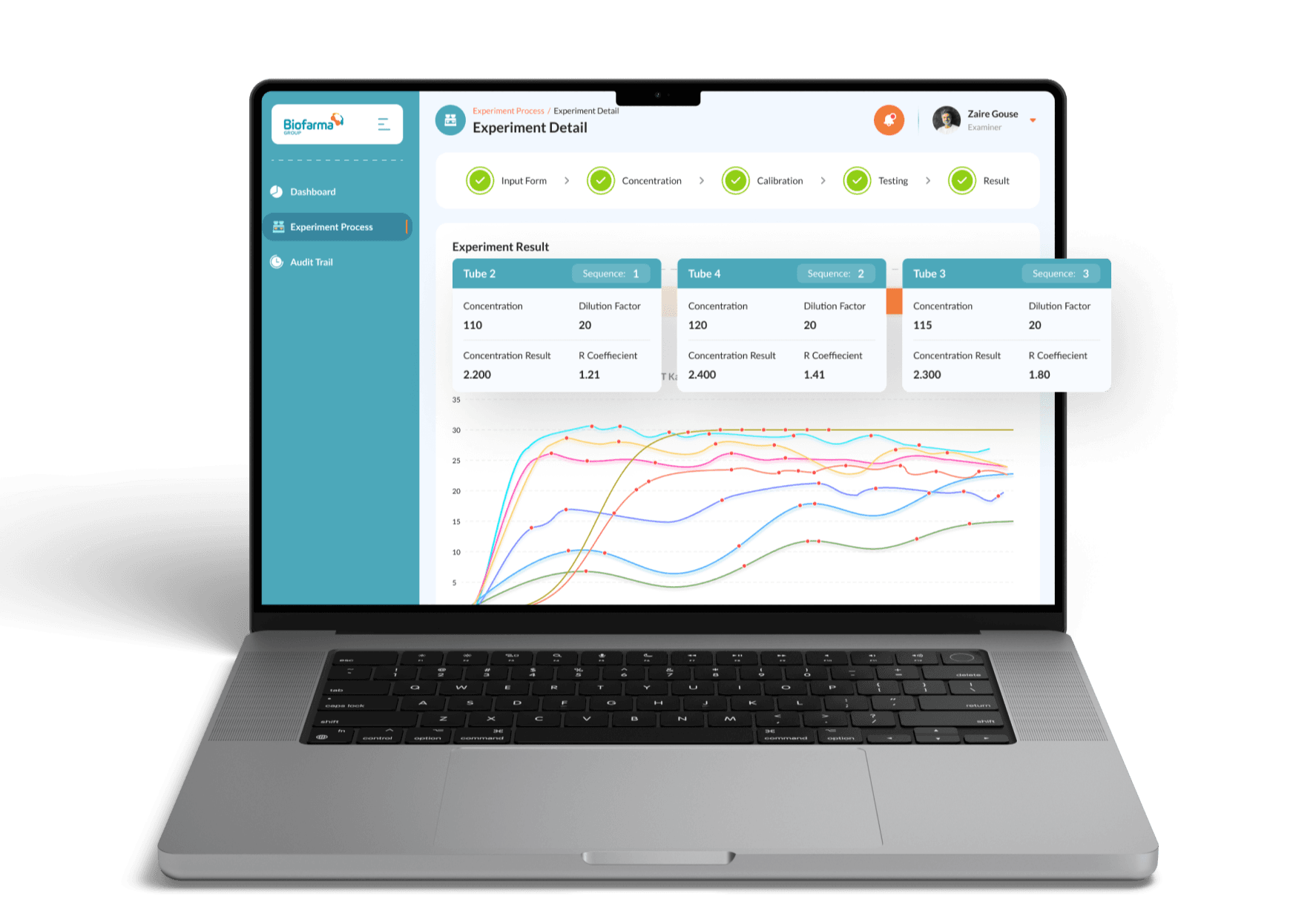
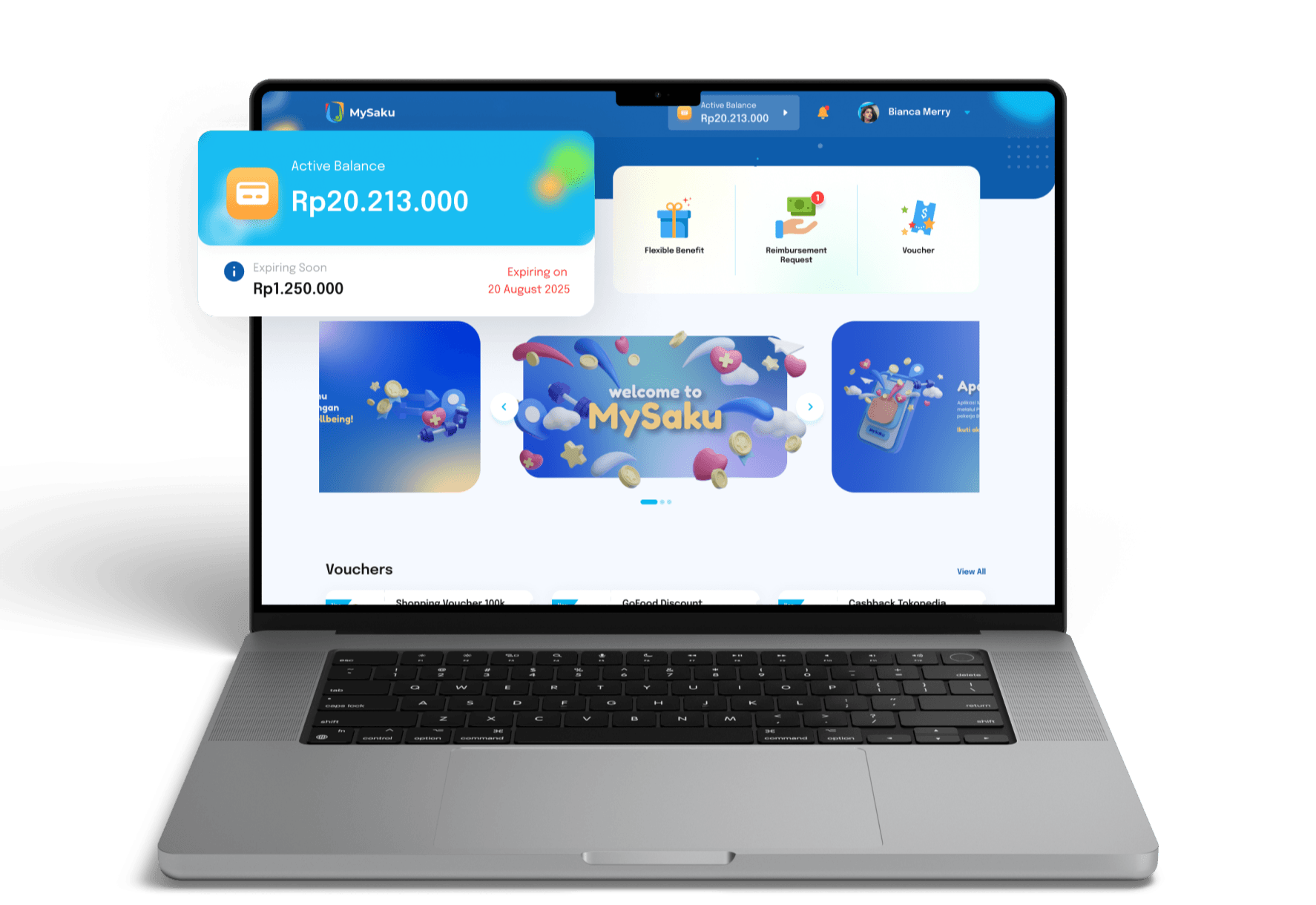
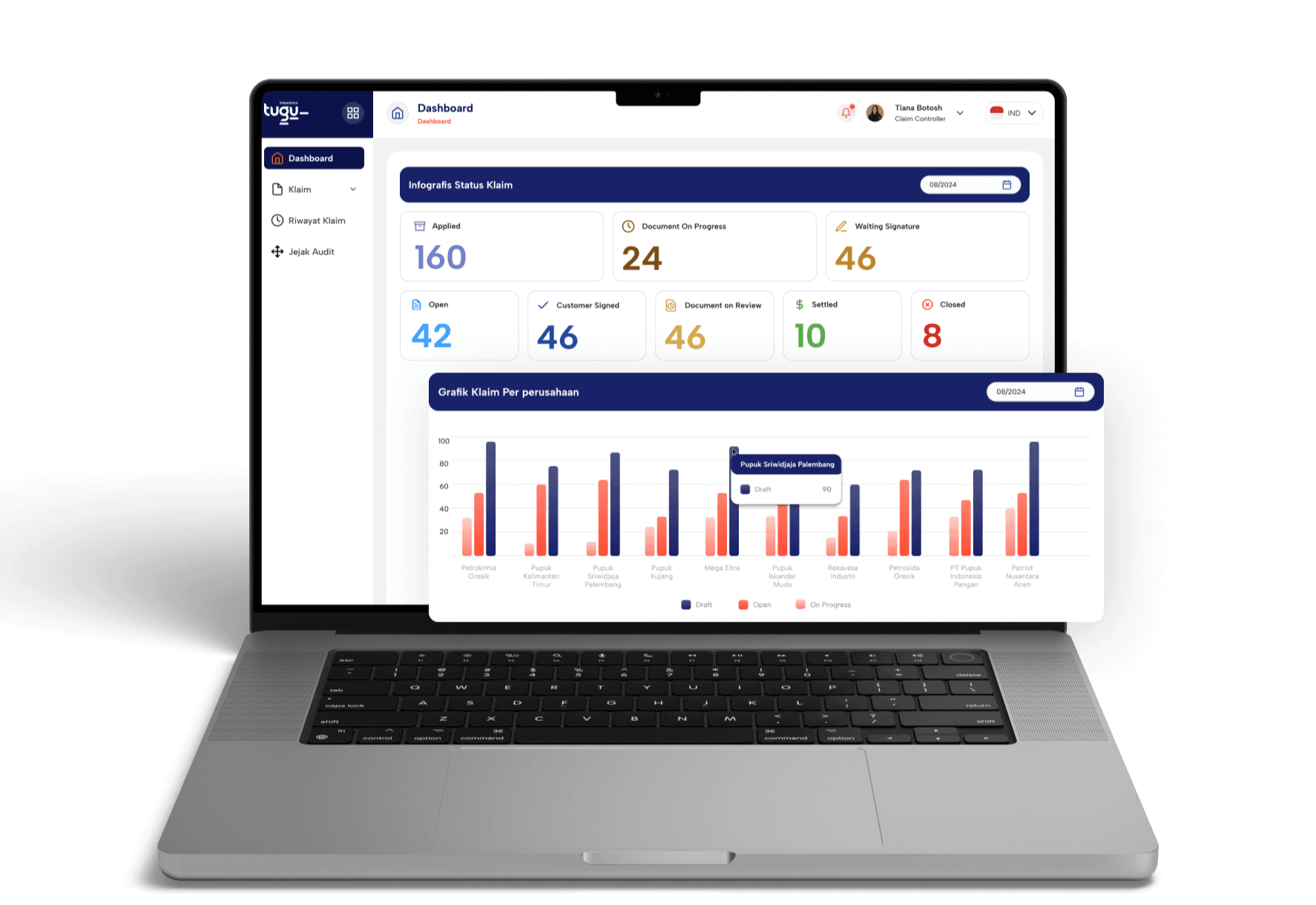
IT ENTERPRISE CONSULTANT
BRIDGE TECHNOLOGY SERVICES (BTS.id)

Is an Information & Communication Technology company by means of to-make-it-possible mindset. Using the most advance and suitable technology, we are able to develop and deploy a new vertical solution faster with the vast range of services for all industries. Established in 2008, we strive to develop and transform bricks-and-mortar business into the modern e-business with greater efficiency and effectiveness. As a software developer and publisher, we offer a solution to increase your company productivity using the latest technology.


AI DEVELOPMENT
AI Development service involves creating intelligent software solutions tailored to solve specific business challenges, optimize operations, or enhance customer experiences.

COMPREHENSIVE IT MANAGE SERVICES
We act as an IT solution for your company. from networking until digitalizing your business prosess.

IT OUTSOURCING SERVICES
BTS.id offres high quality software outsourcing services to client.



0
ADEQUATE
EMPLOYEES


0
CLIENT
WORLD WIDE


0
SUCCESS
PROJECT
WE ARE
BRIDGE TECHNOLOGY SERVICES
Find out how companies are using our solution to step up their game in digital transformation.
Penerapan AI untuk Inspeksi dan Penilaian Kerusakan Kendaraan dalam Klaim Asuransi
Memahami AI Development dalam Industri Asuransi Kendaraan
Perkembangan teknologi digital mendorong perusahaan asuransi kendaraan untuk terus meningkatkan efisiensi dan kualitas layanan di tengah kebutuhan nasabah yang semakin dinamis terutama dibagian proses inspeksi kendaraan.
Custom software yang dipadukan dengan AI akan berperan penting dalam bisnis asuransi kendaraan yang lebih adaptif, efisien dan akurat
Berbeda dengan perangkat lunak konvensional yang bekerja berdasarkan aturan dan instruksi tetap, perangkat lunak berbasis AI mampu mempelajari pola dari data untuk menghasilkan prediksi atau rekomendasi. Dalam industri asuransi kendaraan, teknologi ini dapat membantu mempercepat pengajuan dan pemrosesan klaim, mulai dari memeriksa kelengkapan dokumen, menganalisis foto kerusakan kendaraan.
Agar penerapannya optimal, AI inspeksi kendaraan membutuhkan data berupa foto kendaraan, citra kerusakan, dan informasi kondisi komponen kendaraan. Dengan teknologi computer vision, AI dapat mengidentifikasi dan mengklasifikasikan kerusakan serta mendukung penilaian awal. Integrasi dengan sistem manajemen klaim memungkinkan hasil inspeksi digunakan dalam evaluasi klaim, sehingga mempercepat pemeriksaan, meningkatkan konsistensi penilaian, dan mengurangi ketergantungan pada inspeksi manual tanpa menggantikan verifikasi tenaga ahli.
Tantangan Inspeksi Kendaraan dalam Proses Klaim Asuransi
Inspeksi kendaraan merupakan tahap penting dalam proses klaim asuransi untuk memastikan jenis kerusakan, tingkat keparahan, dan estimasi biaya perbaikan sesuai dengan kondisi kendaraan yang sebenarnya. Namun, proses ini masih menghadapi sejumlah tantangan yang dapat memperlambat penyelesaian klaim dan mempengaruhi akurasi penilaian.
Beberapa tantangan yang sering dihadapi perusahaan asuransi kendaraan meliputi:
- Identifikasi kerusakan kendaraan: Kerusakan tersembunyi atau perbedaan kualitas foto inspeksi dapat menyulitkan petugas dalam mengidentifikasi seluruh bagian kendaraan yang terdampak.
- Ketidakkonsistenan penilaian: Perbedaan pengalaman dan standar penilaian antar inspektor dapat menghasilkan interpretasi tingkat keparahan kerusakan yang berbeda.
- Estimasi biaya perbaikan: Penentuan biaya membutuhkan analisis jenis kerusakan, harga suku cadang, tarif tenaga kerja, dan kebutuhan penggantian komponen agar estimasi lebih akurat.
- Pencatatan dan pengelolaan data: Proses manual dalam mencatat hasil inspeksi, menyimpan foto, dan memperbarui status klaim berisiko menimbulkan kesalahan data, duplikasi, serta keterlambatan pemrosesan.
- Kualitas dan kelengkapan foto inspeksi: Foto yang buram, pencahayaan yang kurang memadai, atau sudut pengambilan yang tidak mencakup seluruh area terdampak dapat membatasi kemampuan sistem dalam mengenali kerusakan. Kondisi ini dapat menyebabkan hasil analisis kurang lengkap dan membutuhkan pengambilan foto ulang.
Melalui custom software, perusahaan dapat membangun sistem inspeksi dan manajemen klaim yang terintegrasi sesuai kebutuhan operasional.
Sementara itu, AI memungkinkan analisis foto kendaraan, klasifikasi kerusakan, dan dukungan estimasi biaya perbaikan secara lebih konsisten. Kombinasi keduanya dapat membantu meningkatkan efisiensi inspeksi, dengan tetap melibatkan tenaga ahli untuk memvalidasi hasil analisis dan keputusan klaim.
Cara Kerja AI dalam Mendeteksi Kerusakan Kendaraan
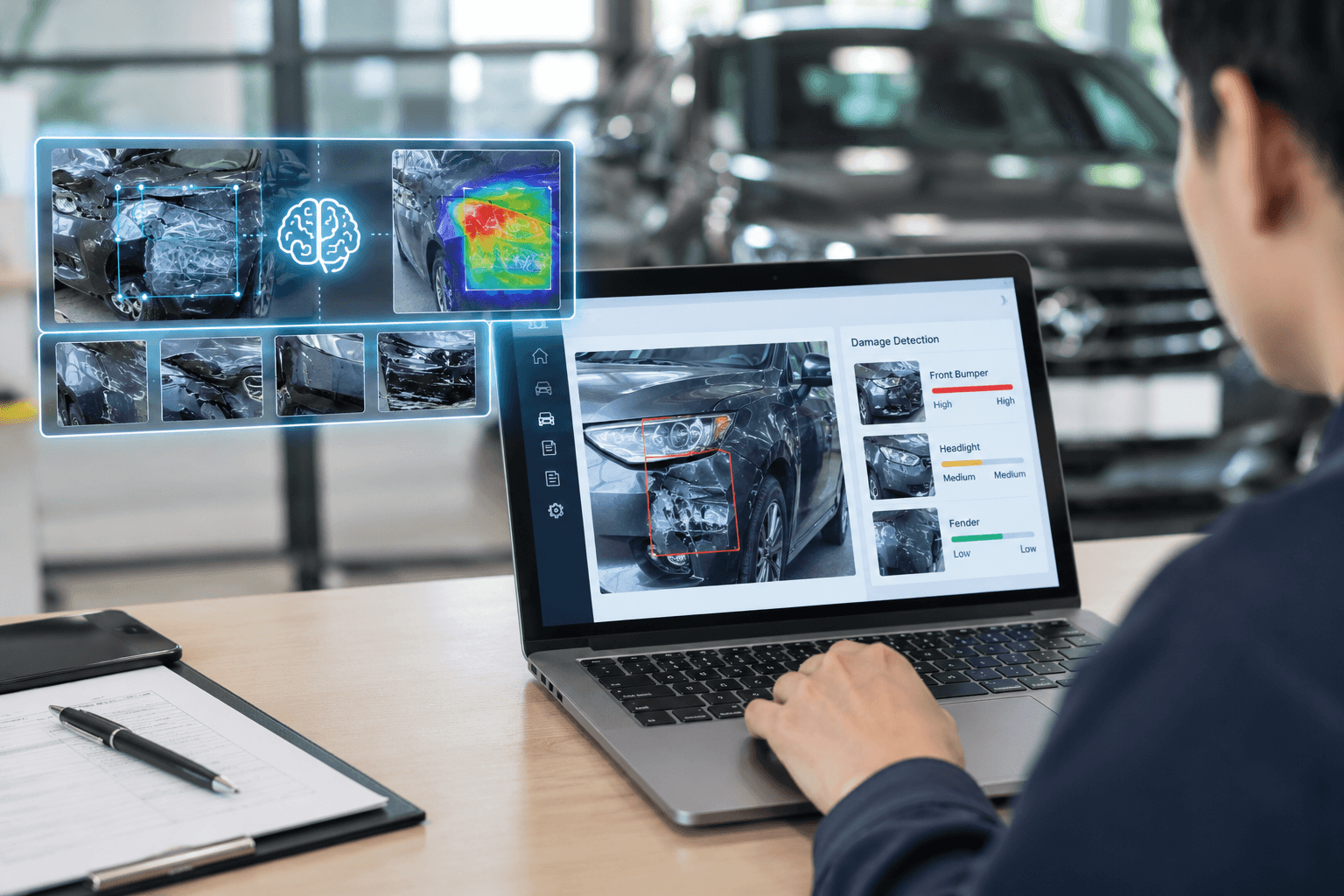
Teknologi AI Inspeksi Kendaraan memanfaatkan computer vision untuk menganalisis foto kendaraan dan mengenali tanda-tanda kerusakan secara otomatis.
Melalui proses AI, sistem dilatih untuk mengidentifikasi lokasi kerusakan, seperti penyok pada body, goresan, retakan pada kaca, atau kerusakan pada bumper, sekaligus mengklasifikasikan jenis kerusakan berdasarkan pola visual yang ditemukan.
Model AI juga dapat memperkirakan tingkat keparahan kerusakan berdasarkan karakteristik visual, seperti ukuran, luas, dan kedalaman kerusakan yang dapat diamati. Kemampuan ini bergantung pada kualitas data pelatihan yang mencakup berbagai jenis kendaraan dan kondisi kerusakan. Data tersebut perlu melalui proses anotasi, yaitu pemberian label pada foto berdasarkan lokasi, jenis, dan tingkat keparahan kerusakan agar model dapat belajar secara terarah.
Sebelum diterapkan, model AI harus diuji menggunakan data yang terpisah dari data pelatihan untuk mengevaluasi akurasi deteksi, ketepatan klasifikasi, dan konsistensi hasilnya. Pengujian juga perlu mencakup variasi pencahayaan, sudut pengambilan gambar, dan kualitas foto.
Meski demikian, AI memiliki keterbatasan dalam mendeteksi kerusakan tersembunyi atau komponen internal yang tidak terlihat dari luar.
Karena itu, pemeriksaan fisik oleh tenaga ahli tetap diperlukan untuk memvalidasi hasil analisis. Dengan dukungan Software House Indonesia yang berpengalaman, perusahaan asuransi dapat mengintegrasikan teknologi ini ke dalam sistem klaim agar proses inspeksi lebih efisien dan terukur.
Fitur Utama Aplikasi Inspeksi Kendaraan Berbasis AI
Aplikasi inspeksi kendaraan berbasis AI dirancang untuk membantu perusahaan asuransi mempercepat pemeriksaan, meningkatkan konsistensi penilaian, dan mengelola data klaim secara terintegrasi.
Aplikasi dapat dilengkapi dengan berbagai fitur utama berikut:
- Formulir Inspeksi Kendaraan Digital: Memudahkan inspector mencatat identitas kendaraan, nomor polis, kondisi kendaraan, serta mengunggah foto kerusakan langsung ke sistem.
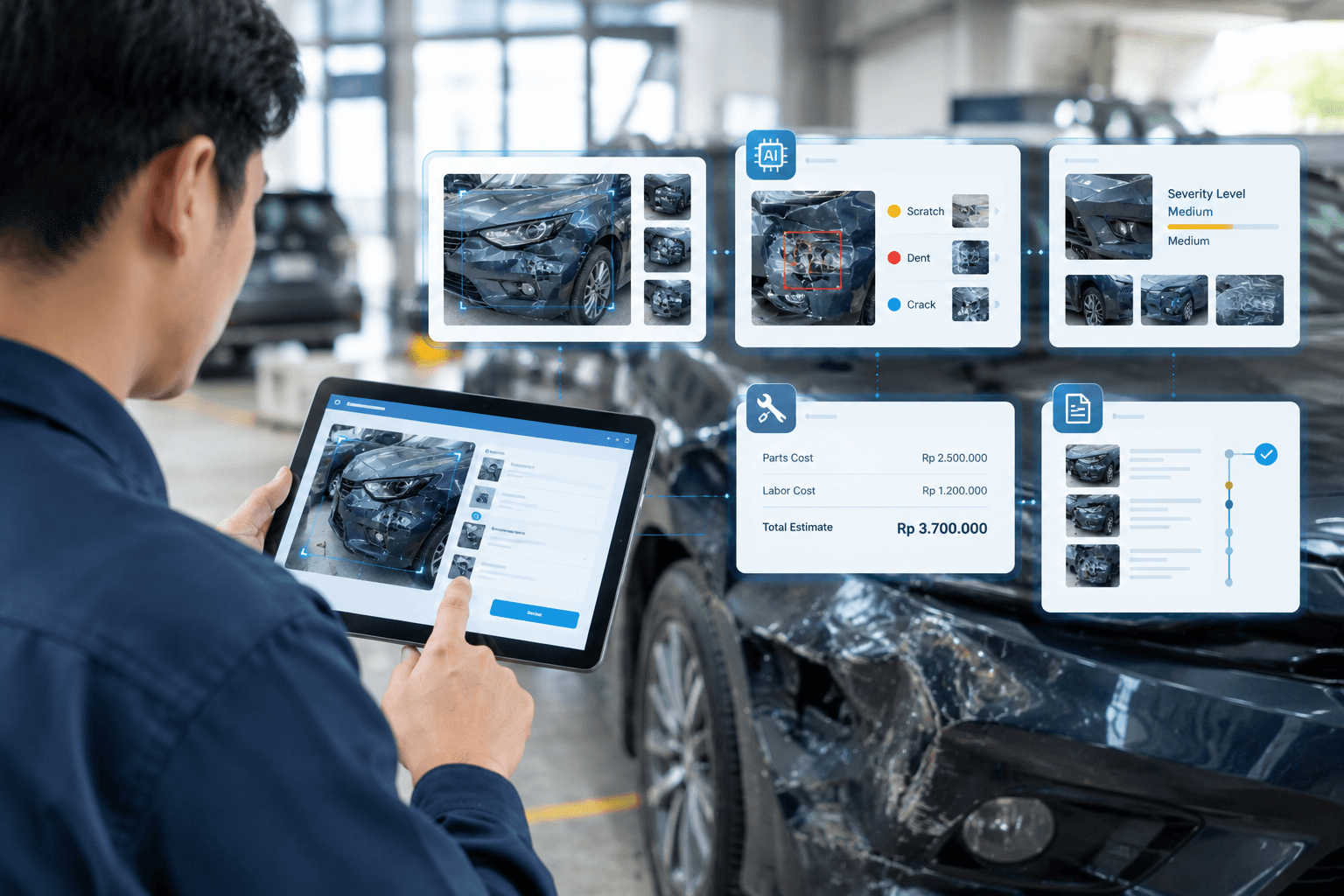
- Deteksi dan Klasifikasi Kerusakan Berbasis AI: Fitur AI Inspeksi Kendaraan menganalisis foto untuk mengenali lokasi dan jenis kerusakan, seperti goresan, penyok, atau retakan.
- Penilaian Tingkat Keparahan Kerusakan: Membantu mengelompokkan kerusakan berdasarkan karakteristik visual agar proses penilaian lebih konsisten, dengan hasil yang tetap perlu divalidasi.
- Estimasi Biaya Perbaikan Kendaraan: Menghasilkan perkiraan biaya berdasarkan jenis kerusakan, harga suku cadang, dan tarif tenaga kerja yang tersedia dalam sistem.
- Laporan Inspeksi Digital dan Riwayat Aktivitas: Menyimpan hasil pemeriksaan, dokumentasi foto, perubahan status, serta catatan aktivitas untuk memudahkan pelacakan dan audit.
Penerapan AI inspeksi kendaraan dapat membantu perusahaan asuransi menekan biaya operasional, mempercepat proses evaluasi klaim, dan meningkatkan produktivitas tim inspeksi. Dengan dukungan Software House Indonesia yang berpengalaman, perusahaan dapat mengoptimalkan manfaat tersebut melalui solusi yang terintegrasi, sehingga proses bisnis menjadi lebih efisien dan kualitas layanan kepada nasabah meningkat.
Manfaat Bisnis dan Metrik Keberhasilan Penerapan AI
Penerapan AI dalam inspeksi kendaraan memberikan manfaat bisnis bagi perusahaan asuransi, terutama dalam mempercepat proses klaim, meningkatkan konsistensi penilaian, dan mengoptimalkan efisiensi operasional.
Untuk memastikan penerapannya memberikan hasil nyata, perusahaan perlu mengukur manfaat tersebut melalui sejumlah indikator kinerja atau Key Performance Indicators (KPI).
Beberapa manfaat dan metrik keberhasilan yang dapat digunakan meliputi:
- Mempercepat waktu penyelesaian inspeksi kendaraan: AI membantu menganalisis foto dan mengidentifikasi kerusakan secara otomatis. Keberhasilannya dapat diukur melalui rata-rata waktu inspeksi sebelum dan sesudah penerapan AI.
- Meningkatkan konsistensi penilaian kerusakan: Analisis berbasis model AI membantu mengurangi perbedaan penilaian antar inspektor. Metriknya mencakup tingkat kesesuaian hasil AI dengan penilaian ahli serta konsistensi klasifikasi kerusakan.
- Menyederhanakan pekerjaan administratif: Otomatisasi pencatatan, pembuatan laporan, dan pembaruan status klaim dapat mengurangi pekerjaan manual. Efisiensinya diukur melalui waktu administrasi per klaim dan jumlah kesalahan pencatatan.
- Meningkatkan kemudahan penelusuran data inspeksi: Penyimpanan laporan, foto, dan riwayat aktivitas dalam sistem terpusat memudahkan pencarian informasi untuk evaluasi maupun audit.
Indikatornya meliputi waktu pencarian data dan kelengkapan dokumentasi inspeksi. - Mengukur kinerja model AI dan efisiensi operasional: Perusahaan perlu memantau akurasi deteksi, precision, recall, serta tingkat kesalahan klasifikasi untuk mengevaluasi kualitas model. Dari sisi bisnis, biaya pemrosesan per klaim, produktivitas inspector, dan tingkat klaim yang memerlukan pemeriksaan ulang dapat digunakan untuk mengukur efisiensi.
Pengukuran KPI secara berkala membantu perusahaan mengetahui apakah penerapan AI benar-benar meningkatkan kinerja inspeksi dan memberikan nilai bisnis.
Hasil evaluasi tersebut juga menjadi dasar untuk menyempurnakan model AI, memperbaiki alur kerja, dan menentukan pengembangan sistem selanjutnya.

Hal yang Perlu Dipertimbangkan dalam Implementasi AI untuk Inspeksi Kendaraan
Implementasi AI untuk inspeksi kendaraan membutuhkan data foto, riwayat klaim, dan hasil pemeriksaan yang berkualitas agar sistem mampu mengenali berbagai jenis kerusakan secara akurat.
Dalam proses AI Development, model perlu diuji dan dievaluasi secara berkala untuk memastikan kinerjanya tetap optimal seiring bertambahnya data dan perubahan kebutuhan bisnis.
Integrasi dengan sistem polis dan manajemen klaim juga penting agar data dapat mengalir secara efisien tanpa duplikasi.
Selain itu, perusahaan perlu menerapkan perlindungan data, pengaturan hak akses, dan tata kelola informasi yang baik. Hasil analisis AI tetap harus diawasi inspector, terutama untuk kasus dengan foto yang kurang jelas atau kerusakan yang membutuhkan pemeriksaan fisik.
Melalui Custom Software Development, aplikasi dapat disesuaikan dengan alur kerja dan kebutuhan perusahaan asuransi. Karena itu, memilih Software House Indonesia yang berpengalaman dapat membantu perusahaan membangun sistem AI Inspeksi Kendaraan yang terintegrasi, aman, dan mudah dikembangkan.
Mewujudkan Implementasi AI yang Sesuai dengan Kebutuhan Bisnis
Implementasi AI Development yang efektif perlu disesuaikan dengan kebutuhan dan alur kerja klaim asuransi, mulai dari pengajuan hingga validasi hasil inspeksi.
Melalui Custom Software Development, perusahaan dapat membangun fitur AI Inspeksi Kendaraan untuk mendeteksi kerusakan, membantu estimasi biaya perbaikan, dan menyusun laporan digital. Integrasi dengan sistem klaim serta data bisnis yang sudah digunakan juga penting agar proses operasional berjalan lebih efisien dan terhubung.
Agar dapat digunakan dalam jangka panjang, solusi AI perlu dirancang dengan memperhatikan keamanan data, skalabilitas, dan pemeliharaan berkelanjutan.
Karena itu, memilih Software House yang memahami kebutuhan bisnis dan memiliki pengalaman dalam integrasi sistem menjadi langkah penting untuk mewujudkan solusi AI yang relevan, andal, dan mampu mendukung perkembangan perusahaan asuransi.
Ingin membangun aplikasi inspeksi kendaraan berbasis AI yang sesuai dengan kebutuhan perusahaan asuransi Anda?
Kami BTS.id salah satu software house bandung terkemuka, siap membantu melalui Custom Software
Development dan AI Development, mulai dari pengembangan fitur deteksi kerusakan, estimasi biaya perbaikan, hingga integrasi dengan sistem klaim yang sudah digunakan.
Konsultasikan kebutuhan bisnis Anda bersama BTS.id untuk merancang solusi digital yang tepat, terukur, dan siap mendukung efisiensi operasional perusahaan.

AI Chatbot Custom vs Platform Siap Pakai: Mana yang Sesuai untuk Bisnis Enterprise?
Mengapa Bisnis Enterprise Perlu Memilih AI Chatbot dengan Tepat?
AI chatbot dapat membantu bisnis enterprise meningkatkan efisiensi pelayanan, mempercepat respons, dan menangani kebutuhan pelanggan dalam skala besar. Namun, pemilihannya perlu disesuaikan dengan kompleksitas bisnis, keamanan data, integrasi sistem, dan kebutuhan pengembangan jangka panjang.
Untuk memenuhi kebutuhan tersebut, perusahaan dapat memilih antara AI chatbot custom yang dikembangkan sesuai kebutuhan bisnis atau platform siap pakai yang menawarkan implementasi lebih cepat.
Platform siap pakai lebih cepat diterapkan, sedangkan chatbot custom dapat disesuaikan dengan proses dan sistem perusahaan. Chatbot untuk enterprise juga idealnya mampu terintegrasi dengan CRM, ERP, knowledge base, dan kanal layanan lainnya.
Dalam penerapannya, chatbot menjadi bagian dari Solusi AI untuk perusahaan besar yang mendukung Otomatisasi layanan pelanggan sekaligus Transformasi digital. Karena itu, penerapannya perlu menjadi bagian dari Strategi AI perusahaan agar teknologi yang digunakan benar-benar mendukung tujuan bisnis dan dapat dikembangkan sesuai kebutuhan di masa depan.
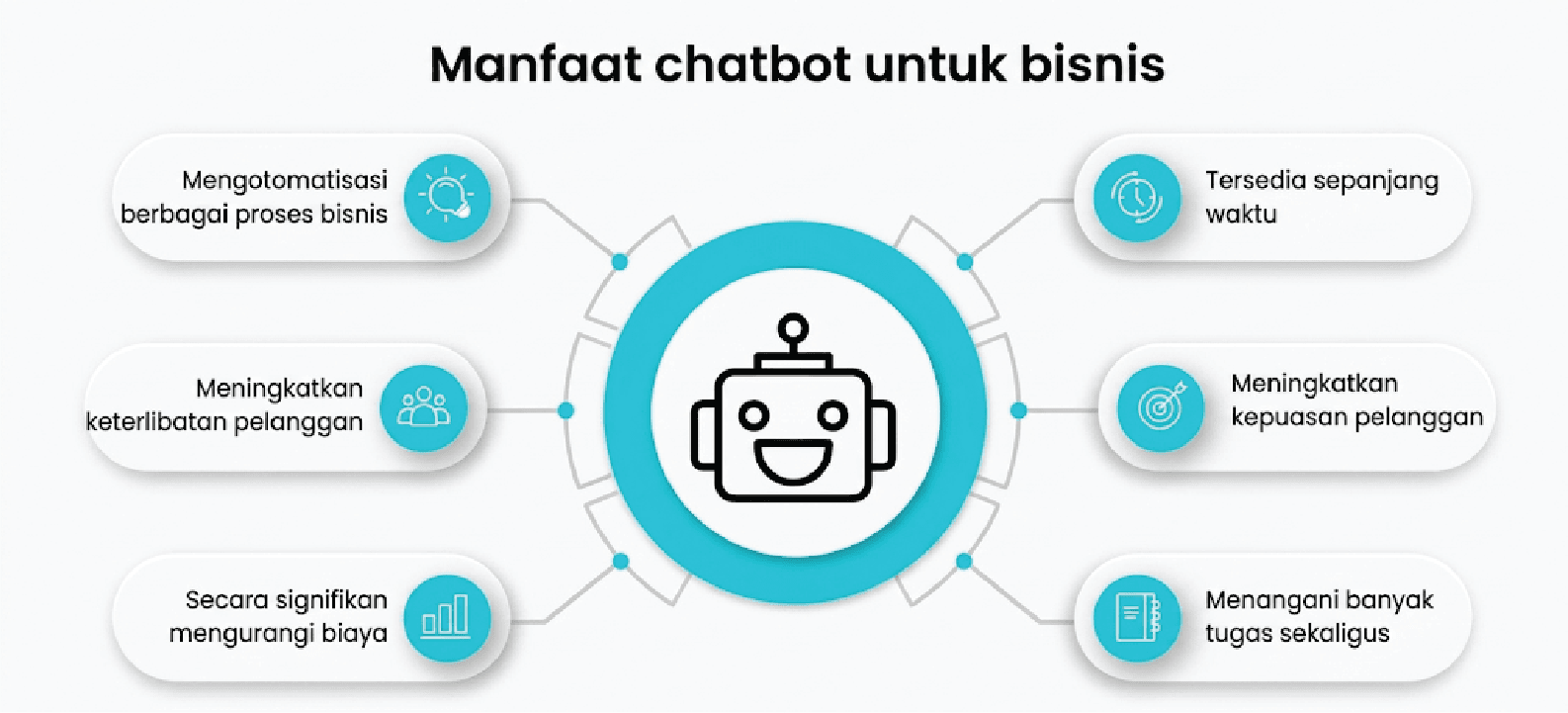
Memahami AI Chatbot untuk Enterprise
AI chatbot untuk enterprise adalah solusi berbasis kecerdasan buatan yang dirancang untuk membantu perusahaan menangani komunikasi, layanan pelanggan, pencarian informasi, hingga proses bisnis secara otomatis. Berbeda dari chatbot sederhana, solusi enterprise perlu mampu menangani skala penggunaan besar, keamanan data, integrasi sistem, dan kebutuhan bisnis yang kompleks.
Secara umum, cara kerja AI chatbot melibatkan pemrosesan pertanyaan pengguna, pemahaman konteks, pencarian informasi yang relevan, kemudian menghasilkan respons yang sesuai. Dalam proses tersebut, knowledge base pada AI chatbot berperan sebagai sumber informasi agar jawaban yang diberikan tetap relevan dan sesuai dengan pengetahuan perusahaan.
Dalam bisnis, AI chatbot dapat berperan dalam customer service, sales, internal support, maupun akses informasi bagi karyawan. Integrasi AI chatbot dengan sistem bisnis seperti CRM, ERP, database, dan aplikasi internal memungkinkan chatbot tidak hanya memberikan jawaban, tetapi juga membantu menjalankan proses tertentu.
Beberapa hal yang perlu diperhatikan dalam penerapan AI chatbot meliputi keamanan dan privasi data, akurasi informasi, kualitas knowledge base, integrasi sistem, kemampuan eskalasi ke human agent, serta monitoring performa. Berdasarkan kebutuhan, jenis AI chatbot untuk kebutuhan enterprise dapat berupa chatbot FAQ, customer service chatbot, internal assistant, hingga chatbot berbasis generative AI yang mampu memahami konteks percakapan secara lebih fleksibel.
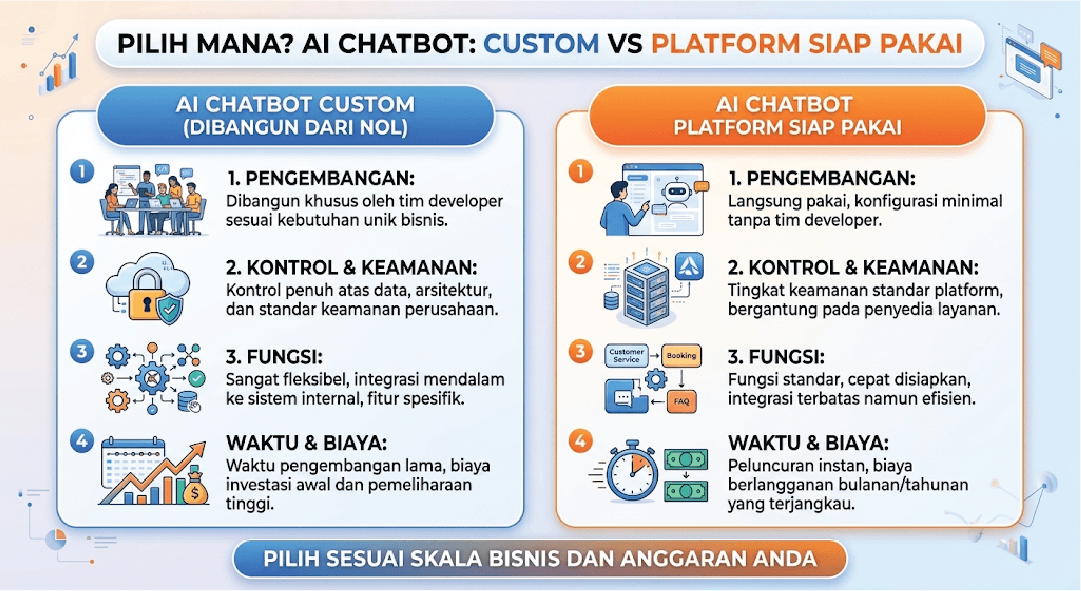
AI Chatbot Custom vs Platform Siap Pakai
Dalam memilih AI Chatbot Custom vs Platform Siap Pakai, perusahaan enterprise perlu mempertimbangkan kebutuhan bisnis, kompleksitas sistem, keamanan, hingga biaya jangka panjang.
Perbandingan keduanya dapat dilihat dari beberapa aspek berikut:
No | Aspek Perbandingan | AI Chatbot Custom | Platform Siap Pakai |
1 | Fleksibilitas Fitur dan Kebutuhan Bisnis | Dapat dirancang sesuai proses, kebutuhan, dan karakteristik bisnis perusahaan. | Menggunakan fitur yang tersedia sehingga lebih cepat digunakan, tetapi pilihan kustomisasinya lebih terbatas. |
2 | Kustomisasi AI dan Knowledge Base | Memungkinkan penyesuaian AI, knowledge base, alur percakapan, dan respons sesuai kebutuhan perusahaan. | Kustomisasi knowledge base dan kemampuan AI bergantung pada fitur yang disediakan platform. |
3 | Integrasi dengan Sistem Internal | Lebih fleksibel untuk diintegrasikan dengan CRM, ERP, database, dan aplikasi internal perusahaan. | Integrasi tersedia melalui konektor atau API yang didukung platform. |
4 | Kontrol Data dan Keamanan | Memberikan kontrol lebih besar terhadap pengelolaan data, akses, dan penerapan standar keamanan perusahaan. | Pengelolaan data dan keamanan mengikuti arsitektur serta kebijakan penyedia platform. |
5 | Skalabilitas Solusi | Dapat dikembangkan mengikuti pertumbuhan pengguna, volume data, dan kebutuhan bisnis. | Skalabilitas bergantung pada kapasitas, paket, dan kemampuan platform yang digunakan. |
6 | Waktu dan Kompleksitas Implementasi | Membutuhkan analisis, pengembangan, integrasi, dan pengujian sehingga waktu implementasi relatif lebih panjang. | Lebih cepat diterapkan karena fitur utama sudah tersedia dan umumnya hanya membutuhkan konfigurasi. |
7 | Biaya dan Maintenance | Membutuhkan investasi awal dan biaya maintenance yang lebih besar, tetapi pengembangan dapat disesuaikan dengan kebutuhan perusahaan | Umumnya menggunakan biaya berlangganan atau berdasarkan penggunaan, dengan maintenance platform ditangani penyedia. |
Pada akhirnya, tidak ada satu pilihan yang paling tepat untuk semua perusahaan. AI chatbot custom lebih sesuai bagi enterprise dengan kebutuhan kompleks dan memerlukan kontrol serta fleksibilitas tinggi, sedangkan platform siap pakai dapat menjadi pilihan ketika perusahaan mengutamakan implementasi yang cepat dan praktis. Keputusan sebaiknya disesuaikan dengan kebutuhan bisnis, kesiapan teknologi, dan strategi pengembangan AI perusahaan dalam jangka panjang.
Integrasi dengan Ekosistem Teknologi Enterprise
Integrasi menjadi bagian penting dalam penerapan AI Chatbot di lingkungan enterprise karena chatbot perlu terhubung dengan berbagai sistem dan sumber data perusahaan. Chatbot custom memungkinkan integrasi dirancang sesuai arsitektur teknologi perusahaan, termasuk mekanisme pertukaran data, alur kerja, dan kontrol akses antar sistem
Beberapa bentuk integrasi yang umum diterapkan meliputi:
- CRM, ERP, dan Ticketing System: Chatbot dapat mengambil data pelanggan, informasi transaksi, maupun membuat dan memperbarui tiket layanan secara otomatis.
- Core Banking dan HRIS: Pada sektor perbankan maupun internal perusahaan, chatbot dapat terhubung dengan sistem transaksi atau data karyawan sesuai hak akses yang ditetapkan.
- API Enterprise dan Middleware: API menjadi penghubung antara chatbot dengan berbagai aplikasi, sedangkan middleware membantu mengatur komunikasi dan pertukaran data antar sistem.
- Integrasi Omnichannel: Satu layanan chatbot dapat dihadirkan melalui WhatsApp, web chat, mobile app, dan email sehingga pengalaman pengguna tetap konsisten di berbagai kanal.
- Arsitektur Microservices: Chatbot dapat ditempatkan sebagai layanan yang terintegrasi dengan microservices lain sehingga pengembangan dan skalabilitas sistem lebih fleksibel.
- Legacy Systems Integration: Sistem lama tetap dapat dimanfaatkan melalui API, middleware, atau integration layer tanpa harus mengganti seluruh infrastruktur yang sudah berjalan.
Integrasi yang dirancang dengan baik membuat Solusi AI Enterprise tidak berdiri sendiri, tetapi menjadi bagian dari ekosistem teknologi perusahaan. Untuk kebutuhan integrasi yang kompleks, Software House Indonesia dapat membantu merancang arsitektur, pengembangan, hingga implementasi solusi secara menyeluruh, termasuk dukungan dari Software House Bandung untuk pengembangan dan integrasi sistem enterprise.
Pengalaman Pengguna (CX) dan Kualitas Percakapan
Kualitas percakapan menjadi faktor penting dalam keberhasilan chatbot enterprise karena pengguna mengharapkan pelayanan yang cepat, akurat, dan terasa natural. Penerapan Natural language processing (NLP) dalam bahasa Indonesia membantu chatbot memahami bahasa sehari-hari, konteks pertanyaan, serta variasi cara pengguna menyampaikan kebutuhan.
Beberapa aspek yang perlu diperhatikan meliputi:
- Personalisasi percakapan: Respons dapat disesuaikan berdasarkan profil, riwayat interaksi, maupun kebutuhan pengguna.
- Conversational AI: Memungkinkan chatbot memahami konteks dan merespons percakapan secara lebih fleksibel.
- Dialog yang natural: Alur komunikasi dirancang agar tidak terasa kaku atau seperti sekadar mengikuti menu otomatis.
- Tingkat akurasi jawaban chatbot: Perlu dijaga melalui knowledge base yang berkualitas, data yang relevan, serta evaluasi dan monitoring secara berkala.
- Pengelolaan intent dan entity: Chatbot perlu mengenali tujuan pengguna serta informasi penting dalam pertanyaan agar dapat memberikan respons yang tepat.
- Fallback ke agen manusia: Jika chatbot tidak memahami permintaan atau menghadapi kasus kompleks, percakapan dapat dialihkan kepada agen.
- Hybrid chatbot (AI + live agent): Menggabungkan otomatisasi AI dengan dukungan manusia sehingga kebutuhan sederhana dapat ditangani otomatis, sementara kasus yang membutuhkan penilaian lebih lanjut tetap ditangani oleh agen.
Dengan pendekatan tersebut, chatbot tidak hanya berfungsi sebagai alat otomatisasi, tetapi juga dapat meningkatkan Customer Experience (CX) melalui interaksi yang lebih cepat, relevan, dan konsisten.
Kapan Bisnis Enterprise Membutuhkan AI Chatbot Custom?
AI chatbot custom mulai dibutuhkan ketika perusahaan memiliki proses bisnis yang kompleks dan tidak dapat sepenuhnya ditangani oleh fitur chatbot standar. Solusi yang dikembangkan secara khusus dapat menyesuaikan alur kerja, aturan bisnis, serta kebutuhan layanan yang berbeda di setiap perusahaan.
Kebutuhan ini juga muncul ketika chatbot harus terhubung dengan berbagai sistem internal, seperti CRM, ERP, database, atau aplikasi perusahaan lainnya. Selain integrasi, perusahaan dapat membutuhkan fitur dan alur percakapan khusus yang tidak tersedia pada platform siap pakai.
Dari sisi pengelolaan informasi, solusi custom memberikan kontrol lebih besar terhadap data dan knowledge yang digunakan chatbot. Hal ini penting bagi perusahaan yang memiliki kebutuhan security dan compliance tertentu, terutama ketika chatbot menangani data pelanggan, karyawan, transaksi, atau informasi bisnis yang bersifat sensitif.
AI chatbot custom juga tepat bagi perusahaan yang memiliki rencana pengembangan AI dalam jangka panjang. Solusi dapat dikembangkan secara bertahap mengikuti perubahan proses bisnis, kebutuhan pengguna, integrasi teknologi baru, serta target transformasi digital perusahaan.
Kapan Platform AI Chatbot Siap Pakai Lebih Relevan?
Platform AI chatbot siap pakai lebih relevan bagi perusahaan yang membutuhkan solusi chatbot dengan cepat tanpa melalui proses pengembangan yang kompleks. Pilihan ini cocok untuk kebutuhan layanan yang relatif sederhana, seperti menjawab pertanyaan umum, memberikan informasi produk, atau membantu pelanggan melalui proses dasar.
Platform siap pakai juga dapat menjadi pilihan bagi perusahaan yang ingin memulai AI dalam skala kecil sebelum mengembangkannya lebih luas. Jika chatbot tidak membutuhkan banyak integrasi dengan sistem internal, implementasinya dapat dilakukan lebih sederhana dan cepat.
Pilihan ini semakin sesuai ketika perusahaan memiliki resource pengembangan terbatas dan tidak ingin membangun serta memelihara sistem dari awal. Fitur yang sudah tersedia membuat proses konfigurasi dan penggunaan lebih mudah, sehingga perusahaan dapat mengadopsi teknologi AI dengan investasi waktu dan sumber daya yang relatif lebih ringan.
Bagaimana Menentukan Pendekatan yang Tepat?
Memilih pendekatan AI chatbot untuk enterprise perlu dilakukan berdasarkan kebutuhan nyata perusahaan, bukan hanya fitur teknologi.
Beberapa langkah berikut dapat membantu menentukan solusi yang paling sesuai:
- Menentukan Tujuan dan Use Case
Tentukan masalah yang ingin diselesaikan, seperti otomatisasi customer service, internal support, atau akses informasi. - Memahami Kebutuhan Bisnis dan Pengguna
Identifikasi proses bisnis, karakteristik pengguna, serta jenis layanan yang membutuhkan dukungan chatbot. - Menilai Kesiapan Teknologi dan Data
Periksa kesiapan infrastruktur, sistem yang akan diintegrasikan, kualitas data, serta knowledge base yang tersedia. - Menyesuaikan Sumber Daya yang Tersedia
Pertimbangkan kemampuan tim, anggaran, waktu implementasi, serta resource untuk maintenance dan pengembangan. - Mempertimbangkan Kebutuhan Jangka Panjang
Pastikan solusi dapat dikembangkan mengikuti pertumbuhan bisnis, kebutuhan integrasi, dan strategi AI perusahaan. - Menentukan Prioritas Implementasi
Mulai dari use case yang memiliki dampak bisnis paling jelas dan dapat memberikan manfaat dalam waktu relatif cepat. - Menetapkan Kriteria Pemilihan Solusi
Tentukan kriteria seperti fleksibilitas, keamanan, integrasi, skalabilitas, kemudahan penggunaan, biaya, dan dukungan teknis sebelum memilih solusi.
Dengan pendekatan tersebut, perusahaan dapat menentukan apakah membutuhkan solusi custom atau platform siap pakai berdasarkan kebutuhan, kesiapan, dan tujuan bisnis secara lebih objektif.
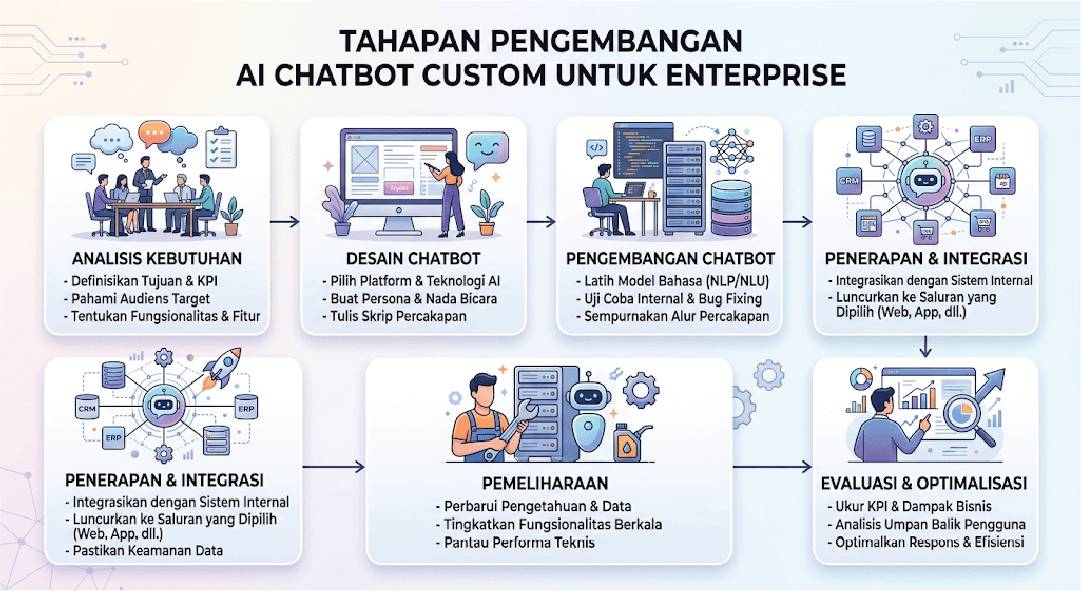
Tahapan Pengembangan AI Chatbot Custom untuk Enterprise
Pengembangan AI chatbot custom untuk enterprise perlu dilakukan secara terstruktur agar solusi yang dihasilkan sesuai kebutuhan bisnis, aman, akurat, dan siap digunakan dalam skala besar.
Tahapannya meliputi:
- Analisis Kebutuhan dan Use Case
Identifikasi tujuan bisnis, kebutuhan pengguna, proses yang ingin diotomatisasi, serta use case prioritas yang akan ditangani chatbot. - Perancangan Arsitektur Chatbot
Rancang arsitektur yang mencakup komponen AI, knowledge base, database, API, keamanan, serta alur komunikasi dengan sistem lainnya. - Pemilihan Model AI dan Teknologi Pendukung
Pilih model AI, NLP, framework, database, serta teknologi pendukung berdasarkan kebutuhan, kompleksitas, keamanan, dan skala penggunaan. - Integrasi dengan API dan Sistem Internal
Hubungkan chatbot dengan CRM, ERP, database, aplikasi internal, maupun sistem lainnya agar dapat mengakses dan memproses informasi yang dibutuhkan. - Pengelolaan Knowledge dan Data
Siapkan, strukturkan, dan kelola data serta knowledge base agar chatbot memiliki sumber informasi yang relevan, akurat, dan mudah diperbarui. - Testing Performa, Keamanan, dan Akurasi
Lakukan pengujian terhadap kualitas jawaban, kemampuan memahami intent, performa sistem, keamanan data, serta stabilitas chatbot dalam berbagai skenario. - Deployment, Monitoring, dan Maintenance
Setelah siap digunakan, chatbot di-deploy ke lingkungan produksi dan dipantau secara berkala.
Maintenance dilakukan untuk memperbaiki performa, memperbarui knowledge, serta menyesuaikan solusi dengan kebutuhan bisnis yang berkembang.
Dengan tahapan yang terencana, pengembangan chatbot tidak berhenti pada pembuatan fitur percakapan saja, tetapi menghasilkan solusi yang dapat terintegrasi dengan ekosistem teknologi enterprise. Pendekatan ini membantu perusahaan membangun chatbot yang lebih akurat, aman, scalable, dan mampu memberikan manfaat bisnis dalam jangka panjang.
Memilih Partner untuk Pengembangan AI Chatbot Enterprise
Memilih partner untuk pengembangan AI chatbot enterprise perlu mempertimbangkan kemampuan teknis sekaligus pemahaman terhadap kebutuhan bisnis. Partner yang tepat tidak hanya membangun chatbot, tetapi mampu memahami use case, proses bisnis, serta tujuan perusahaan agar solusi yang dikembangkan benar-benar memberikan dampak.
Beberapa kemampuan penting yang perlu dimiliki partner meliputi:
- Memahami Kebutuhan dan Use Case Bisnis
Mengidentifikasi kebutuhan, masalah, serta use case prioritas agar chatbot dikembangkan berdasarkan tujuan bisnis yang jelas. - Merancang Solusi Sesuai Kebutuhan Enterprise
Menyusun arsitektur, fitur, dan teknologi yang sesuai dengan skala, kompleksitas, serta kebutuhan perusahaan. - Mengintegrasikan Chatbot dengan Sistem Internal
Memastikan chatbot dapat terhubung dengan CRM, ERP, database, API, dan sistem internal lainnya secara aman dan optimal. - Menjaga Security dan Kualitas Chatbot
Menerapkan keamanan data sekaligus melakukan testing untuk memastikan akurasi, performa, dan keandalan chatbot. - Menyiapkan Arsitektur yang Scalable
Membangun fondasi teknologi yang dapat mengikuti pertumbuhan pengguna, data, serta kebutuhan bisnis di masa depan. - Mendukung Maintenance dan Pengembangan AI
Memberikan dukungan setelah implementasi, termasuk monitoring, maintenance, peningkatan knowledge, dan pengembangan fitur AI secara berkelanjutan.
Bekerja sama dengan software house dapat menjadi pilihan bagi perusahaan yang membutuhkan partner teknologi dengan kemampuan pengembangan dan integrasi sistem enterprise.
Sebelum memilih partner, perusahaan sebaiknya menilai pengalaman, kemampuan teknis, pendekatan pengembangan, serta dukungan jangka panjang yang ditawarkan.
Jika perusahaan sedang mencari Software House Bandung untuk membangun solusi AI chatbot enterprise yang sesuai kebutuhan, konsultasikan kebutuhan AI chatbot enterprise bersama kami BTS.id.
BTS.id siap membantu mulai dari analisis kebutuhan, perancangan solusi, pengembangan, integrasi, hingga maintenance dan pengembangan AI secara berkelanjutan.
Ingin mengetahui pendekatan AI chatbot yang paling sesuai untuk kebutuhan enterprise? Konsultasikan rencana dan kebutuhan bisnis Anda bersama kami BTS.id untuk menemukan solusi yang tepat, terukur, dan siap dikembangkan seiring pertumbuhan perusahaan.
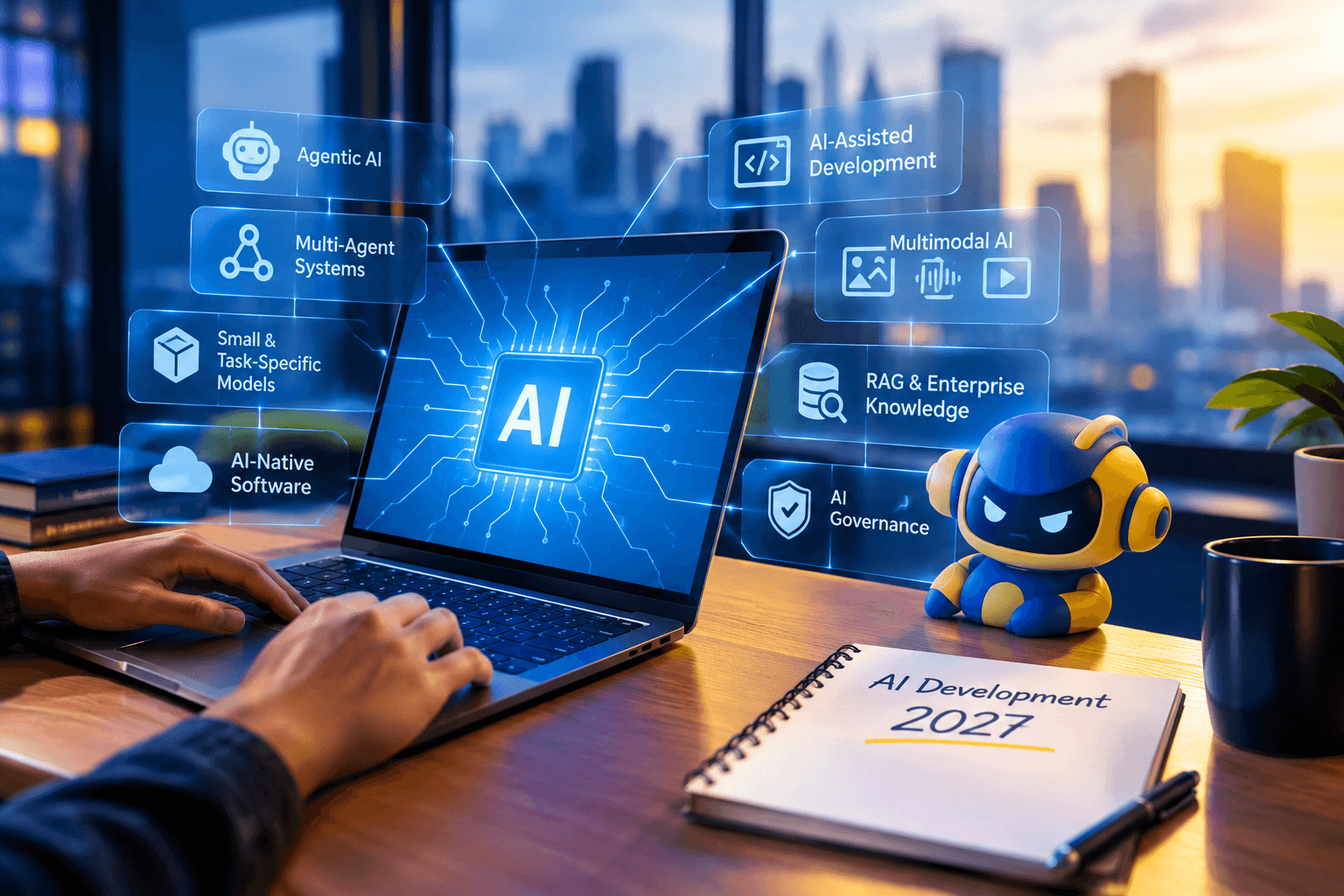
Tren AI Development 2027 yang Akan Membentuk Software Enterprise
Apa yang Dimaksud dengan AI Development untuk Enterprise?
AI Development merupakan proses merancang, membangun, mengintegrasikan, dan mengembangkan aplikasi atau sistem berbasis kecerdasan buatan (AI) untuk menjalankan fungsi tertentu secara lebih otomatis, cerdas, dan adaptif.
Dalam konteks transformasi digital enterprise, AI Development berperan dalam membantu perusahaan mengoptimalkan proses bisnis, mengolah data dalam jumlah besar, hingga mendukung pengambilan keputusan.
Kebutuhan software enterprise juga semakin berkembang sehingga perusahaan membutuhkan sistem yang tidak hanya mampu menjalankan fungsi dasar, tetapi dapat beradaptasi terhadap perubahan kebutuhan bisnis
dan perilaku pengguna.
AI dapat diterapkan dalam pengembangan software enterprise melalui berbagai fungsi, seperti otomatisasi proses, analisis data, prediksi, personalisasi layanan, hingga integrasi dengan sistem yang sudah digunakan perusahaan.
Agar dapat memberikan manfaat secara berkelanjutan, solusi AI yang dikembangkan perlu memiliki kemampuan scalable, sehingga dapat mengikuti pertumbuhan volume data dan kebutuhan pengguna, sekaligus terintegrasi dengan ekosistem teknologi perusahaan.
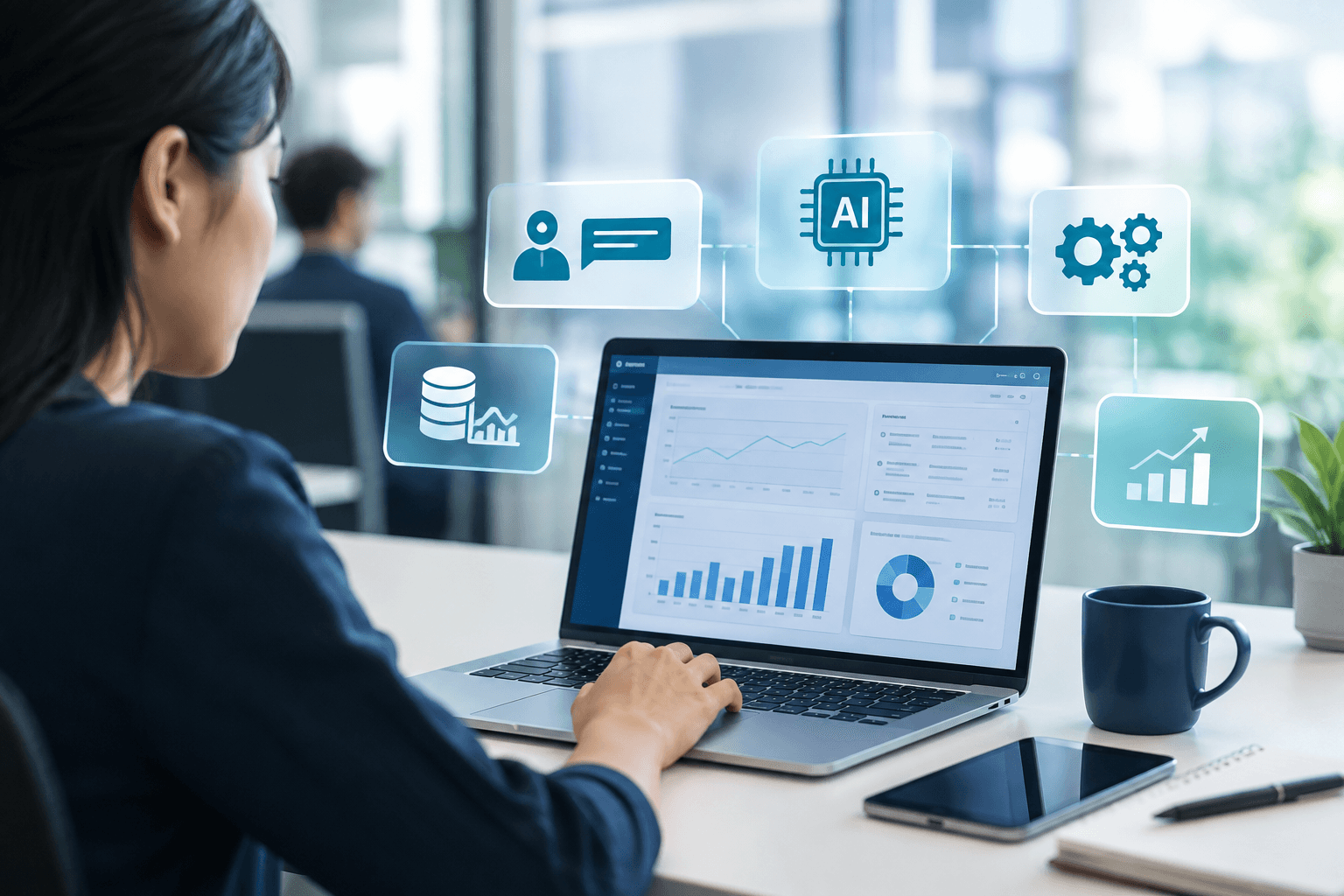
Mengapa AI Development Semakin Penting bagi Enterprise di 2027?
Memasuki 2027, kebutuhan perusahaan terhadap AI Development semakin berkaitan dengan perubahan ekspektasi pengguna dan tuntutan bisnis yang bergerak cepat.
Pengguna mengharapkan pelayanan yang lebih cepat, personal, dan responsif, sehingga perusahaan membutuhkan teknologi yang mampu menyesuaikan layanan berdasarkan data dan kebutuhan secara lebih dinamis.
Penerapan AI Enterprise juga semakin penting karena dapat membantu perusahaan mengotomatisasi berbagai workflow dan proses bisnis yang sebelumnya membutuhkan banyak pekerjaan manual. Otomasi tersebut dapat digunakan untuk menangani tugas berulang, memproses informasi, sehingga mendukung alur kerja antar bagian agar berjalan lebih efektif.
Selain otomatisasi, data menjadi salah satu aset penting dalam menentukan arah bisnis. Teknologi AI dapat membantu perusahaan mengolah dan menganalisis data dalam jumlah besar sehingga informasi yang dihasilkan dapat menjadi dasar pengambilan keputusan yang lebih cepat dan terukur.
Dari sisi operasional, penerapan teknologi AI juga dapat membantu mengurangi pekerjaan manual, mempercepat proses, serta mengoptimalkan penggunaan sumber daya. Sementara itu, Software Enterprise perlu dirancang lebih scalable agar mampu mengikuti pertumbuhan jumlah pengguna, data, transaksi, maupun kompleksitas kebutuhan bisnis tanpa menghambat performa sistem.
Tren AI Development yang Mengubah Software Enterprise
Perkembangan kecerdasan buatan terus mendorong perubahan dalam cara software enterprise dirancang, dikembangkan, dan digunakan. Beberapa tren AI Development yang semakin relevan bagi perusahaan meliputi:
- Agentic AI
Agentic AI memungkinkan sistem AI menjalankan tugas secara lebih mandiri dengan memahami tujuan, menyusun langkah, menggunakan berbagai tools, dan melakukan tindakan berdasarkan konteks yang tersedia. Teknologi ini dapat membantu mengotomatisasi proses bisnis yang membutuhkan beberapa tahapan sekaligus. - Multi-Agent Systems
Multi-Agent Systems melibatkan beberapa agen AI yang memiliki fungsi berbeda dan dapat berkoordinasi untuk menyelesaikan suatu pekerjaan. Pendekatan ini memungkinkan proses yang kompleks dibagi menjadi beberapa tugas spesifik sehingga dapat ditangani secara lebih terstruktur. - Small & Task-Specific Models
Model AI berukuran lebih kecil yang dirancang untuk tugas tertentu semakin banyak digunakan karena dapat menawarkan efisiensi dari sisi biaya, kebutuhan komputasi, dan kecepatan pemrosesan. Model
seperti ini dapat disesuaikan dengan kebutuhan dan lingkungan operasional perusahaan. - AI-Native Software
AI-Native Software dirancang dengan kemampuan AI sebagai bagian inti dari arsitektur dan pengalaman pengguna, bukan sekadar fitur tambahan. Pendekatan ini memungkinkan software memanfaatkan AI sejak awal untuk memberikan layanan yang lebih adaptif dan otomatis. - AI-Assisted Development
AI-Assisted Development memanfaatkan AI untuk membantu developer dalam berbagai tahapan pengembangan software, seperti menghasilkan kode, menemukan potensi kesalahan, membuat dokumentasi, hingga membantu proses pengujian. Penggunaan AI dapat mempercepat pekerjaan developer sekaligus mendukung produktivitas tim. - Multimodal AI
Multimodal AI mampu memahami dan memproses lebih dari satu jenis data, seperti teks, gambar, suara, maupun video. Dalam lingkungan enterprise, kemampuan ini dapat digunakan untuk membangun aplikasi yang mampu memahami informasi dari berbagai sumber secara lebih menyeluruh. - RAG & Enterprise Knowledge
Retrieval-Augmented Generation (RAG) memungkinkan AI mengambil informasi yang relevan dari sumber data tertentu sebelum menghasilkan respons. Dalam enterprise, pendekatan ini dapat dimanfaatkan untuk menghubungkan AI dengan knowledge base, dokumen internal, prosedur, dan sumber informasi perusahaan sehingga respons lebih relevan dengan konteks bisnis. - AI Governance
Semakin luas penggunaan AI membuat perusahaan membutuhkan tata kelola yang jelas terkait keamanan data, privasi, akses, transparansi, akurasi, serta penggunaan AI yang bertanggung jawab. AI Governance membantu perusahaan menetapkan aturan dan kontrol agar penerapan AI tetap sesuai dengan kebutuhan bisnis dan regulasi yang berlaku.
Berbagai tren tersebut menunjukkan bahwa AI tidak lagi hanya menjadi fitur tambahan dalam software, tetapi mulai menjadi bagian penting dari arsitektur, proses pengembangan, dan operasional software enterprise.
Dengan memilih pendekatan AI yang sesuai dengan kebutuhan bisnis, perusahaan dapat membangun sistem yang lebih adaptif, efisien, dan siap mengikuti perkembangan kebutuhan pengguna serta teknologi di masa mendatang.
Bagaimana AI Mengubah Software Development di Enterprise
Perkembangan Artificial Intelligence (AI) membawa perubahan dalam cara perusahaan enterprise merancang, mengembangkan, menguji, dan mengelola software. AI tidak lagi sekadar menjadi fitur tambahan dalam aplikasi, tetapi mulai diterapkan dalam berbagai tahapan software development, mulai dari perencanaan, coding, integrasi sistem, hingga quality assurance dan keamanan.
Karena itu, software house Indonesia perlu memahami bagaimana AI dapat diterapkan secara tepat tanpa mengabaikan kebutuhan bisnis dan sistem yang sudah berjalan.
Perubahan tersebut dapat terlihat pada beberapa aspek utama dalam proses pengembangan software enterprise, mulai dari perancangan arsitektur hingga pengawasan terhadap penggunaan AI, di antaranya:
- AI & Software Architecture
AI mendorong perubahan pada arsitektur software agar sistem mampu menangani model AI, data dalam jumlah besar, pemrosesan real-time, serta kebutuhan komputasi yang berbeda. Arsitektur yang tepat perlu mempertimbangkan skalabilitas, performa, integrasi, dan pengelolaan model sejak tahap perancangan. - AI & Existing Systems
Penerapan AI tidak selalu berarti mengganti seluruh sistem yang sudah digunakan. AI Development dapat diintegrasikan secara bertahap dengan aplikasi dan sistem existing sehingga perusahaan tetap dapat memanfaatkan investasi teknologi sebelumnya sekaligus menambahkan kemampuan baru. - API & Data Integration
AI Enterprise membutuhkan akses terhadap data dan layanan dari berbagai sumber agar dapat bekerja secara optimal. API dan integrasi data memungkinkan model AI terhubung dengan database, aplikasi internal, layanan eksternal, maupun sistem enterprise lainnya secara terstruktur dan terkontrol. - AI-Assisted Development
AI dapat membantu developer dalam berbagai aktivitas, mulai dari menghasilkan potongan kode, memahami kode yang sudah ada, membuat dokumentasi, hingga membantu menemukan potensi bug.
Peran AI dalam proses development lebih tepat digunakan sebagai pendukung produktivitas, sementara keputusan teknis tetap memerlukan validasi developer. - AI-Powered Testing & QA
AI dapat dimanfaatkan dalam proses testing dan Quality Assurance untuk membantu membuat test case, menganalisis hasil pengujian, menemukan pola error, serta mengidentifikasi potensi masalah berdasarkan data pengujian. Pendekatan ini dapat membantu tim QA melakukan pengujian dengan cakupan yang lebih luas dan efisien. - Security & Human Oversight
Penggunaan AI dalam enterprise juga perlu memperhatikan keamanan data, kontrol akses, privasi, dan risiko keluaran model yang tidak akurat. Human oversight tetap diperlukan untuk memvalidasi hasil AI, menentukan keputusan penting, serta memastikan sistem digunakan sesuai kebijakan dan kebutuhan bisnis.
Dengan perubahan tersebut, pengembangan Software Enterprise menjadi proses yang semakin terintegrasi antara AI, data, sistem existing, dan keahlian manusia. Penerapan AI yang direncanakan dengan baik dapat membantu perusahaan mengembangkan software yang lebih adaptif tanpa mengesampingkan aspek keamanan, kualitas, dan kontrol manusia.
Tantangan dan Risiko Implementasi AI di Enterprise
Penerapan AI di lingkungan enterprise menawarkan berbagai peluang untuk meningkatkan efisiensi dan kemampuan software, tetapi proses implementasinya juga memiliki sejumlah tantangan. Software House yang menjadi technology partner perlu memahami kondisi teknologi, data, keamanan, serta kesiapan sumber daya manusia agar implementasi AI dapat berjalan sesuai kebutuhan bisnis.
Beberapa tantangan utama yang perlu diperhatikan perusahaan dalam menerapkan AI antara lain:
- Legacy System
Banyak perusahaan masih menggunakan sistem lama yang telah berjalan selama bertahun-tahun.
Sistem tersebut belum tentu dirancang untuk mendukung teknologi AI sehingga proses integrasi dapat membutuhkan penyesuaian arsitektur, middleware, atau komponen tertentu tanpa mengganggu operasional yang sudah berjalan. - Kualitas dan Akses Data
AI Development sangat bergantung pada ketersediaan data yang relevan, akurat, dan terstruktur. Data yang tersebar, tidak konsisten, tidak lengkap, atau sulit diakses dapat mempengaruhi kualitas hasil AI.
Karena itu, perusahaan perlu memiliki pengelolaan data yang baik sebelum dan selama implementasi. - Integrasi Antar-Sistem
AI Enterprise sering kali harus terhubung dengan berbagai aplikasi, database, API, dan layanan yang digunakan perusahaan. Perbedaan teknologi, format data, serta protokol komunikasi dapat membuat proses integrasi menjadi lebih kompleks dan membutuhkan perencanaan yang matang. - Security dan Privacy
Penggunaan AI melibatkan pemrosesan data yang berpotensi bersifat sensitif atau rahasia. Perusahaan perlu memperhatikan kontrol akses, perlindungan data, keamanan API, serta kebijakan penggunaan data untuk mengurangi risiko kebocoran informasi dan penggunaan data yang tidak sesuai. - Infrastruktur
Implementasi AI dapat membutuhkan kapasitas komputasi, penyimpanan, jaringan, dan sistem monitoring yang lebih besar dibandingkan aplikasi konvensional. Infrastruktur perlu disiapkan agar mampu mendukung kebutuhan pemrosesan AI sekaligus tetap scalable ketika penggunaan dan volume data meningkat. - AI Talent dan Technical Expertise
Implementasi AI membutuhkan tenaga profesional yang memahami pengembangan software, data, machine learning, integrasi sistem, hingga keamanan. Keterbatasan AI talent dan technical expertise dapat menjadi hambatan dalam membangun, mengintegrasikan, serta memelihara solusi AI secara berkelanjutan.
Tantangan tersebut menunjukkan bahwa penerapan AI bukan hanya persoalan memilih model atau teknologi, tetapi juga membutuhkan kesiapan ekosistem teknologi dan sumber daya manusia. Dengan perencanaan yang matang, perusahaan dapat mengintegrasikan AI secara bertahap sambil tetap menjaga kualitas Software Enterprise, keamanan data, dan keberlangsungan sistem yang sudah digunakan.
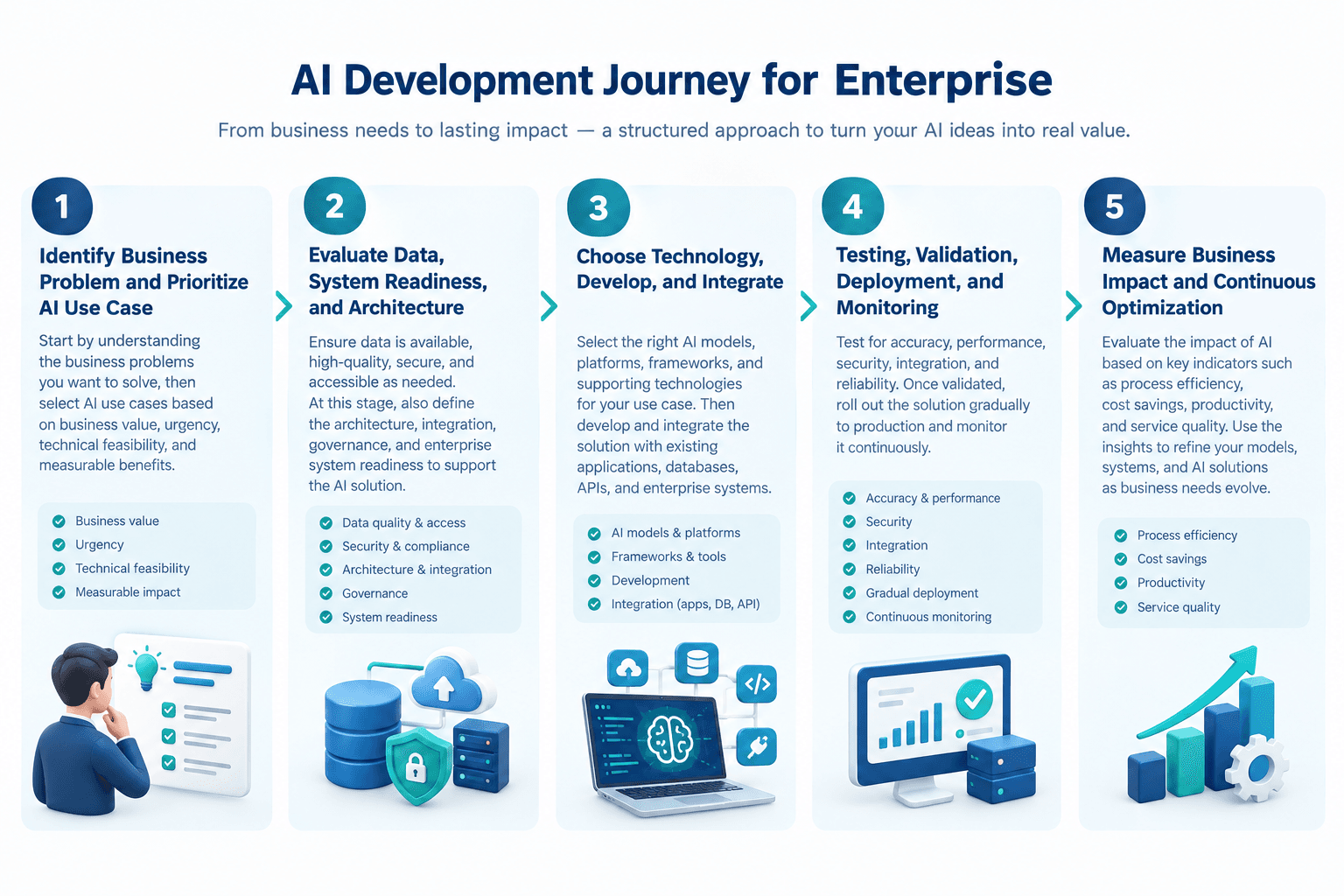
Strategi Implementasi AI Development di Enterprise
Implementasi AI Development di lingkungan enterprise perlu dilakukan secara terencana agar teknologi yang diterapkan benar-benar menjawab kebutuhan bisnis. Strategi yang tepat membantu perusahaan mengurangi risiko implementasi, memastikan kesiapan teknologi, serta mengukur manfaat AI secara berkelanjutan.
Beberapa tahapan yang dapat dilakukan meliputi:
- Identifikasi Business Problem dan Prioritas AI Use Case
Mulai dengan memahami masalah bisnis yang ingin diselesaikan, kemudian tentukan use case AI berdasarkan nilai bisnis, urgensi, kelayakan teknis, dan manfaat yang dapat diukur. - Evaluasi Data, System Readiness, dan Architecture
Pastikan data tersedia, berkualitas, aman, dan dapat diakses sesuai kebutuhan. Pada tahap ini, perusahaan juga perlu menentukan arsitektur, integrasi, governance, serta kesiapan sistem enterprise yang akan mendukung solusi AI. - Pilih Teknologi, Develop, dan Integrate
Pilih model AI, platform, framework, dan teknologi pendukung sesuai kebutuhan use case, kemudian kembangkan dan integrasikan solusi dengan aplikasi, database, API, maupun sistem enterprise yang sudah digunakan. - Testing, Validation, Deployment, dan Monitoring
Lakukan pengujian terhadap akurasi, performa, keamanan, integrasi, dan keandalan sistem. Setelah tervalidasi, solusi dapat diterapkan secara bertahap ke lingkungan produksi dan dipantau secara berkelanjutan. - Ukur Business Impact dan Continuous Optimization
Evaluasi dampak AI berdasarkan indikator seperti efisiensi proses, penghematan biaya, produktivitas, dan kualitas layanan. Hasil evaluasi menjadi dasar untuk melakukan penyempurnaan terhadap model, sistem, dan solusi AI sesuai perubahan kebutuhan bisnis.
Dengan pendekatan bertahap tersebut, implementasi AI dapat menjadi bagian dari strategi transformasi digital enterprise, bukan sekadar proyek teknologi. Proses yang terukur juga membantu perusahaan memastikan bahwa solusi yang dikembangkan tetap relevan, aman, dan memberikan manfaat nyata bagi bisnis.
Bagaimana Mengukur Keberhasilan AI Development?
Keberhasilan AI Development tidak cukup dinilai dari apakah teknologi berhasil diterapkan, tetapi juga dari dampaknya terhadap tujuan bisnis. Karena itu, perusahaan perlu menentukan KPI dan business objectives sejak awal sebagai acuan untuk mengukur hasil implementasi secara objektif. Indikator tersebut dapat disesuaikan dengan tujuan penggunaan AI, seperti meningkatkan efisiensi, mempercepat proses, atau meningkatkan kualitas layanan.
Salah satu aspek yang perlu diukur adalah efisiensi proses dan produktivitas setelah AI diterapkan. Perusahaan dapat membandingkan waktu penyelesaian pekerjaan, jumlah proses manual, penggunaan sumber daya, atau produktivitas sebelum dan sesudah implementasi. Selain itu, akurasi dan kualitas output AI juga perlu dievaluasi untuk memastikan hasil yang diberikan sesuai dengan kebutuhan dan standar bisnis.
Keberhasilan implementasi juga dapat dilihat dari user adoption dan pengalaman pengguna. Tingkat penggunaan, kemudahan interaksi, serta respons pengguna terhadap sistem dapat menunjukkan apakah solusi AI benar-benar diterima dan memberikan manfaat. Dari sisi finansial, perusahaan dapat menganalisis ROI dan cost efficiency dengan membandingkan investasi teknologi terhadap penghematan biaya atau nilai bisnis yang dihasilkan.
Selanjutnya, perusahaan perlu memantau performance dan scalability untuk memastikan sistem tetap mampu bekerja dengan baik ketika jumlah pengguna, transaksi, atau volume data meningkat. Evaluasi dampak bisnis juga sebaiknya dilakukan secara berkala agar perusahaan dapat mengetahui apakah manfaat AI tetap sesuai dengan target dan melakukan penyesuaian ketika kebutuhan bisnis berubah.
Dengan pengukuran yang menyeluruh, perusahaan dapat melihat AI bukan hanya sebagai investasi teknologi, tetapi sebagai solusi yang perlu memberikan hasil nyata dan terukur bagi bisnis.
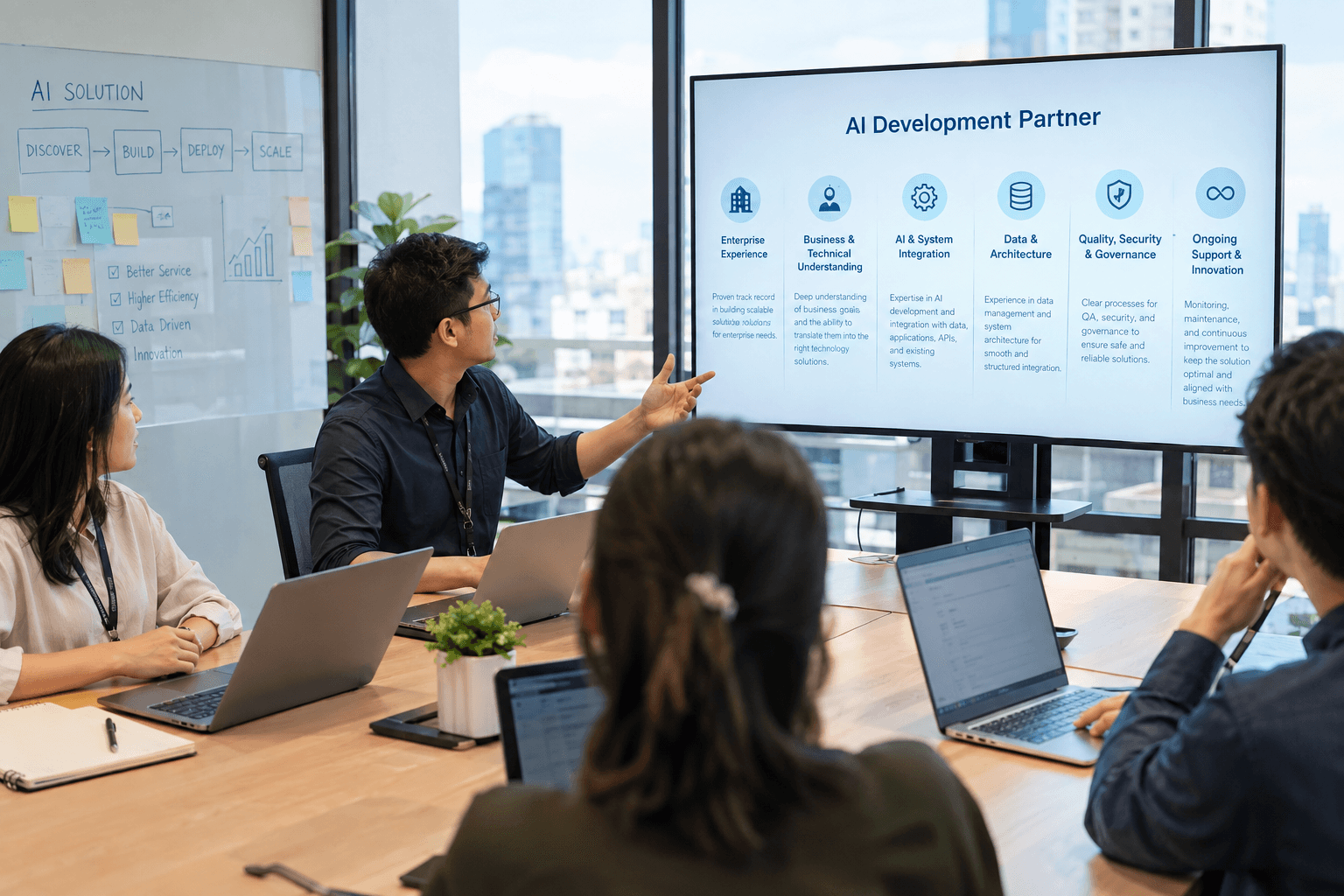
Bagaimana Memilih Partner AI Development untuk Enterprise?
Memilih partner AI Development untuk enterprise perlu mempertimbangkan pengalaman dalam mengembangkan solusi berskala enterprise serta kemampuan memahami business dan technical requirements.
Partner yang tepat tidak hanya mampu membangun solusi AI, tetapi juga memahami kebutuhan bisnis dan dapat menerjemahkannya menjadi solusi teknologi yang sesuai.
Keahlian dalam AI development dan system integration juga penting, terutama jika solusi perlu terhubung dengan data, aplikasi, API, dan existing systems perusahaan. Pengalaman mengelola data serta memahami arsitektur sistem yang sudah digunakan dapat membantu proses integrasi berjalan lebih terstruktur tanpa mengganggu operasional.
Selain kemampuan teknis, pastikan partner memiliki proses quality assurance, security, dan governance yang jelas. Dukungan sebaiknya tidak berhenti setelah deployment, tetapi mencakup monitoring, maintenance, serta pengembangan berkelanjutan agar solusi AI tetap aman, optimal, dan dapat mengikuti perubahan kebutuhan bisnis.
Bangun Solusi AI Enterprise Bersama Software House Indonesia
Membangun solusi AI Enterprise membutuhkan partner yang mampu memahami kebutuhan bisnis sekaligus memiliki kemampuan teknis untuk mengembangkan dan mengintegrasikan teknologi AI. Software House Indonesia dapat membantu perusahaan melalui proses yang terstruktur, mulai dari business dan technology assessment untuk memahami kebutuhan, kondisi sistem, serta peluang penerapan AI yang relevan.
Tahap berikutnya mencakup AI solution dan architecture planning untuk menentukan pendekatan teknologi, model AI, arsitektur sistem, kebutuhan data, serta strategi integrasi. Proses kemudian dilanjutkan dengan AI Development dan system & data integration agar solusi dapat terhubung dengan aplikasi, database, API, dan sistem yang sudah digunakan perusahaan.
Kualitas dan keamanan juga menjadi bagian penting dalam proses pengembangan. Quality assurance dilakukan untuk memastikan fungsi, performa, dan kehandalan solusi, sementara security diterapkan untuk melindungi data dan sistem. Setelah siap, solusi dapat melalui deployment, monitoring, dan optimization secara berkala untuk menjaga performanya tetap optimal.
Pengembangan tidak berhenti setelah sistem digunakan. Maintenance dan pengembangan berkelanjutan diperlukan agar solusi dapat mengikuti perubahan kebutuhan bisnis, perkembangan teknologi, serta peningkatan skala penggunaan.
Dengan dukungan software house Bandung yang memiliki pengalaman dalam pengembangan teknologi enterprise, perusahaan dapat membangun solusi AI yang terintegrasi dan memiliki pondasi untuk berkembang dalam jangka panjang.
Software House Indonesia dapat berperan sebagai technology partner yang membantu perusahaan mulai dari perencanaan solusi, pengembangan dan integrasi AI, hingga pengembangan software enterprise yang lebih adaptif terhadap kebutuhan bisnis.
Jika perusahaan Anda ingin mengembangkan solusi AI Development yang terintegrasi dengan Software Enterprise dan kebutuhan bisnis yang spesifik, BTS.id siap menjadi technology partner mulai dari assessment, perencanaan, pengembangan, integrasi, hingga maintenance dan optimalisasi solusi secara berkelanjutan.
Hubungi BTS.id untuk mendiskusikan kebutuhan dan membangun solusi AI yang sesuai dengan kebutuhan enterprise Anda.
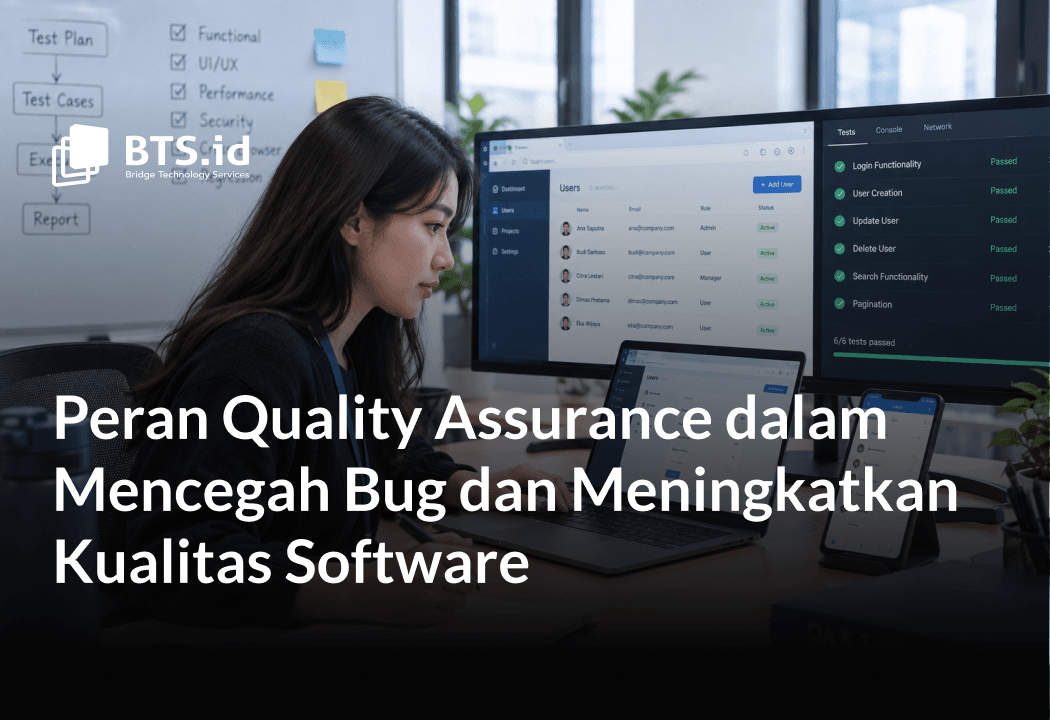
Peran Quality Assurance dalam Mencegah Bug dan Meningkatkan Kualitas Software
Apa Itu Software House Indonesia dan Bagaimana Proses Pengembangannya?
Software house Indonesia adalah perusahaan yang menyediakan layanan pengembangan software untuk membantu bisnis memenuhi kebutuhan teknologi dan meningkatkan efisiensi operasional. Peran software house mencakup konsultasi, pengembangan, integrasi, hingga pemeliharaan sistem, dengan layanan yang dapat disesuaikan untuk berbagai jenis proyek, seperti aplikasi web, mobile, sistem enterprise, ERP, CRM, dan software custom.
Proses pengembangan biasanya diawali dengan analisis kebutuhan bisnis untuk memahami masalah, tujuan, serta kebutuhan pengguna.
Hasil analisis kemudian diterjemahkan ke dalam perancangan UI/UX, sebelum masuk ke tahap pengembangan software oleh tim developer. Setelah fitur selesai dibuat, dilakukan pengujian software untuk memastikan fungsi berjalan sesuai kebutuhan dan meminimalkan bug.
Software yang telah memenuhi standar kemudian masuk ke tahap implementasi dan maintenance, termasuk deployment, pemantauan, perbaikan, dan pengembangan fitur berikutnya.
Dengan menggunakan software house, perusahaan dapat memperoleh solusi teknologi yang lebih sesuai kebutuhan, menghemat sumber daya internal, mempercepat proses pengembangan, serta mendapatkan dukungan teknis secara berkelanjutan.
Setiap tahapan pengembangan perlu dikelola dengan baik dan terkontrol untuk memastikan software yang dihasilkan tidak sekadar selesai dibuat, tetapi juga sesuai dengan standar kualitas, kebutuhan pengguna, serta tujuan bisnis. Proses yang terstruktur membantu mengidentifikasi dan menangani potensi masalah sejak tahap awal sehingga risiko kesalahan dapat diminimalkan. Dalam hal ini, Quality Assurance berperan penting untuk menjaga kualitas software di sepanjang proses pengembangannya hingga siap digunakan.

Memahami Quality Assurance: Lebih dari Sekadar Mencari Bug
Quality Assurance (QA) adalah proses sistematis untuk memastikan software dikembangkan dan dipelihara sesuai standar kualitas serta kebutuhan bisnis. QA tidak hanya berfokus pada menemukan bug, tetapi juga mencegah masalah sejak awal melalui perencanaan, pengawasan proses, dan evaluasi kualitas di setiap tahap pengembangan.
QA dan testing memiliki peran yang berbeda. Testing berfokus pada pemeriksaan software untuk menemukan kesalahan atau bug, sedangkan QA memiliki cakupan lebih luas, yaitu memastikan seluruh proses pengembangan mendukung terciptanya software yang berkualitas.
Sementara itu, Quality Control (QC) lebih berfokus pada pemeriksaan hasil akhir untuk menemukan masalah, sedangkan Quality Assurance berorientasi pada pencegahan masalah melalui perbaikan proses.
Secara umum, proses QA meliputi:
- Menentukan kebutuhan dan standar kualitas software.
- Menyusun strategi dan skenario pengujian.
- Melakukan testing dan identifikasi risiko.
- Mencatat serta mengevaluasi bug.
- Memastikan perbaikan berjalan sesuai standar.
- Melakukan evaluasi dan peningkatan proses secara berkelanjutan.
Standar kualitas software biasanya mencakup aspek fungsionalitas, keamanan, performa, usability, reliability, dan maintainability. Dalam praktik Software Testing Indonesia, penerapan QA yang terstruktur membantu memastikan software tidak hanya berfungsi sesuai spesifikasi, tetapi juga memberikan pengalaman pengguna yang baik, stabil saat digunakan, dan mudah dikembangkan di masa mendatang.
Peran Vital QA di Setiap Tahap Siklus Pengembangan Software (SDLC)
Dalam setiap tahap SDLC, Quality Assurance berperan memastikan proses pengembangan berjalan sesuai kebutuhan dan standar yang telah ditetapkan. Pada tahap analisis kebutuhan (requirement), QA membantu meninjau requirement agar jelas, lengkap, konsisten, dan dapat diuji.
Saat perancangan UI/UX, QA juga memastikan alur dan fungsi yang dirancang sesuai kebutuhan pengguna serta tidak menimbulkan potensi masalah saat diimplementasikan.
Ketika masuk tahap development, QA bekerja bersama developer untuk memahami fitur, mengidentifikasi risiko, dan menyiapkan skenario pengujian.
Proses Software Testing kemudian dilakukan untuk memastikan setiap fungsi berjalan sesuai requirement, termasuk pengujian integrasi dan regression testing. Pendekatan ini membantu menjaga Kualitas Software sekaligus menemukan masalah lebih awal sebelum berdampak pada pengguna.
Pada tahap deployment dan maintenance, QA menerapkan konsep continuous testing dengan melakukan pengujian secara berkelanjutan setiap kali terdapat perubahan, perbaikan, atau penambahan fitur.
Dengan demikian, Quality Assurance tidak hanya berfungsi sebagai pemeriksa akhir, tetapi menjadi bagian dari seluruh siklus pengembangan untuk menjaga software tetap stabil, andal, dan sesuai kebutuhan bisnis.
Praktek Terbaik (Best Practices) QA di Software House Profesional
Software house profesional menerapkan praktik QA yang terstruktur untuk menjaga kualitas sejak awal hingga software siap digunakan. Salah satunya adalah menyusun Test Plan dan Test Case yang efektif berdasarkan requirement, dengan skenario pengujian yang jelas, terukur, dan mencakup kondisi normal maupun risiko yang mungkin terjadi.
Proses Software Testing juga perlu menggunakan beberapa pendekatan, seperti regression testing untuk memastikan perubahan tidak merusak fitur yang sudah berjalan, smoke testing untuk memvalidasi fungsi utama, serta exploratory testing untuk menemukan masalah yang mungkin tidak tercakup dalam skenario pengujian.
Selain pengujian, code review penting dilakukan untuk memastikan kode memenuhi standar teknis, mudah dipelihara, dan meminimalkan potensi masalah sejak tahap development. Seluruh aktivitas QA juga perlu didukung dokumentasi yang rapi, mulai dari test case, hasil pengujian, laporan bug, hingga status perbaikannya. Praktik tersebut membantu Quality Assurance bekerja lebih konsisten sekaligus menjaga Kualitas Software agar tetap terkontrol sepanjang siklus pengembangan.

Manual Testing vs Automation Testing Mana yang Lebih Efektif
Dalam proses software testing, terdapat dua pendekatan utama, yaitu manual testing dan automation testing. Manual testing dilakukan dengan menguji software secara langsung oleh tester tanpa menggunakan script otomatis, sehingga cocok untuk pengujian yang membutuhkan observasi dan penilaian langsung.
Sementara itu, automation testing menggunakan tools dan script untuk menjalankan pengujian secara otomatis, terutama pada pengujian yang berulang dan membutuhkan efisiensi waktu.
Manual testing dan automation testing memiliki kelebihan masing-masing. Pemilihannya bergantung pada kebutuhan, kompleksitas, dan karakteristik proyek.
Keduanya juga dapat digunakan secara bersamaan untuk mendapatkan hasil pengujian yang lebih optimal.
- Manual Testing
Manual testing dilakukan secara langsung oleh tester tanpa menggunakan script otomatis. Pendekatan ini lebih fleksibel untuk exploratory testing, usability testing, serta pengujian fitur yang membutuhkan penilaian dan observasi manusia. Kekurangannya, pengujian berulang membutuhkan waktu dan tenaga lebih besar. - Automation Testing
Automation testing menggunakan script dan tools untuk menjalankan pengujian secara otomatis. Metode ini sangat efektif untuk regression testing dan test case yang harus dijalankan berulang karena hasilnya lebih cepat dan konsisten. Automation juga mendukung scalable testing ketika jumlah fitur dan skenario pengujian semakin besar.
Beberapa tools yang umum digunakan antara lain Selenium, Playwright, Cypress, dan Appium. Pemilihannya disesuaikan dengan jenis aplikasi, bahasa pemrograman, serta kebutuhan pengujian.
Automation testing dapat diintegrasikan ke dalam CI/CD testing sehingga pengujian otomatis berjalan setiap kali terdapat perubahan kode. Dengan demikian, bug dapat ditemukan lebih awal sebelum perubahan diteruskan ke tahap berikutnya.
Mana yang Lebih Efektif?
Tidak ada satu metode yang selalu lebih baik. Manual testing tetap dibutuhkan untuk pengujian yang memerlukan penilaian manusia, sementara automation testing unggul dalam pengujian berulang dan berskala besar. Kombinasi keduanya dapat meningkatkan efisiensi testing sekaligus membantu menjaga kualitas software.
Dampak Pengembangan Software Tanpa Quality Assurance
Pengembangan software tanpa Quality Assurance dapat meningkatkan risiko kegagalan sistem karena tidak adanya proses terstruktur untuk memastikan setiap fitur berjalan sesuai kebutuhan. Tanpa proses Software Testing yang memadai, berbagai masalah dapat lolos hingga software digunakan oleh pengguna dan berdampak langsung pada operasional bisnis.
Berbagai dampak tersebut dapat mempengaruhi kualitas software maupun kelancaran operasional bisnis. Beberapa risiko utama yang perlu diperhatikan antara lain:
- Risiko Tanpa QA
Bug, kesalahan fungsi, dan ketidaksesuaian dengan requirement lebih sulit ditemukan sejak awal sehingga biaya dan waktu perbaikannya dapat meningkat. - Kegagalan Implementasi Software
Software yang belum diuji secara menyeluruh berisiko mengalami masalah saat deployment, mulai dari fitur tidak berjalan hingga sistem tidak dapat digunakan dengan baik. - Komplain Pengguna
Bug, fitur yang tidak sesuai, atau pengalaman penggunaan yang buruk dapat meningkatkan jumlah keluhan dan menurunkan kepuasan pengguna. - Downtime Sistem
Kesalahan yang tidak terdeteksi dapat menyebabkan sistem mengalami gangguan atau downtime, sehingga aktivitas bisnis ikut terhambat. - Risiko Keamanan Aplikasi
Tanpa pemeriksaan yang memadai, celah keamanan dapat terlewat dan berpotensi dimanfaatkan untuk mengakses atau mengganggu sistem. - Kualitas Buruk
Tidak adanya proses QA yang konsisten dapat membuat Kualitas Software tidak terkontrol, sulit dipelihara, dan lebih berisiko mengalami masalah ketika dikembangkan lebih lanjut.
Karena itu, QA bukan sekadar tahap tambahan dalam pengembangan software, tetapi bagian penting untuk mencegah masalah sejak awal dan memastikan software siap digunakan secara aman, stabil, dan sesuai kebutuhan bisnis.
Cara Memilih Software House dengan Quality Assurance yang Teruji
Memilih software house tidak cukup hanya melihat kemampuan development dan portofolio proyek. Perusahaan juga perlu memastikan penyedia memiliki proses Quality Assurance yang terstruktur agar software yang dihasilkan sesuai kebutuhan, stabil, dan minim resiko saat digunakan.
Untuk memastikan kualitas software yang dikembangkan tetap terjaga, ada beberapa hal penting yang perlu diperhatikan saat memilih software house, terutama terkait proses dan penerapan Quality Assurance, adalah sebagai berikut:
- Memiliki Proses QA yang Jelas
Pastikan software house memiliki alur QA yang terintegrasi sejak analisis kebutuhan, development, testing, hingga deployment. Proses yang jelas menunjukkan bahwa kualitas diperhatikan sepanjang siklus pengembangan. - Tim QA yang Kompeten
Tim QA sebaiknya memiliki pengalaman dan pemahaman terhadap berbagai metode pengujian, termasuk functional, regression, performance, maupun security testing sesuai kebutuhan proyek. - Standar Pengujian Terdokumentasi
Test plan, test case, acceptance criteria, dan dokumentasi bug perlu dibuat secara sistematis agar proses pengujian dapat dilakukan secara konsisten dan hasilnya dapat ditelusuri. - Transparansi Hasil Testing
Software house yang profesional dapat memberikan informasi mengenai hasil pengujian, bug yang ditemukan, status perbaikan, serta risiko yang masih perlu diperhatikan oleh klien. - Dukungan Setelah Implementasi
QA tidak berhenti ketika software berhasil di-deploy. Pastikan tersedia dukungan maintenance dan pengujian setelah implementasi untuk memastikan sistem tetap stabil ketika terjadi perubahan atau penambahan fitur.
Dengan mempertimbangkan kelima aspek tersebut, perusahaan dapat memilih software house yang tidak hanya mampu membangun software, tetapi juga memiliki komitmen terhadap kualitas, keamanan, dan keberlanjutan sistem.

Quality Assurance untuk Software yang Andal dan Mendukung Kesuksesan Bisnis
Quality Assurance bukan sekadar tahap testing di akhir pengembangan, tetapi proses yang perlu diterapkan sejak analisis kebutuhan, perancangan, development, hingga implementasi dan maintenance.
Proses yang baik membantu menemukan potensi masalah lebih awal sehingga software dapat dikembangkan dengan lebih terarah dan menghasilkan sistem yang lebih andal.
Kualitas Software juga memiliki pengaruh langsung terhadap keberhasilan bisnis. Software yang stabil, aman, dan sesuai kebutuhan dapat mendukung operasional, meningkatkan produktivitas, serta memberikan pengalaman pengguna yang lebih baik. Sebaliknya, software dengan banyak bug atau gangguan dapat menimbulkan downtime, biaya perbaikan, hingga menurunkan kepercayaan pengguna.
Karena itu, memilih Software House Indonesia yang mengutamakan kualitas sejak awal pengembangan menjadi langkah penting untuk mengurangi risiko proyek. Software house dengan proses QA yang terstruktur dan Software Testing yang tepat dapat membantu memastikan setiap fitur telah melalui validasi sebelum digunakan. Bagi perusahaan di Jawa Barat, memilih Software House Bandung yang memiliki pengalaman dan proses pengembangan profesional juga dapat memudahkan komunikasi serta dukungan proyek secara berkelanjutan.
Untuk kebutuhan software custom dengan proses pengembangan dan QA yang terstruktur, BTS.id dapat membantu mulai dari analisis kebutuhan, development, testing, hingga maintenance.
Software House Bandung seperti BTS.id dapat menjadi pilihan bagi perusahaan yang membutuhkan solusi software dengan pendekatan pengembangan yang terstruktur dan berorientasi pada kebutuhan bisnis.
Dengan dukungan tim yang memahami development dan QA, proses pengembangan dapat dilakukan secara lebih terkontrol, mulai dari perencanaan hingga maintenance.
Jika perusahaan Anda sedang membutuhkan software custom yang andal dan sesuai kebutuhan bisnis, BTS.id siap membantu mulai dari analisis kebutuhan, pengembangan, hingga pengujian dan maintenance. Hubungi BTS.id untuk mendiskusikan kebutuhan software dan temukan solusi teknologi yang tepat untuk bisnis Anda.
Strategi Membangun Super App untuk Bisnis Enterprise yang Scalable
Peran Software House dalam Transformasi Digital
Transformasi digital bukan lagi sekadar mengikuti perkembangan teknologi, tetapi menjadi bagian penting dari strategi bisnis untuk meningkatkan efisiensi, produktivitas, dan daya saing. Seiring perkembangan digital transformation, kebutuhan bisnis juga semakin berubah.
Perusahaan membutuhkan sistem yang mampu beradaptasi dengan proses kerja yang dinamis, mengelola data secara lebih efektif, serta memberikan pengalaman yang lebih baik bagi pelanggan.
Dalam konteks ini, software house Indonesia memiliki peran penting dalam membantu perusahaan menerjemahkan kebutuhan bisnis menjadi solusi teknologi yang tepat. Jika sebelumnya perusahaan banyak mengandalkan aplikasi standalone untuk menangani kebutuhan tertentu, kini kebutuhan tersebut mulai bergeser menuju solusi digital terintegrasi yang memungkinkan berbagai sistem, proses, dan sumber data saling terhubung.
Namun, transformasi digital tidak berarti perusahaan harus menggunakan teknologi yang paling baru atau paling kompleks. Pemilihan teknologi perlu didasarkan pada business needs, mulai dari tujuan bisnis, proses operasional, karakteristik pengguna, kebutuhan integrasi, hingga kemampuan perusahaan dalam mengelola sistem tersebut. Dengan pendekatan ini, investasi teknologi dapat memberikan manfaat yang lebih nyata dan terukur.
Karena itu, software house tidak hanya berperan sebagai pihak yang mengembangkan aplikasi, tetapi juga sebagai technology partner yang membantu perusahaan merancang, membangun, mengintegrasikan, dan mengembangkan solusi digital sesuai kebutuhan bisnis. Software house yang profesional akan memahami tantangan bisnis terlebih dahulu sebelum menentukan pendekatan teknologi, sehingga solusi yang dibangun tidak hanya berfungsi secara teknis, tetapi juga mampu mendukung pertumbuhan dan strategi bisnis dalam jangka panjang.

Apa Itu Super App
Super App adalah platform digital yang mengintegrasikan berbagai layanan dan fungsi dalam satu aplikasi, sehingga pengguna tidak perlu berpindah ke banyak aplikasi untuk memenuhi kebutuhan yang berbeda. Konsep ini menjadi bagian dari perkembangan digital transformation karena mengutamakan kemudahan akses, integrasi sistem, dan pengalaman pengguna dalam satu ekosistem digital.
Secara umum, karakteristik Super App dapat terlihat dari beberapa hal berikut:
- Multiple services dalam satu platform, yaitu menyediakan berbagai layanan seperti pembayaran, pembelian, pemesanan, layanan pelanggan, hingga fitur bisnis dalam satu aplikasi.
- Integrasi layanan dan data, memungkinkan berbagai fitur saling terhubung sehingga data dapat digunakan secara lebih efektif dan proses menjadi lebih efisien.
- User experience yang terintegrasi, pengguna dapat mengakses berbagai layanan dengan akun, navigasi, dan pengalaman yang relatif konsisten tanpa harus berpindah platform.
- Ekosistem digital yang saling terhubung, memungkinkan layanan internal maupun layanan dari pihak ketiga berinteraksi melalui integrasi sistem dan API.
Berbeda dengan aplikasi biasa yang umumnya dibuat untuk menjalankan fungsi atau kebutuhan tertentu, Super App memiliki cakupan layanan yang jauh lebih luas. Aplikasi biasa mungkin hanya berfokus pada pembayaran, e-commerce, transportasi, atau layanan pelanggan, sedangkan Super App berusaha menggabungkan berbagai kebutuhan tersebut dalam satu platform.
Dengan demikian, Super App dapat dipahami sebagai integrated digital ecosystem, bukan sekadar aplikasi dengan banyak fitur. Di dalamnya terdapat berbagai layanan, data, sistem, dan pengguna yang saling terhubung untuk menciptakan pengalaman digital yang lebih praktis sekaligus mendukung kebutuhan bisnis secara lebih terintegrasi.
Mengapa Bisnis Enterprise Mempertimbangkan Super App?
Bagi bisnis enterprise, Super App bukan hanya tentang menggabungkan banyak fitur dalam satu aplikasi, tetapi tentang membangun ekosistem digital yang mampu menghubungkan bisnis, layanan, data, dan pelanggan secara lebih terintegrasi. Konsep ini semakin dipertimbangkan seiring meningkatnya kebutuhan perusahaan untuk memberikan layanan yang cepat, praktis, dan relevan di tengah perkembangan digital transformation.
Dari sisi business perspective, Super App dapat memberikan sejumlah manfaat strategis, antara lain:
- Customer retention & engagement, semakin banyak kebutuhan pelanggan yang dapat dipenuhi dalam satu platform, semakin besar peluang perusahaan mempertahankan pelanggan sekaligus meningkatkan interaksi secara berkelanjutan.
- Cross-selling & upselling, integrasi berbagai layanan memungkinkan perusahaan menawarkan produk atau layanan lain yang relevan berdasarkan kebutuhan dan aktivitas pelanggan.
- Recurring usage, keberadaan berbagai layanan dalam satu platform dapat mendorong pelanggan untuk kembali menggunakan aplikasi secara rutin.
- Operational efficiency, integrasi proses dan layanan dapat mengurangi penggunaan sistem yang terpisah, mengoptimalkan proses operasional, serta mengurangi duplikasi pekerjaan.
- Customer data integration, data pelanggan dari berbagai touchpoint dapat terhubung sehingga perusahaan memperoleh gambaran customer journey yang lebih menyeluruh dan dapat menggunakannya untuk mendukung pengambilan keputusan.
Sementara dari user & market perspective, perubahan perilaku pengguna juga mendorong kebutuhan terhadap platform digital yang lebih terintegrasi. Pengguna semakin terbiasa dengan mobile-first behavior, yaitu mengakses berbagai kebutuhan melalui perangkat mobile. Mereka juga mengharapkan seamless customer journey, tanpa harus berpindah-pindah aplikasi 2etika menggunakan layanan dari perusahaan yang sama.
Selain itu, semakin banyaknya multiple digital touchpoints, seperti aplikasi mobile, website, marketplace, layanan pelanggan, dan kanal digital lainnya, membuat integrasi menjadi semakin penting. Di sisi lain, meningkatnya permintaan terhadap integrated services dan berkembangnya digital ecosystem membuat perusahaan perlu mempertimbangkan bagaimana berbagai layanan dapat saling terhubung dalam satu pengalaman digital.
Karena itu, bagi bisnis enterprise, Super App dapat menjadi salah satu pendekatan untuk membangun digital ecosystem yang lebih terintegrasi, meningkatkan engagement pelanggan, sekaligus menciptakan efisiensi dan peluang bisnis baru.
Menentukan Model Digital yang Tepat untuk Bisnis
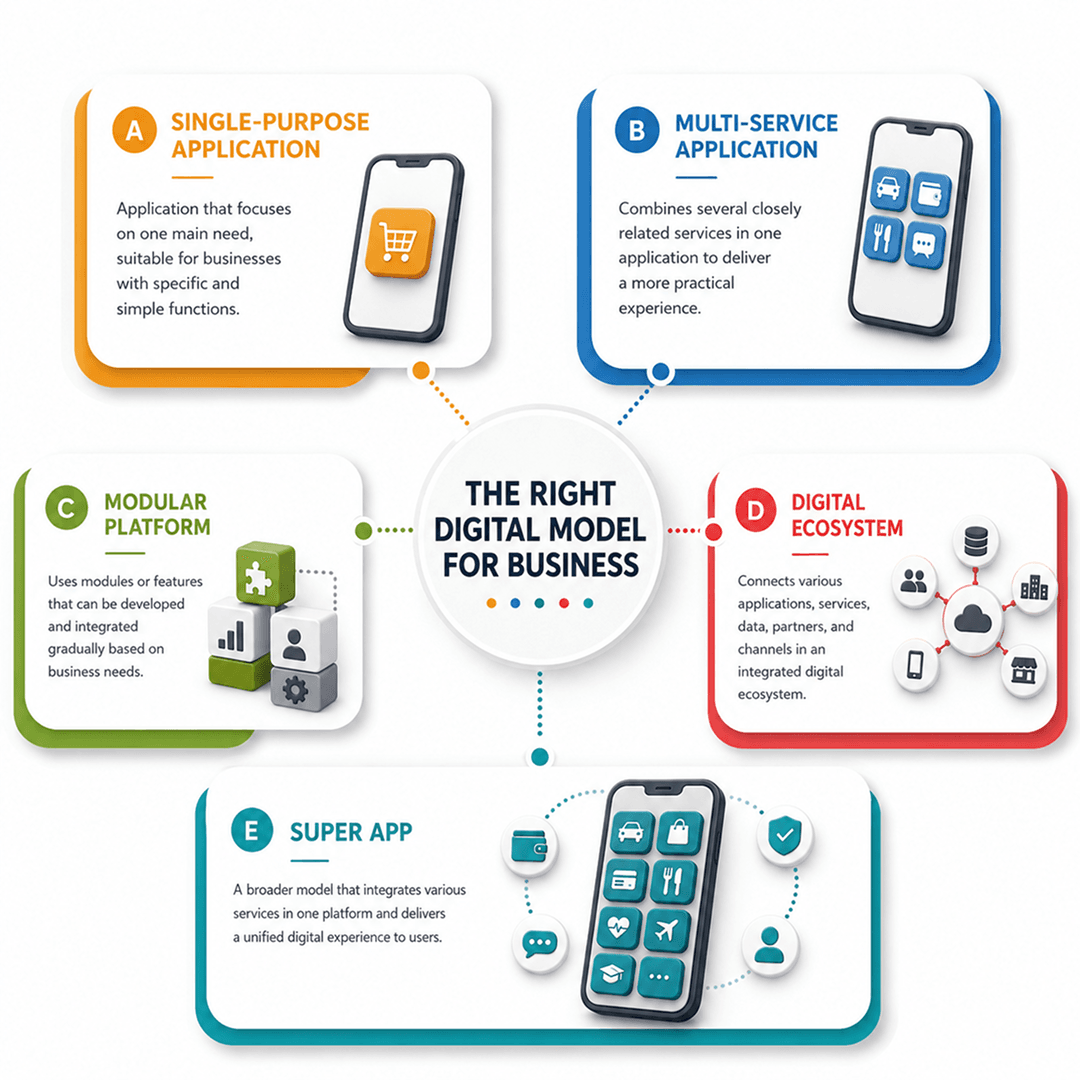
Tidak semua bisnis membutuhkan Super App dengan puluhan layanan dalam satu platform. Model digital yang tepat perlu disesuaikan dengan tujuan bisnis, karakteristik pengguna, proses operasional, serta potensi pengembangan di masa depan.
Karena itu, perusahaan perlu memahami beberapa pilihan model sebelum menentukan solusi yang paling sesuai.
- Single-purpose application — aplikasi yang berfokus pada satu kebutuhan utama, cocok untuk bisnis dengan fungsi yang spesifik dan sederhana.
- Multi-service application — menggabungkan beberapa layanan yang masih memiliki keterkaitan erat dalam satu aplikasi untuk memberikan pengalaman yang lebih praktis.
- Modular platform — menggunakan modul atau fitur yang dapat dikembangkan dan diintegrasikan secara bertahap sesuai kebutuhan bisnis.
- Digital ecosystem — menghubungkan berbagai aplikasi, layanan, data, partner, dan channel dalam ekosistem digital yang saling terintegrasi.
- Super App — model dengan cakupan lebih luas yang mengintegrasikan berbagai layanan dalam satu platform dan memberikan pengalaman digital terpadu kepada pengguna.
Pemilihannya sebaiknya dimulai dari business model dan user needs, bukan dari tren teknologi.
Perusahaan perlu melihat siapa penggunanya, kebutuhan apa yang ingin diselesaikan, bagaimana proses bisnis berjalan, serta nilai bisnis apa yang ingin dicapai. Dengan begitu, teknologi benar-benar menjadi pendukung strategi, bukan sekadar investasi fitur.
Selain kebutuhan saat ini, perusahaan juga perlu mempertimbangkan integration & scalability.
Solusi ideal harus mampu terhubung dengan sistem yang sudah ada dan tetap dapat dikembangkan ketika jumlah pengguna, transaksi, layanan, maupun kebutuhan bisnis meningkat.
Faktor complexity dan investment juga tidak kalah penting. Semakin kompleks platform yang dibangun, semakin besar pula kebutuhan pengembangan, integrasi, maintenance, keamanan, dan investasi. Karena itu, tingkat kompleksitas sebaiknya sebanding dengan business value yang dihasilkan.
Dalam proses tersebut, perusahaan dapat melibatkan Technology Partner yang mampu memahami kebutuhan bisnis sekaligus aspek teknis. Pendekatan ini membantu perusahaan memilih model digital yang realistis, scalable, dan memberikan nilai jangka panjang, baik berupa aplikasi sederhana, platform modular, maupun Digital Ecosystem yang lebih luas.
Kapan Bisnis Membutuhkan Super App?
Tidak semua bisnis membutuhkan Super App. Model ini lebih tepat untuk perusahaan yang memiliki multiple products atau services yang saling berkaitan dan digunakan oleh shared user base, sehingga pelanggan berpotensi menggunakan beberapa layanan dalam satu ekosistem.
Super App juga relevan ketika bisnis membutuhkan integrasi layanan dan customer data untuk menciptakan customer journey yang lebih seamless, memahami perilaku pengguna, serta meningkatkan peluang cross-selling dan engagement. Jika perusahaan memiliki peluang memperluas layanan melalui partner dan berbagai kanal digital, Super App juga dapat menjadi fondasi untuk membangun digital ecosystem yang lebih terintegrasi.
Namun, perusahaan perlu memastikan kesiapan dalam mengelola kompleksitas dan investasi jangka panjang, termasuk integrasi sistem, keamanan, scalability, maintenance, serta pengembangan platform secara berkelanjutan. Jadi, keputusan membangun Super App sebaiknya didasarkan pada kebutuhan pengguna dan business value yang jelas, bukan sekadar mengikuti tren teknologi.
Apa Saja Tantangan Membangun Super App?
Membangun Super App memiliki kompleksitas lebih tinggi dibandingkan aplikasi biasa karena harus mengintegrasikan berbagai layanan, sistem, data, dan kebutuhan pengguna dalam satu platform.
Beberapa tantangan yang perlu dipertimbangkan antara lain:
- Development cost & investment — membutuhkan investasi yang cukup besar, mulai dari pengembangan aplikasi, integrasi sistem, infrastruktur, keamanan, hingga pengembangan fitur secara berkelanjutan.
- Technical & system integration complexity — Super App perlu terhubung dengan berbagai sistem internal, database, API, maupun layanan pihak ketiga sehingga membutuhkan arsitektur yang matang dan scalable.
- Security dan privacy — semakin banyak layanan dan data yang terintegrasi, semakin besar pula kebutuhan terhadap perlindungan data, kontrol akses, keamanan transaksi, dan privacy pengguna.
- UX complexity & feature overload — terlalu banyak fitur dapat membuat aplikasi sulit digunakan. Karena itu, navigasi dan user experience harus dirancang sederhana berdasarkan kebutuhan serta customer journey.
- Scalability — platform harus mampu menangani pertumbuhan jumlah pengguna, transaksi, dan layanan tanpa menurunkan performa maupun stabilitas sistem.
- Maintenance & continuous optimization — Super App membutuhkan monitoring, maintenance, peningkatan keamanan, serta optimasi fitur secara berkelanjutan agar tetap relevan dan memberikan pengalaman pengguna yang baik.
- Organizational readiness — pengelolaan Super App membutuhkan kolaborasi antara tim bisnis, teknologi, data, security, dan operasional. Kesiapan organisasi menjadi faktor penting agar platform dapat dikembangkan secara konsisten dalam jangka panjang.
Pada akhirnya, membangun Super App bukan hanya persoalan menambahkan banyak fitur ke dalam satu aplikasi. Perusahaan perlu menyeimbangkan kebutuhan bisnis, pengalaman pengguna, kesiapan teknologi, keamanan, serta kemampuan organisasi untuk mengelolanya dalam jangka panjang.
Dengan perencanaan yang matang dan dukungan Technology Partner yang tepat, kompleksitas tersebut dapat dikelola sehingga Super App mampu memberikan business value yang nyata dan berkelanjutan.
Apa yang Dibutuhkan untuk Membangun Super App yang Scalable?
Membangun Super App yang scalable membutuhkan fondasi teknologi yang mampu berkembang mengikuti pertumbuhan pengguna, layanan, dan transaksi. Arsitektur juga perlu dirancang sejak awal agar berbagai sistem dapat terintegrasi tanpa membuat platform semakin sulit dikembangkan dan dipelihara.
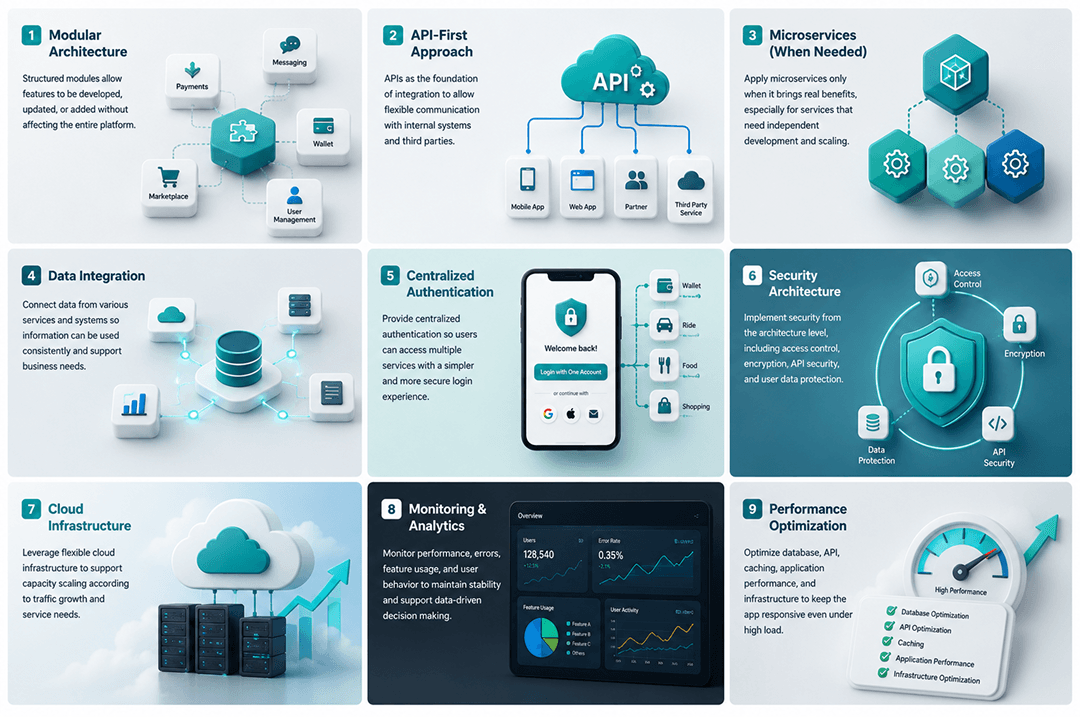
Beberapa komponen penting yang perlu diperhatikan meliputi:
- Modular architecture, membagi sistem menjadi modul yang terstruktur sehingga fitur dapat dikembangkan, diperbarui, atau ditambahkan tanpa mengganggu keseluruhan platform.
- API-first approach, menggunakan API sebagai fondasi integrasi agar layanan dapat berkomunikasi dengan sistem internal maupun pihak ketiga secara lebih fleksibel.
- Microservices sesuai kebutuhan, menerapkan microservices ketika memang memberikan manfaat, terutama untuk layanan yang membutuhkan pengembangan dan scaling secara independen.
- Data integration, menghubungkan data dari berbagai layanan dan sistem agar informasi dapat digunakan secara konsisten dan mendukung kebutuhan bisnis.
- Centralized authentication, menyediakan mekanisme autentikasi terpusat sehingga pengguna dapat mengakses berbagai layanan dengan pengalaman login yang lebih sederhana dan aman.
- Security architecture, menerapkan keamanan sejak level arsitektur, termasuk access control, encryption, API security, serta perlindungan data pengguna.
- Cloud infrastructure, memanfaatkan infrastruktur cloud yang fleksibel untuk mendukung scaling kapasitas sesuai pertumbuhan trafik dan kebutuhan layanan.
- Monitoring & analytics, memantau performa, error, penggunaan fitur, serta perilaku pengguna untuk membantu menjaga stabilitas sekaligus mendukung pengambilan keputusan.
- Performance optimization, melakukan optimasi database, API, caching, application performance, dan infrastruktur agar aplikasi tetap responsif meskipun beban meningkat.
Implementasi berbagai komponen tersebut sebaiknya disesuaikan dengan kebutuhan dan skala bisnis, bukan sekadar mengikuti tren teknologi. Software house Indonesia yang berpengalaman dapat membantu merancang fondasi teknologi yang tepat, sementara technology partner dapat mendampingi pengembangan dan evolusinya. Dengan arsitektur yang matang, digital ecosystem dapat berkembang secara bertahap tanpa mengorbankan scalability, security, maupun user experience.
Bagaimana Membangun Super App Secara Bertahap?
Membangun Super App tidak harus dilakukan sekaligus dengan mengembangkan seluruh layanan sejak awal. Pendekatan bertahap justru dapat membantu perusahaan mengendalikan risiko, menguji respons pasar, dan memastikan setiap pengembangan benar-benar memberikan business value.
Tahapannya dapat dilakukan sebagai berikut:
- Define the business problem, tentukan masalah bisnis dan kebutuhan pengguna yang ingin diselesaikan, bukan sekadar menentukan fitur yang ingin dibuat.
- Identify the core service, pilih layanan utama yang paling penting dan memiliki potensi penggunaan tinggi sebagai fondasi awal platform.
- Build MVP, kembangkan Minimum Viable Product dengan fitur inti yang cukup untuk digunakan dan diuji oleh pengguna.
- Validate user adoption, ukur apakah pengguna benar-benar menggunakan layanan tersebut, termasuk engagement, retention, dan pola penggunaan.
- Collect business & user data, gunakan data penggunaan dan feedback pelanggan untuk memahami kebutuhan serta menentukan prioritas pengembangan berikutnya.
- Integrate additional services, tambahkan layanan yang relevan secara bertahap berdasarkan kebutuhan pengguna dan peluang bisnis, sekaligus mengintegrasikannya dengan sistem yang sudah ada.
- Expand the ecosystem, ketika fondasi platform sudah stabil, perusahaan dapat memperluas ekosistem melalui partner, layanan pihak ketiga, maupun integrasi digital lainnya.
- Continuous optimization, lakukan monitoring, maintenance, peningkatan keamanan, optimasi performa, dan penyempurnaan user experience secara berkelanjutan.
Pendekatan bertahap membuat pengembangan Super App menjadi lebih terukur karena perusahaan dapat membangun berdasarkan data dan validasi nyata, bukan asumsi.
Dalam proses ini, software house Indonesia dapat membantu perusahaan menerjemahkan kebutuhan bisnis menjadi solusi teknologi yang scalable, sedangkan software house Indonesia yang memiliki pengalaman enterprise dapat mendukung integrasi dan pengembangan platform dalam jangka panjang.
Peran Software House sebagai Technology Partner
Dalam membangun Super App, software house tidak hanya berperan sebagai pihak yang mengerjakan coding, tetapi sebagai Technology Partner yang membantu perusahaan menerjemahkan kebutuhan bisnis menjadi solusi digital yang terukur, scalable, dan siap dikembangkan dalam jangka panjang. Pendekatan ini penting karena kompleksitas Super App mencakup bisnis, produk, teknologi, data, keamanan, hingga operasional.
Peran tersebut dapat mencakup:
- Business & product discovery, memahami tujuan bisnis, masalah pengguna, peluang pasar, dan kebutuhan produk sebelum menentukan solusi.
- Business requirement analysis, menerjemahkan kebutuhan bisnis menjadi requirement yang jelas dan dapat diimplementasikan secara teknis.
- Product strategy, menentukan prioritas fitur, roadmap, MVP, serta arah pengembangan produk berdasarkan business value dan user needs.
- UI/UX strategy & design, merancang alur, navigasi, dan pengalaman pengguna agar berbagai layanan tetap mudah digunakan meskipun berada dalam satu platform.
- Technology architecture, menentukan arsitektur aplikasi, database, infrastructure, dan teknologi yang sesuai dengan kebutuhan scalability dan integrasi.
- API & system integration, menghubungkan Super App dengan sistem internal, database, API, maupun layanan pihak ketiga.
- Software development, membangun platform dan fitur secara terstruktur berdasarkan roadmap dan standar pengembangan software.
- Testing & quality assurance, memastikan setiap fitur berfungsi sesuai requirement, stabil, aman, dan memberikan kualitas pengalaman yang konsisten.
- Security & scalability, membangun perlindungan data sekaligus memastikan platform mampu menangani pertumbuhan pengguna, transaksi, dan layanan.
- Maintenance & continuous improvement, melakukan monitoring, maintenance, optimasi performa, perbaikan masalah, serta pengembangan fitur berdasarkan data dan feedback pengguna.
Dengan melibatkan software house sebagai Technology Partner, perusahaan dapat memiliki tim teknologi yang tidak hanya fokus pada pengembangan aplikasi, tetapi juga memahami bagaimana teknologi mendukung strategi bisnis.
Hal ini membuat pengembangan Super App lebih terarah, mengurangi risiko investasi teknologi, dan memungkinkan platform berkembang secara bertahap sesuai kebutuhan bisnis.
Apakah Bisnis Anda Membutuhkan Super App?
Membangun Super App sebaiknya dimulai dari business problem, bukan sekadar mengikuti tren teknologi. Perusahaan perlu mengevaluasi apakah memiliki multiple services dengan shared user base, membutuhkan integrasi layanan dan customer data, serta memiliki peluang cross-selling dan recurring usage yang cukup kuat.
Di saat yang sama, complexity, investment, dan potensi ROI juga perlu dihitung agar pengembangan memberikan business value yang nyata.
Tidak harus langsung membangun platform besar. Perusahaan dapat memvalidasi konsep melalui MVP, mengukur respons pengguna, kemudian membangun ecosystem secara bertahap berdasarkan data dan kebutuhan bisnis.
Sejak awal, architecture juga perlu disiapkan agar mampu berkembang mengikuti pertumbuhan pengguna, layanan, dan integrasi di masa depan.
Agar keputusan teknologi lebih tepat, perusahaan membutuhkan technology partner yang mampu memahami sisi bisnis sekaligus aspek teknis. Jika Anda sedang mempertimbangkan pengembangan Super App atau solusi digital terintegrasi, software house Bandung seperti BTS.id dapat membantu mulai dari business discovery, product strategy, technology architecture, hingga software development dan continuous improvement.
Siap mengevaluasi apakah Super App tepat untuk bisnis Anda?
Konsultasikan kebutuhan bisnis dan rencana transformasi digital Anda bersama BTS.id dan temukan pendekatan teknologi yang paling sesuai dengan tujuan bisnis Anda.
Pilih software house Bandung yang tidak hanya membangun aplikasi, tetapi juga membantu membangun solusi digital yang siap berkembang bersama bisnis Anda.
INSIGHT
BRIDGE TECHNOLOGY SERVICES

CLUTCH

GOODFIRM
REVIEW US
BRIDGE TECHNOLOGY SERVICES








OFFICIAL
BRIDGE TECHNOLOGY SERVICES
Explore how we can help you plan, build, and strengthen your digital transformation. Not only does it uplift your business value in general but also strengthen your day-to-day operations and increase efficiency
Grow Your Business Right Now
Contact UsCONTACT
BRIDGE TECHNOLOGY SERVICES